Alternating Current for NEET
AC Fundamentals
Understanding Alternating Current
Unlike Direct Current (DC), which flows in one direction, Alternating Current (AC) continuously changes its direction and magnitude. Think of it like a tide, constantly flowing in and out. This oscillation is what powers our homes and most of our devices.
The most common form of AC follows a sinusoidal pattern. This means the voltage and current vary as sine functions of time. This isn't just a convenient mathematical model; it's the natural form of electricity produced by rotating generators.
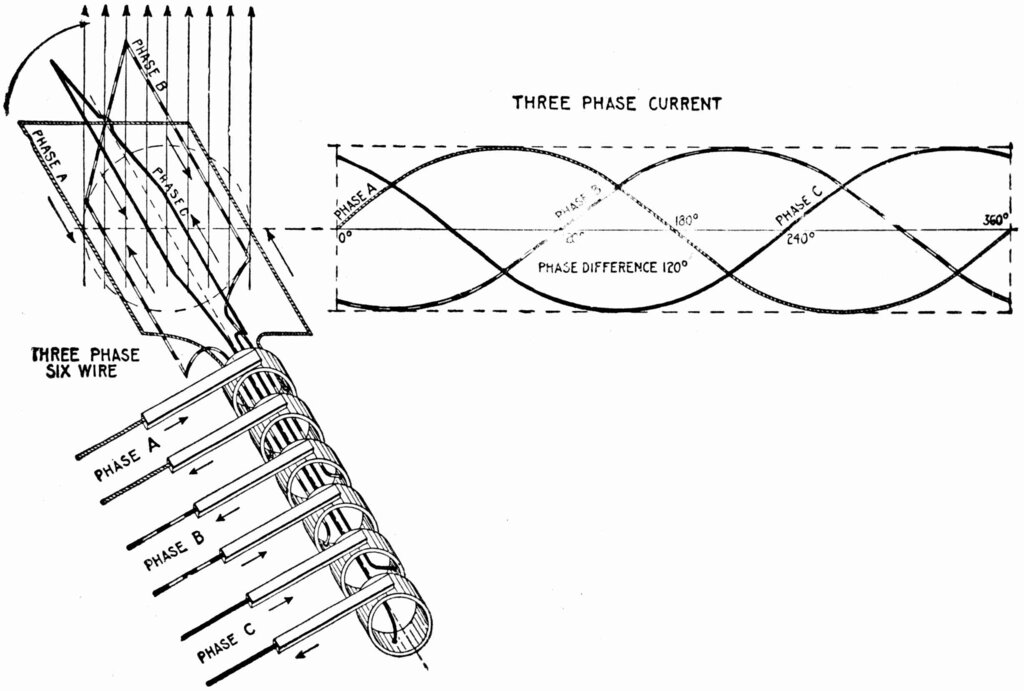
The Language of Waves
To analyse AC circuits, we need to describe this changing current and voltage mathematically. We use the following equations for instantaneous voltage and current at any time :
The term 'phase' tells us where we are in the cycle. The phase difference, , is crucial. It describes the timing relationship between the voltage and current waveforms.
- If , voltage and current are in phase. They reach their peaks and cross zero at the same instant. This happens in a purely resistive circuit.
- If , they are out of phase. One wave leads or lags the other. For instance, in a purely capacitive circuit, the current leads the voltage by or radians.
Measuring a Moving Target
Since AC values are constantly changing, how do we assign a single, useful number to them? If you take a simple average of a sine wave over one full cycle, you get zero. The positive half-cycle perfectly cancels out the negative half-cycle. This tells us nothing about the power it delivers.
The average value over a half-cycle, however, is not zero and gives us a measure of the wave's magnitude.
While the half-cycle average is useful, it doesn't correctly describe the power delivered by an AC source. Power is proportional to the square of the current (). Since is always positive, its average over a full cycle is not zero. To find a meaningful value that relates AC to DC in terms of power, we use the Root Mean Square (RMS) value.
RMS
noun
The Root Mean Square value of an alternating current is the value of a steady, direct current that would produce the same heating effect (power dissipation) in the same resistor over the same period of time.
The RMS value is exactly what its name suggests: you take the root of the mean of the square of the instantaneous values.
This gives us the crucial relationships for sinusoidal AC:
When you see a voltage like 230V for mains electricity, it's the RMS value. The peak voltage is actually much higher, at V. For power calculations in AC circuits, like finding the heat produced in a resistor, you must use RMS values.
Let's check your understanding of these core AC concepts.
What is the primary characteristic that distinguishes Alternating Current (AC) from Direct Current (DC)?
Why is the simple average of a sinusoidal AC voltage or current over one full cycle not a useful measure of its power delivery?