Alternating Current Explained
Electric Current Basics
What is Electric Current?
Think of electric current like water flowing through a pipe. If you have a lot of water moving quickly, you have a strong current. If it's just a trickle, the current is weak. Electric current is simply the flow of electric charge. The more charge that flows past a point in a certain amount of time, the stronger the current.
Electric current is a flow of electric charge through a material.
We measure current in a unit called amperes, or amps for short, represented by the symbol A. One ampere is a specific amount of charge—one coulomb, to be exact—flowing past a point every second. You'll often see this relationship written mathematically, where stands for current, for charge, and for time.
The Movement of Charge
So what is this "charge" that's flowing? In most materials, like the copper wires in your walls, the charge comes from tiny particles called electrons. Electrons carry a negative electric charge. When a force is applied to them, they can be coaxed to move from one atom to another. This organized movement of millions of electrons is what creates an electric current.
Interestingly, there's a historical quirk in how we draw electric circuits. Early scientists thought that current was a flow of positive charge. So, by convention, diagrams show current flowing from the positive terminal to the negative one. This is called conventional current. We now know it's actually the negatively charged electrons flowing in the opposite direction. For most purposes, this difference doesn't change how we analyze circuits, but it's a good fact to know.
Conductors and Insulators
Electrons don't flow easily through every material. Some materials let them pass freely, while others stop them in their tracks. This property determines whether a material is a conductor or an insulator.
A conductor is a material where electrons can move with very little resistance. The atoms in conductors have loosely held electrons that are happy to jump from one atom to the next. Metals like copper, aluminum, and silver are excellent conductors. This is why electrical wires are made of copper.
An insulator is the opposite. Its electrons are tightly bound to their atoms and can't move around easily. Materials like rubber, glass, and plastic are good insulators. They are used to cover electrical wires to keep the current from going where it shouldn't—like into you!
| Property | Conductors | Insulators |
|---|---|---|
| Electron Mobility | High (electrons move easily) | Low (electrons are tightly bound) |
| Resistance to Current | Low | High |
| Examples | Copper, Silver, Gold, Water | Rubber, Plastic, Glass, Wood |
The Big Three
To fully understand current, we need to introduce two other key concepts: voltage and resistance. Together, they form the foundation of how electricity works. Let's return to the water analogy.
Understanding the basics of electricity requires familiarity with three fundamental concepts:Voltage: the electric potential difference between two points.Current: defines the flow of electric charge.Resistance: signifies the opposition to that flow.
Voltage
noun
The pressure or force that pushes electric charge, causing it to flow. It's like the water pressure in a pipe. Measured in volts (V).
Current
noun
The rate of flow of electric charge. This is how much charge is moving through the wire, similar to the volume of water flowing through a pipe. Measured in amperes (A).
Resistance
noun
The material's opposition to the flow of current. It's like a narrow section or a clog in the pipe that slows the water down. Measured in ohms (Ω).
These three quantities are interconnected. Voltage causes current to flow, while resistance opposes it. A higher voltage can push more current, but higher resistance will reduce the amount of current that can flow for a given voltage.
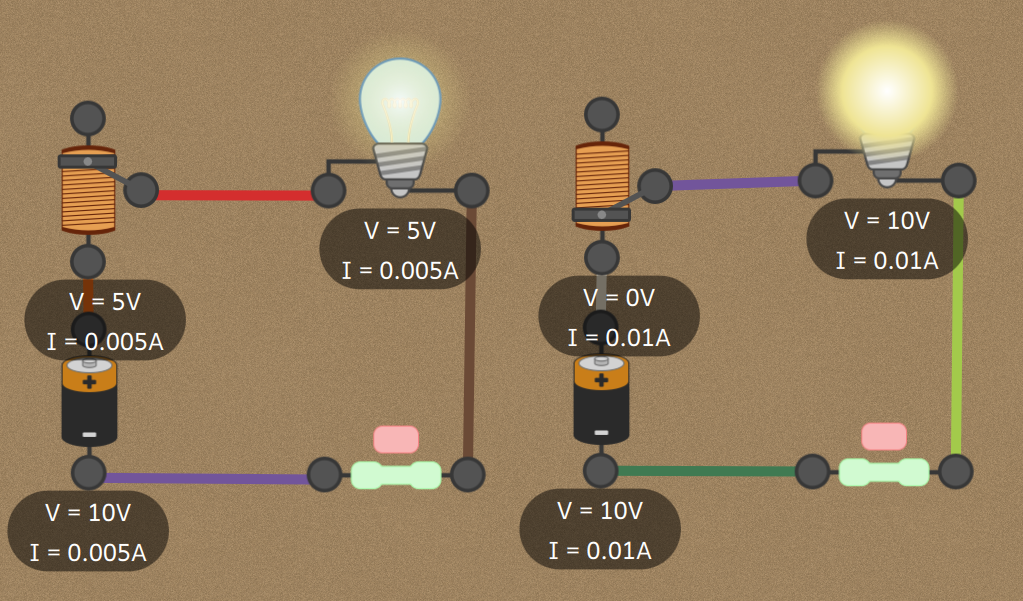
This fundamental relationship is the key to understanding and designing every electrical circuit, from the simplest flashlight to the most complex computer.
What is electric current?
The standard unit used to measure electric current is the: