Altair The Eagle Star
Introduction to Altair
Meet Altair
Look up into the summer night sky and you might spot Altair, the brightest star in the constellation Aquila, the Eagle. It's not just a faint twinkle; it's the twelfth-brightest star visible from Earth. This is partly because it's relatively close to us, sitting just 16.7 light-years away.
Astronomers measure a star's brightness as seen from Earth using a scale called apparent visual magnitude. On this scale, lower numbers mean brighter objects. Altair shines with a magnitude of 0.77, making it an easy target for stargazers.
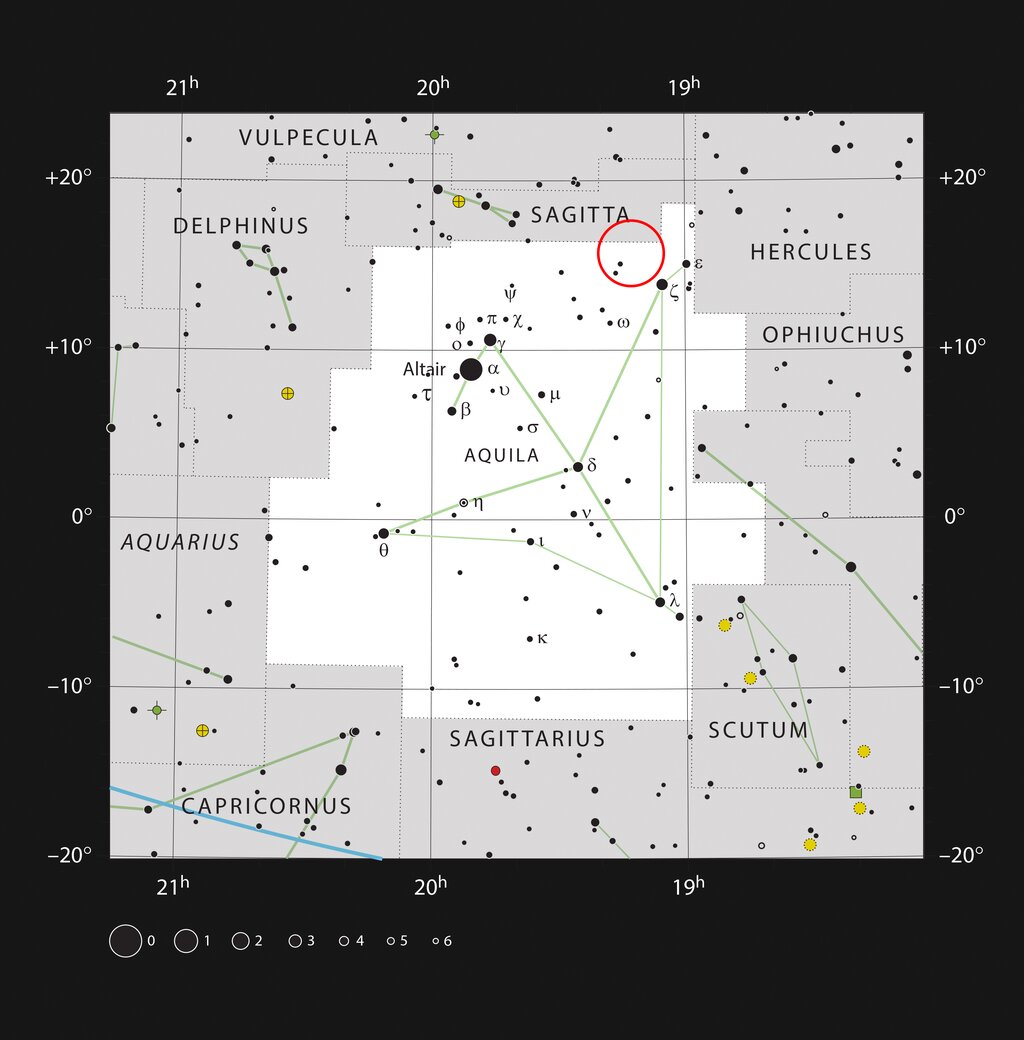
Altair is classified as an A-type main-sequence star. This means it's hotter, bigger, and more luminous than our own Sun. Like the Sun, it generates energy by fusing hydrogen into helium in its core, but it burns through its fuel at a much faster rate.
A Star in the Summer Triangle
Altair isn't a solo act. It forms a famous star pattern, or asterism, known as the Summer Triangle. This large, distinctive shape is a hallmark of the summer sky in the Northern Hemisphere. The other two corners of the triangle are marked by the bright stars Vega (in the constellation Lyra) and Deneb (in Cygnus).
Because the three stars are so bright and their pattern is so clear, the Summer Triangle is often used as a starting point for navigating the night sky.
A Fast Spinner
One of Altair's most fascinating features isn't its brightness or location, but its speed. It rotates incredibly fast, completing a full turn in about ten hours. For comparison, our Sun takes about 25 days to do the same.
This rapid rotation has a dramatic effect on the star's shape. Centrifugal force causes Altair to bulge at its equator, flattening it into what's known as an oblate spheroid. Its equatorial diameter is more than 20% larger than its polar diameter.
If you could see Altair up close, it would look less like a perfect sphere and more like a slightly squashed ball.

This rapid spin also affects its surface temperature. The poles, being closer to the center of mass, are hotter and brighter, while the bulging equator is cooler and dimmer. This phenomenon is called gravity darkening.
What is the primary cause of Altair's flattened, oblate spheroid shape?
Altair is one of three bright stars that form the Summer Triangle. What are the other two?
Altair's unique combination of proximity, brightness, and rapid rotation makes it a captivating object for both amateur stargazers and professional astronomers.