Algorithms and Data Structures Mastery
Complexity and Linear Structures
How We Measure Efficiency
When we write code, it's not enough for it to just work. We also need it to be efficient. But how do we measure efficiency in a consistent way? We can't just time it with a stopwatch, because the result would change depending on the computer's speed. Instead, we analyze how an algorithm's performance changes as the amount of input data grows. This method is called asymptotic analysis and it gives us a high-level way to compare different approaches.
The language we use for this is s. It describes the worst-case scenario for an algorithm's runtime or memory usage. Think of it as a classification system. If you have an algorithm that looks at every single item in a list of size , its performance is directly proportional to . We say its complexity is , or linear time. If the algorithm's runtime doesn't change no matter how big the input is, we call it , or constant time.
Looking up a word in a dictionary is a good analogy for logarithmic time, or . You don't read every word from the beginning. Instead, you open to the middle, see if your word comes before or after, and then repeat the process with a smaller section. With each step, you cut the problem size dramatically.
| Notation | Name | Example |
|---|---|---|
| Constant | Accessing an array element by its index. | |
| Logarithmic | Binary search in a sorted array. | |
| Linear | Looping through all elements in a list. | |
| Quadratic | A nested loop iterating over the same list. |
Memory's Blueprint
The way data is organized in memory has a massive impact on performance. The most common structure is the array, which stores elements in a single, continuous block of memory. Think of a row of numbered mailboxes. If you know the mailbox number (the index), you can go directly to it. This is why accessing an element in an array is an operation.
But this rigidity has a cost. What if you need to add a new mailbox in the middle of the row? You'd have to shift every subsequent mailbox down by one position to make room. This is an operation, which can be very slow for large arrays. Deleting an element creates a similar problem.
This is where the linked list comes in. Instead of one solid block, a linked list stores each element in its own container, called a node. Each node holds a piece of data and a pointer—an address that tells the computer where to find the next node in the sequence. Inserting a new element is as simple as updating a couple of pointers, making it a fast operation. The drawback? To find the 100th element, you have to start at the first and follow the pointers 99 times. Random access is .
A singly linked list only has pointers going forward. A doubly linked list adds a second pointer in each node that points backward. This uses a bit more memory, but it allows you to traverse the list in both directions and makes deleting a node even simpler, as you can easily access the previous node to update its pointer.
Managing Data Flow
Beyond simple storage, we need structures to manage temporary data. The stack is a perfect example. It follows a "Last-In, First-Out" (LIFO) principle. Imagine a stack of plates: you add a new plate to the top, and you also take one from the top. The last plate you put on is the first one you'll use. This is ideal for tasks like the "undo" feature in a text editor. Every action you take is pushed onto the stack, and when you hit undo, the most recent action is popped off.
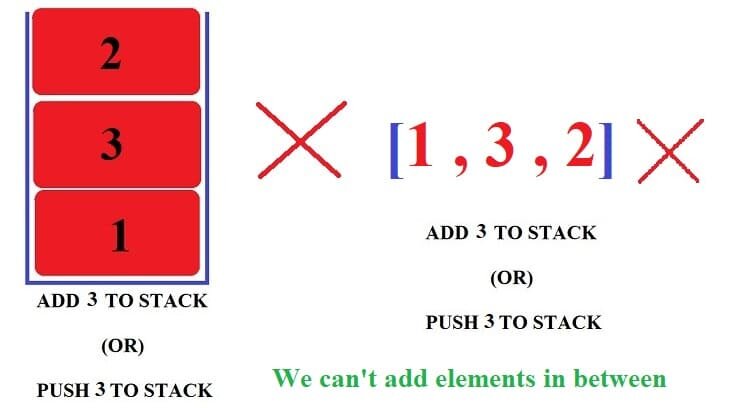
The queue, on the other hand, is "First-In, First-Out" (FIFO). Think of a line at a grocery store. The first person to get in line is the first person to be served. Queues are used everywhere, from managing print jobs sent to a printer to handling requests on a web server. The operation to add an item is called enqueue, and the operation to remove an item is dequeue.
A common way to implement a queue efficiently is with a s. This is a fixed-size array that wraps around on itself. When you reach the end of the array, the next item is stored back at the beginning, assuming there's space. This avoids the need to shift every element down when you dequeue the first item, keeping the operation at a speedy instead of a slow $O(n) for a standard array.
Ready to test your knowledge? Let's see what you've learned about these fundamental structures.
What is the primary purpose of asymptotic analysis, often expressed using Big O notation?
Why is inserting a new element into the middle of a large array considered an inefficient operation, with a time complexity of ?
Understanding these trade-offs is the first step toward writing truly professional code. Choosing the right data structure for the job is often the difference between a program that flies and one that crawls.