Algebra Fundamentals
Introduction to Variables
Letters in Math
Until now, math has probably been all about numbers. You add them, subtract them, and multiply them. But algebra introduces something new: letters. Suddenly, you'll see an or a hanging out with the numbers. What's that all about?
Think of a letter in algebra as a placeholder for a number you don't know yet. It's like a box that can hold different values.
This placeholder is called a variable. It's a symbol, usually a letter, that stands in for a value that can change or is currently unknown. Any letter can be a variable, from to .
Variable
noun
A symbol, typically a letter, used to represent a number that is unknown or can change.
Imagine you're saving money for a new bike. You know the bike costs $300, but the amount you've saved so far changes every week. Instead of writing down a new number each time, you could use a variable, like , to represent your savings. This makes it easier to talk about the situation without knowing the exact number yet.
Expressions vs. Equations
Variables don't just float around on their own. They are key ingredients in two important building blocks of algebra: expressions and equations.
An algebraic expression is a mathematical phrase that can contain numbers, variables, and operators (like +, –, ×, ÷). It represents a single value. For example, if you buy some number of tacos, and each taco costs $3, the total cost could be represented by the expression . The value of this expression changes depending on how many tacos () you buy.
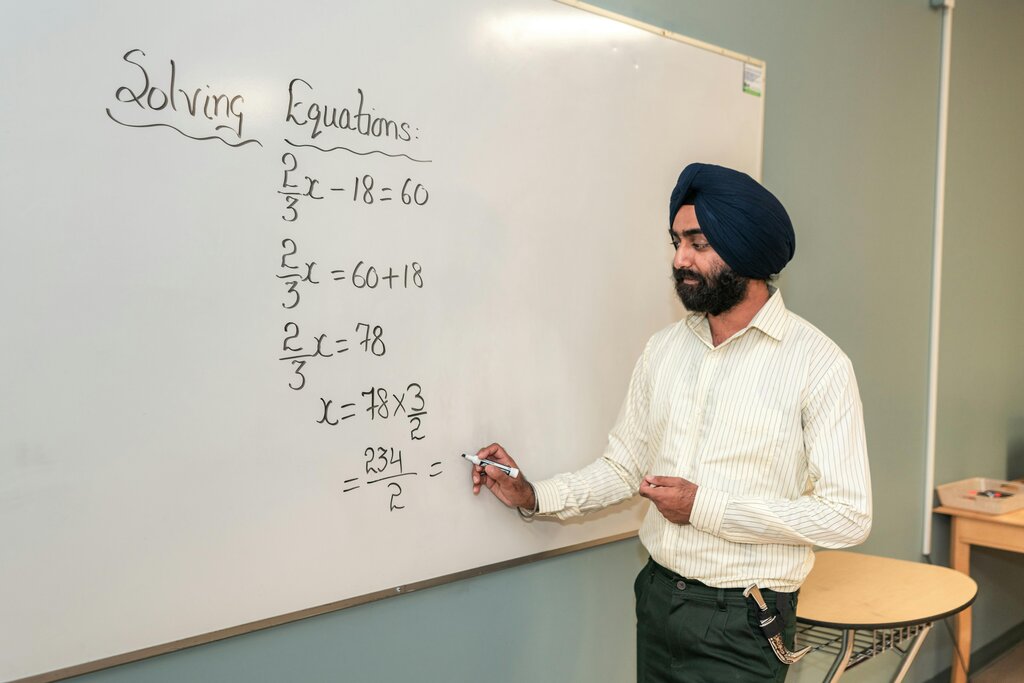
An equation, on the other hand, is a statement that two expressions are equal. It's like a complete sentence. An equation always has an equals sign (=). For instance, if you spent $12 on tacos, you could create the equation $3t = 12$. This equation states that the expression for the total cost ($3t$) is equal to the value 12.
| Concept | Description | Example |
|---|---|---|
| Expression | A mathematical phrase with numbers and variables. | x + 5 |
| Equation | A statement that two expressions are equal. | x + 5 = 15 |
The key takeaway is that variables give us a powerful way to describe relationships between numbers, even when we don't know what all the numbers are. They are the foundation for building the expressions and equations you'll explore throughout algebra.
Ready to check your understanding? Let's see what you've learned about the basics of variables.
In algebra, what is the primary role of a variable?
Which of the following is an algebraic equation?
Understanding variables is the first major step into the world of algebra. You're now ready to see how they're used to build and solve new kinds of problems.