Algebra Foundations For Beginners
Introduction to Algebra
Beyond the Numbers
Up until now, you've likely worked in the world of arithmetic. You add, subtract, multiply, and divide numbers you already know. For example, $3 + 5 = 8$. It's direct and concrete.
Algebra takes a step into the abstract. It's a powerful tool that helps us reason about quantities even when we don't know their exact value. Instead of just working with known numbers, we start working with unknowns.
Algebra marks a significant shift in mathematical thinking, requiring students to move from concrete arithmetic to abstract concepts and variables.
Think of arithmetic as following a recipe where all the ingredient amounts are listed. Algebra is like trying to figure out a recipe when some of the amounts are missing. You know the final dish, but you have to work backward to find the missing parts.
The Language of Algebra
At its heart, algebra introduces a new kind of language. This language uses letters and symbols to stand in for numbers. These symbols let us write down rules and relationships in a general way, without needing to know the specific numbers involved.
Variable
noun
A symbol, usually a letter, that represents a quantity that is unknown or can change within the context of a problem.
Imagine you're saving money for a new bike. You know the bike costs $300, and you save $25 each week. Arithmetic can tell you how much you've saved after 4 weeks: .
Algebra lets you ask a more flexible question: How many weeks will it take to save for the bike? We can use a variable, like , to represent the unknown number of weeks. The relationship becomes . We're not solving this yet, but just setting it up is the first big step in algebraic thinking.
Variables are placeholders for numbers you don't know yet. They turn specific problems into general rules.
Why It Matters
So, why learn this new language? Because it's everywhere. Algebra is the foundation for higher-level math, but it's also a practical tool for everyday life. It's used in calculating interest on a loan, scaling a recipe up or down, programming a computer, or even planning a road trip to figure out your fuel needs and travel time.
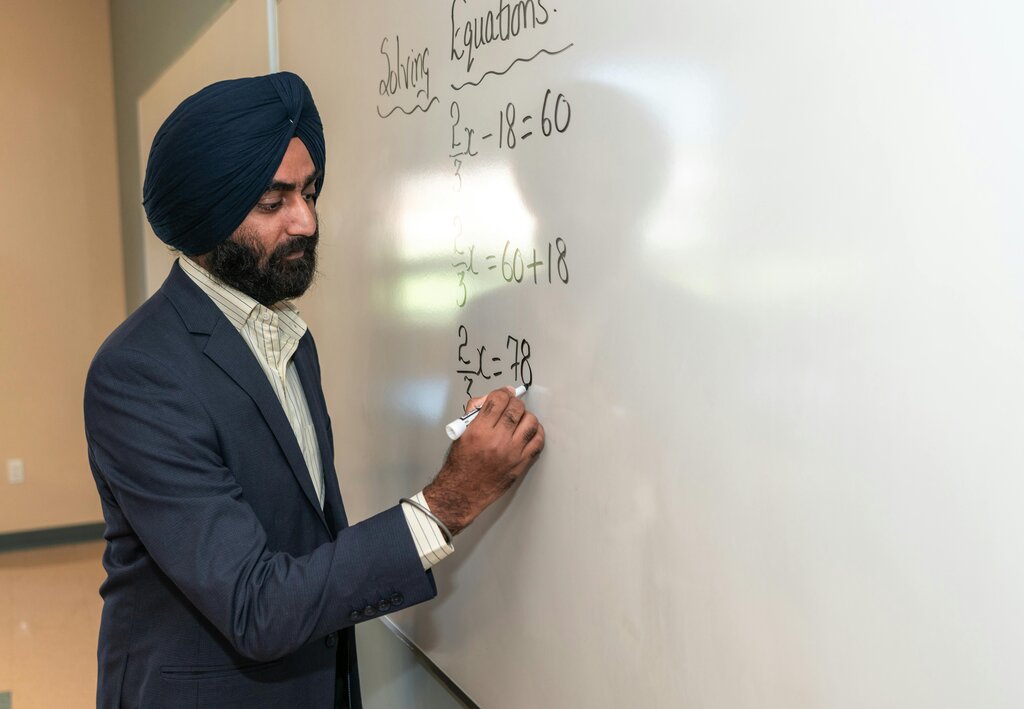
It teaches you to think logically and to break down complex problems into smaller, manageable parts. By representing a problem with variables, you can see its underlying structure and find a solution that works for any numbers you plug in later.
Learning algebra isn't just about finding . It's about developing a new way to see and interact with the world.
What is the primary difference between arithmetic and algebra?
Which of the following scenarios is best modeled with an algebraic equation?