Algebra Essentials
Introduction to Algebra
Beyond Known Numbers
In arithmetic, you work with numbers you know. For example, $3 + 5 = 8$. Everything is laid out for you. But what if you don't know a number? What if you have a bag of apples, but you haven't counted them yet?
This is where algebra begins. It gives us a way to talk about unknown quantities. Instead of leaving a blank space, we use a symbol to hold the place of that unknown number. This symbol is called a variable.
Variable
noun
A symbol, typically a letter, used to represent an unknown number or a quantity that can change.
Think of a variable as a nickname for a number we haven't figured out yet. The most common letters to use are and , but any letter will do. Using a variable lets us set up problems even when we don't have all the information.
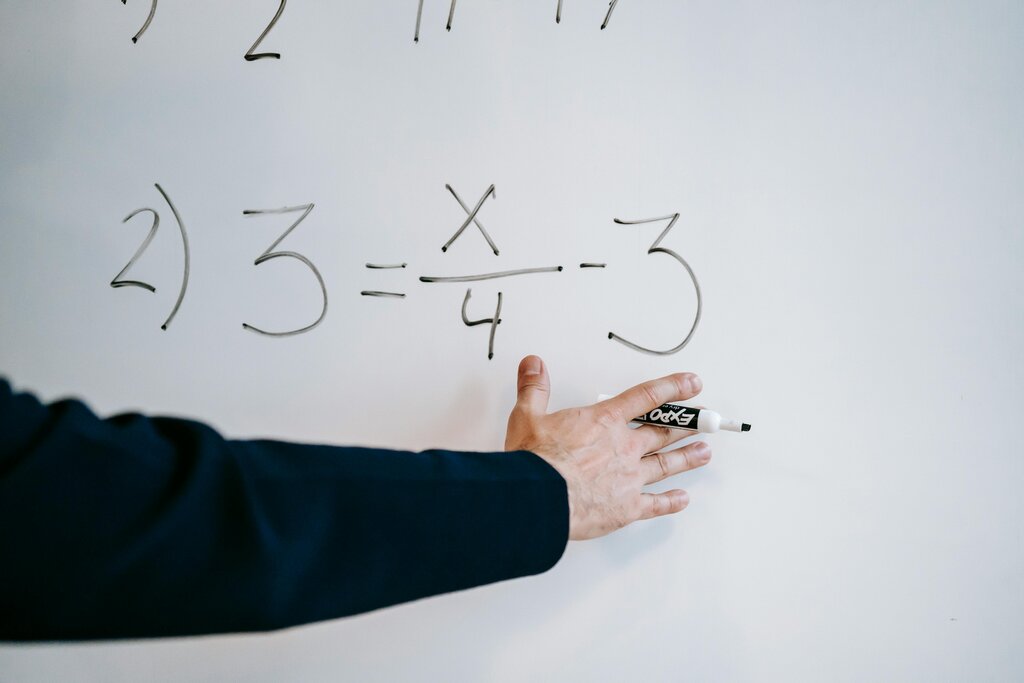
Creating Expressions
Once we have variables, we can combine them with numbers and operations like addition, subtraction, multiplication, and division. When we do this, we create an algebraic expression.
For example, if you start with an unknown number of cookies, , and then eat 3 of them, you are left with cookies. The combination is an expression. It describes a quantity without telling you its exact value.
An expression is a mathematical phrase. It doesn't have an equals sign and can't be 'solved' on its own.
Here are a few more examples of turning words into expressions:
- "A number increased by 10" becomes .
- "The product of 7 and a number " becomes .
- "A number divided by 4" becomes or .
Forming Equations
An expression is like a phrase, but an equation is like a complete sentence. An equation sets two expressions equal to each other using an equals sign (). This creates a statement that can be solved.
Let's go back to the cookies. The expression described how many cookies you had left. If you know that you have 9 cookies left, you can form an equation.
This equation makes a statement: "The original number of cookies, minus 3, is equal to 9." Because it's a complete statement, we can now solve it to find the value of our variable. By adding 3 to both sides, we find that . You started with 12 cookies.
Equation
noun
A mathematical statement that asserts the equality of two expressions. It contains an equals sign.
The equals sign is the key. It acts like a balance, telling us that whatever is on the left side has the exact same value as what's on the right side. The main goal in algebra is often to figure out the value of the variable that keeps this balance true.
Simplifying algebraic expressions is a fundamental skill in algebra that paves the way for understanding more complex topics in mathematics.
Time to check your understanding of these new concepts.