Algebra 2 Essentials
Quadratic Equations
Finding the Roots
A quadratic equation is any equation that can be written in the form , where is a variable and , , and are constants, with the key condition that cannot be zero. If it were, we'd just have a linear equation.
Solving a quadratic equation means finding its "roots" or "zeros." These are the values of that make the equation true. For example, in the equation , the roots are and , because plugging either value into the equation makes the left side equal zero. Most quadratic equations have two roots.
Solving an equation is like finding the secret key that unlocks it. For quadratics, there are often two keys.
Solving by Factoring
Factoring is often the quickest way to solve a quadratic equation. It relies on a simple idea: if the product of two numbers is zero, at least one of those numbers must be zero. If , then either or (or both).
Let's try this with an equation: .
Our goal is to rewrite the left side as a product of two expressions (factors). We need to find two numbers that multiply to 6 and add up to -5. Those numbers are -2 and -3. So, we can factor the equation like this:
Now we have our situation. This means either or . Solving these simple equations gives us our two roots: and .
Factoring is fast and clean, but it has a major limitation: it only works if the quadratic expression can be factored easily. For many equations, it's not a practical option.
Completing the Square
What if you can't easily factor an equation? Completing the square is a powerful technique that works for any quadratic equation. The goal is to manipulate the equation to create a "perfect square trinomial," which is an expression that can be factored into or .
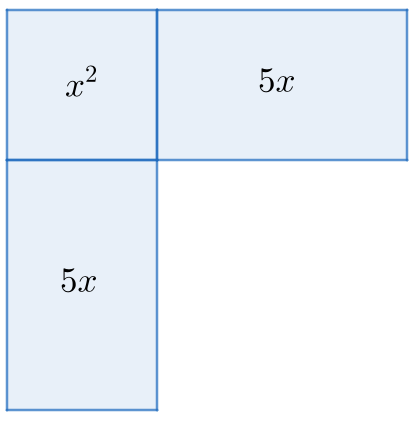
Imagine you have a square with side length (an area of ) and two rectangles, each with sides and . The total area is . To make this a complete, larger square, you need to fill in a small corner piece. What's the size of that missing piece? It's a small square with side length , so its area is .
Let's use this method to solve .
-
Move the constant term to the other side.
-
Find the missing piece. Take half of the coefficient of the term (which is 6), and square it. Half of 6 is 3, and is 9. This is the value that "completes the square."
-
Add this value to both sides. To keep the equation balanced, whatever we add to the left, we must add to the right.
-
Factor the left side. The left side is now a perfect square trinomial.
-
Take the square root of both sides. Don't forget the plus-or-minus sign on the right!
-
Solve for x. This gives us two possible solutions.
The roots are and . This method is reliable and builds the foundation for the most universal tool of all: the quadratic formula.
The Quadratic Formula
If you apply the method of completing the square to the general quadratic equation, , you end up with a formula that can solve any quadratic equation. This is the quadratic formula, and it's one of the most famous equations in algebra.
To use it, you just identify the values of , , and from your equation and plug them in. Let's solve . Here, , , and .
Plugging these into the formula:
This gives us two solutions:
The quadratic formula is a catch-all method. If you can't factor an equation or forget the steps to completing the square, this formula will always work.
The quadratic formula is more than just an academic tool; it is a robust method that underpins pre-calculus problem-solving, bridging algebraic theory and practical application.
The Nature of the Roots
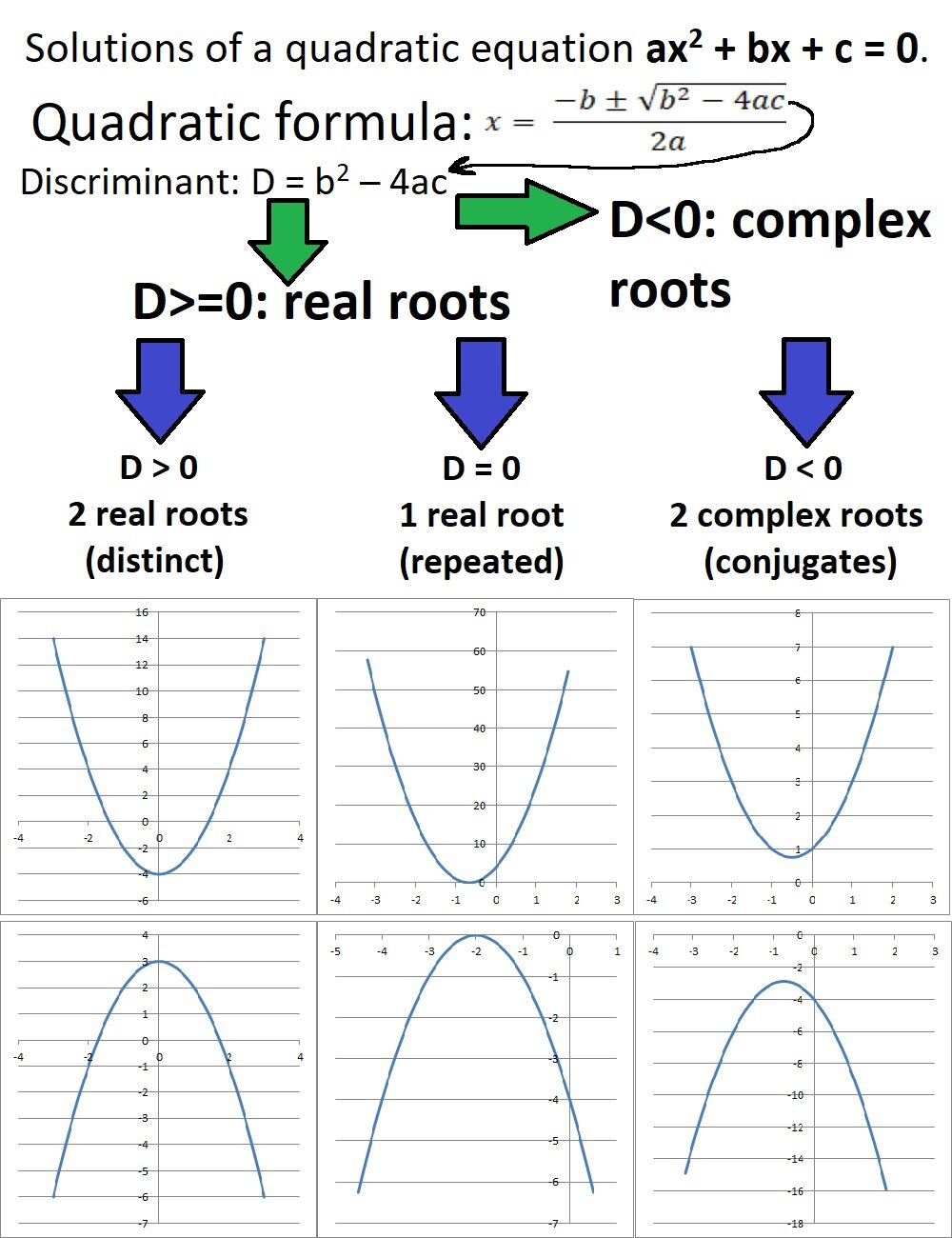
The part of the quadratic formula inside the square root, , is especially important. It's called the discriminant, and it tells us about the nature of the roots without having to solve the entire equation.
Discriminant
noun
The expression from the quadratic formula, which is used to determine the number and type of roots of a quadratic equation.
There are three possibilities for the value of the discriminant:
- If : The equation has two distinct, real roots. This is because you are adding and subtracting a positive value in the numerator.
- If : The equation has exactly one real root (sometimes called a repeated root). The part of the formula becomes , so you get only one answer, .
- If : The equation has no real roots. Since the square root of a negative number is not a real number, there are no real solutions. The roots in this case are called complex roots, but we won't be exploring them here.
Real-World Applications
Quadratic equations aren't just for math class; they appear in physics, engineering, and finance. One classic example is projectile motion.
The height of an object thrown into the air can be modeled by the equation , where is time in seconds, is the initial upward velocity, and is the initial height. If you want to know when the object hits the ground, you set the height to 0 and solve the resulting quadratic equation for .
Another common application is optimization. Businesses use quadratic equations to model revenue and profit. For example, a company's revenue might be modeled by , where is the price of their product. To find the price that maximizes revenue, they would find the vertex of the parabola, a concept closely tied to the equation's structure. This helps them make strategic decisions about pricing.
From the arc of a thrown ball to the pricing of a product, quadratic equations provide the mathematical language to describe and optimize the world around us.
Ready to test your knowledge on solving these equations?
What is the defining characteristic of a quadratic equation in the standard form ?
Using the factoring method, what are the roots of the equation ?
Understanding these methods gives you a complete toolkit for tackling any quadratic equation you encounter.