Alexandrian Philology and Textual Canonization
Institutional Bibliographic Systems
The Pinakes as Institutional Technology
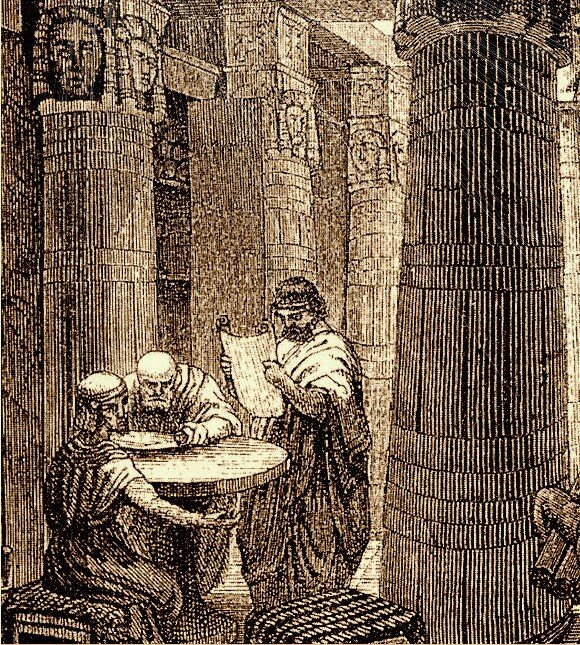
The Library of Alexandria was more than a repository; it was an ideological project. Central to this project was not just the accumulation of texts but their systematic organization. This required a new technology, one that could tame the chaotic, fluid world of scrolls and oral traditions into a structured, navigable system. That technology was the Pinakes.
The Mouseion really was primarily a research institution and its associated book collection – which we will continue to refer to by the shorthand expression the “Great Library” – was clearly one of if not the most extensive in the ancient world (more on that below).
Attributed to the scholar-poet Callimachus, the Pinakes—or Tables of Persons Illustrious in Every Branch of Learning, and of What They Wrote—was a 120-roll bibliographic catalog. It was not a simple inventory. It was the first large-scale implementation of metadata, a system designed to fix the identity of texts and authors, thereby creating a controllable, institutional canon.
Forging a Canon
Before the Pinakes, the concept of a definitive authorial work was tenuous. Texts were variable, shaped by performance, transcription errors, and regional interpretation. Callimachus's system imposed order by creating a standard bibliographic entry for each work. This entry included the author's name, a brief biography, the title of the work, and its incipit (the first line).
| Field | Purpose |
|---|---|
| Author & Biography | Stabilized authorial identity, linking a text to a specific person and context. |
| Title | Formalized a work's name, often for the first time. |
| Incipit | Provided a unique identifier, distinguishing different versions or similarly titled works. |
| Genre | Placed the work within a new, formal taxonomy (e.g., epic, tragedy, comedy, history). |
| Stichometry | Recorded the total line count, creating a fixed measure of the work's physical and intellectual scope. |
This structure was a radical innovation. The biographical data grounded a text in a specific, historical author, moving it away from the anonymity of oral tradition. The incipit acted as a fingerprint. But perhaps the most critical element was the use of , the systematic counting of lines. By recording a line count, the Pinakes established a standard length for a work. This not only helped librarians identify complete or incomplete scrolls but also served as a bulwark against unauthorized additions or truncations. A text now had a defined, measurable form.
Taxonomy as Power
The Pinakes also introduced a comprehensive taxonomy of knowledge. Callimachus organized authors into broad categories like Rhetoric, Law, Epic, Tragedy, Comedy, Lyric Poetry, History, Medicine, Mathematics, and Natural Science. These classifications were not neutral; they reflected a Hellenocentric worldview and a scholarly hierarchy. By creating these categories, Callimachus was not just describing the library's collection—he was defining the very structure of Greek literature and learning.
To be included in the Pinakes was to be deemed 'illustrious.' To be omitted, or to have your work categorized in a lesser genre, was to be marginalized from the official record of knowledge.
This act of classification was an exercise of power. The Ptolemaic patrons of the library, through this bibliographic apparatus, could legitimize certain authors and traditions while sidelining others. The Pinakes transformed a fluid cultural inheritance into a fixed, state-sanctioned canon. It established which version of a text was authentic, who the definitive author was, and where the work stood in the landscape of human knowledge. This transition from a dynamic oral-adjacent culture to a world of stable, cataloged texts was not merely administrative—it was the foundation of institutional knowledge control that would influence scholarship for millennia.
Now let's test your understanding of these bibliographic systems.
What was the primary purpose of the Pinakes created by Callimachus?
Which component acted as a 'fingerprint' for a text, helping to uniquely identify it within the Pinakes?