Alexander the Greats Conquests
Macedonian Army Structure
An Army Remade
The Macedonian army wasn't just a group of soldiers; it was a finely tuned machine, with each part designed for a specific purpose. Alexander the Great inherited a powerful force from his father, Philip II, and perfected it. The core of this army was its infantry, organized into a fearsome formation known as the phalanx.
Imagine a wall of soldiers, packed shoulder-to-shoulder in a tight rectangle, typically eight to sixteen ranks deep. Each soldier carried a small shield strapped to their left arm, leaving both hands free to wield their primary weapon: the sarissa.
sarissa
noun
An exceptionally long spear, typically 13 to 20 feet in length, used by the Macedonian phalanx.
The sheer length of the sarissa was a game-changer. The pikes of the first five ranks of the phalanx could all project beyond the front of the formation, creating a dense thicket of spear points that was nearly impenetrable to enemy infantry or cavalry charges. This made the phalanx the solid, unshakeable anvil of the Macedonian army.
The Hammer Strike
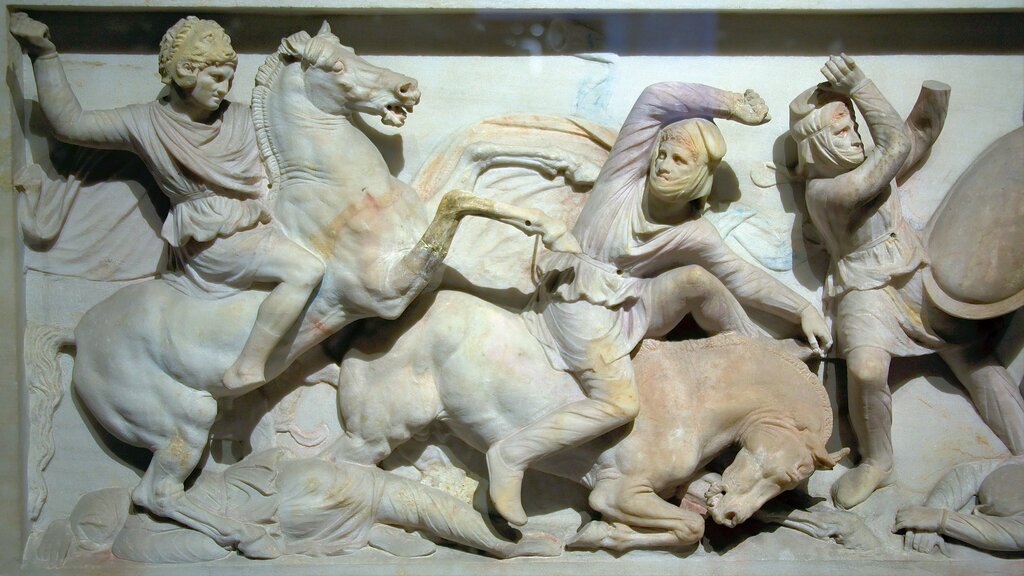
If the phalanx was the anvil, the cavalry was the hammer. The most prestigious unit was the Companion Cavalry (Hetairoi), composed of Macedonian nobility who fought alongside Alexander. They were the army's elite shock troops, trained to charge and break enemy formations at the decisive moment.
Riding the best horses and equipped with a long lance called a xyston and a sword, the Companions typically formed a wedge-shaped formation. This allowed them to punch through enemy lines with focused force. Alexander himself often led their charges, a tactic that was both inspiring and incredibly risky.
More Than Spears and Horses
A great army needs more than just a solid defensive line and a powerful offensive punch. Alexander's force was a combined arms army, meaning it integrated different types of troops to cover each other's weaknesses and create a versatile fighting force. This is where the specialized units came in.
The Hypaspists, or "Shield-Bearers," were an elite infantry unit. More mobile than the phalanx, they could guard the vulnerable flanks of the main infantry line or undertake special missions.
Other vital components included light cavalry for scouting and screening, such as the Thessalians and Paeonians. For ranged support, Alexander relied on Cretan archers, famous for their skill, and Agrianians, fierce javelin-throwers who excelled in rough terrain. These units could harass the enemy from a distance, disrupt their formations, and protect the main army from skirmishers.
| Unit | Primary Role | Key Equipment |
|---|---|---|
| Phalanx | Main infantry line (Anvil) | Sarissa, small shield |
| Companion Cavalry | Elite shock cavalry (Hammer) | Xyston (lance), sword |
| Hypaspists | Elite, flexible infantry | Spear, large shield |
| Cretan Archers | Ranged support | Bow and arrow |
| Agrianians | Light infantry skirmishers | Javelins |
Chain of Command
This complex machine required a clear command structure. At the very top was Alexander, the commander-in-chief. Below him were his trusted generals, known as the Somatophylakes (bodyguards), who often commanded large divisions of the army.
The army was broken down into smaller, more manageable units. The infantry phalanx was organized into battalions (taxeis), while the cavalry was organized into squadrons (ilai). Each of these had its own commander who reported up the chain. This structure ensured that orders could be passed down and executed quickly and efficiently, even in the chaos of battle. It was this blend of specialized troops and effective leadership that made the Macedonian army one of the most successful in history.
Now, let's test your knowledge on the structure of this legendary army.
What was the primary weapon of a Macedonian phalanx soldier, which gave the formation its unique defensive and offensive capabilities?
In the famous 'hammer and anvil' tactic, the Macedonian phalanx acted as the 'anvil'. Which unit served as the 'hammer'?