AI's Transformative Power Across Industries
Introduction to Artificial Intelligence
What Is Artificial Intelligence?
At its core, artificial intelligence is the science of making machines that can think or act like humans. The goal is to create systems that can perform tasks that normally require human intelligence, such as learning, reasoning, problem-solving, and understanding language.
Artificial Intelligence
noun
A field of computer science dedicated to creating systems capable of performing tasks that typically require human intelligence.
Think of it this way: we don't program an AI with a rigid set of instructions for every possible scenario. Instead, we create a framework that allows it to learn from data, identify patterns, and make decisions on its own. This ability to learn and adapt is what makes AI so powerful.
The central idea is not to just mimic human actions, but to understand and replicate the underlying intelligence that drives them.
A Brief History
The concept of intelligent machines has been around for centuries, but the formal field of AI research began in the summer of 1956 at a workshop at Dartmouth College. There, a group of scientists coined the term "artificial intelligence" and laid out the field's foundational vision.
The journey wasn't a straight line. Early excitement led to periods of reduced funding and interest, known as "AI winters," when the technology couldn't live up to the hype. But breakthroughs in computing power and the availability of massive datasets eventually led to a resurgence. Key developments, from the first chess-playing programs to modern language models, have marked AI's evolution.
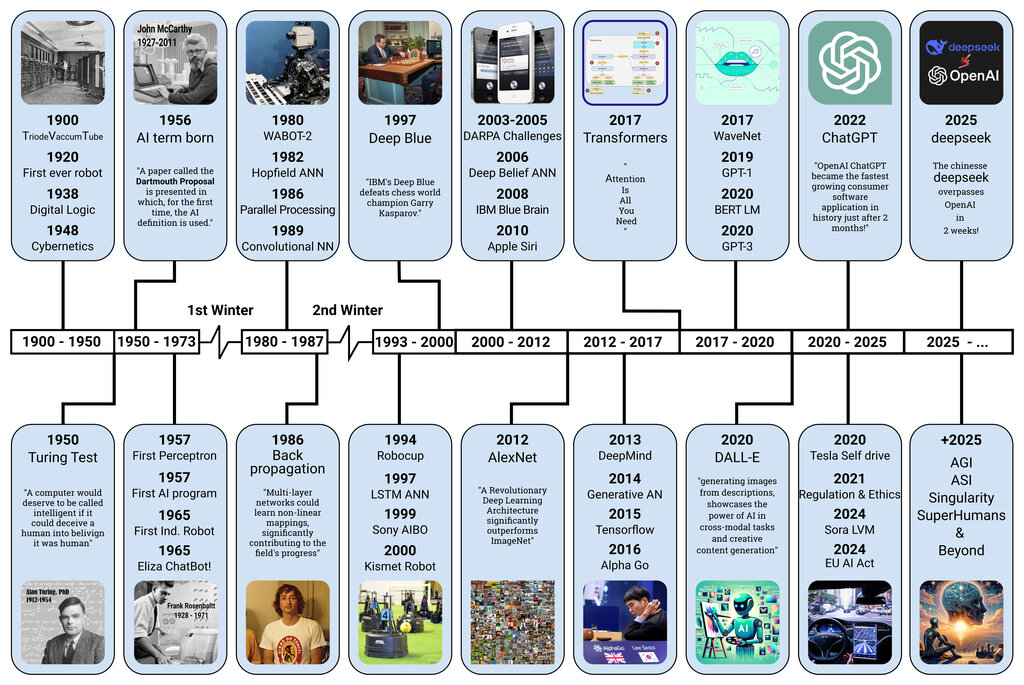
This progress has been driven by different approaches and subfields, each contributing to the broader goal of creating intelligent systems.
The AI Family
AI is a broad field with many branches. You'll often hear terms like machine learning, neural networks, and deep learning used interchangeably, but they have distinct relationships.
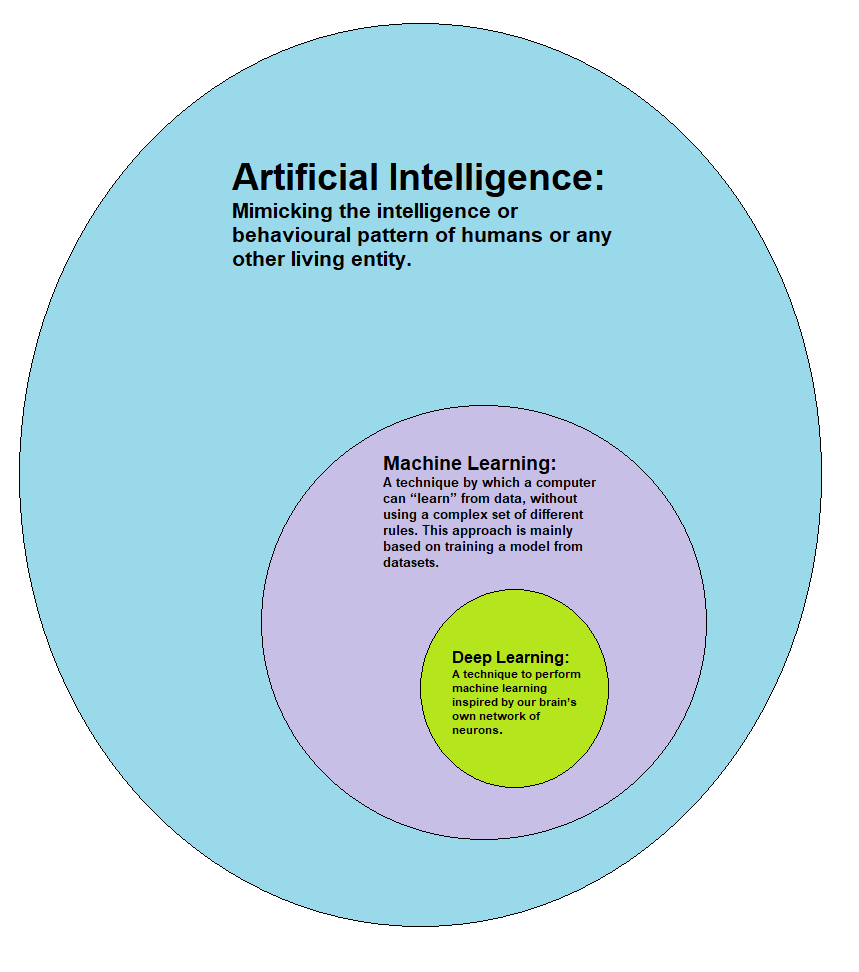
Machine Learning (ML) is a subset of AI. It's an approach where we give a machine access to data and let it learn for itself. Instead of writing code to identify a cat, you would show a machine learning model thousands of cat pictures until it learns the features of a cat on its own.
Neural Networks are a key part of machine learning, inspired by the structure of the human brain. They consist of layers of interconnected nodes, or "neurons." Each neuron receives input, processes it, and passes its output to the next layer. By adjusting the connections between these neurons, the network learns to recognize patterns.
Deep Learning (DL) is a more advanced type of machine learning. It uses deep neural networks with many layers—sometimes hundreds or thousands. This depth allows the model to learn very complex patterns from vast amounts of data. This is the technology behind many of the most impressive AI advancements, like image recognition and natural language processing.
| Feature | Machine Learning | Deep Learning |
|---|---|---|
| Data Needs | Works with smaller datasets | Requires large datasets |
| Hardware | Can run on standard CPUs | Needs powerful GPUs |
| Feature Extraction | Requires manual feature definition by humans | Learns features automatically from data |
| Training Time | Relatively fast | Can take hours or weeks |
Ethical Considerations
As AI becomes more integrated into our lives, it raises important ethical questions. These aren't just abstract problems for philosophers; they have real-world consequences.
One major issue is bias. AI systems learn from data, and if that data reflects existing societal biases, the AI will learn and even amplify them. For example, if a hiring AI is trained on historical data where men were hired more often for technical roles, it might unfairly penalize female candidates.
Privacy is another concern. AI systems often require vast amounts of personal data to function, from our online searches to our locations. How this data is collected, stored, and used is a critical ethical and legal issue.
Finally, there's the question of accountability. When a self-driving car gets into an accident, who is responsible? The owner, the manufacturer, or the AI itself? Establishing clear lines of responsibility is essential for building trust in these systems.

Let's review the core concepts we've covered.
Now, let's test your understanding with a few questions.
What is the fundamental characteristic that distinguishes AI from traditional programming?
The term 'artificial intelligence' was first coined at a workshop held in 1956 at which institution?