AI's Scientific Revolution
Introduction to Artificial Intelligence
What Is AI?
Artificial intelligence, or AI, is about creating machines that can think, learn, and solve problems like humans. It's not about robots that look like people, but about the software inside any computer that allows it to perform tasks that normally require human intelligence. This could be anything from understanding spoken language to recognizing faces in a photo.
The idea isn't new. Philosophers have wondered for centuries if human thought could be mechanized. But the modern field of AI truly began in the mid-20th century with the invention of the computer. Early pioneers believed that a machine as complex as the human brain was just a few decades away.
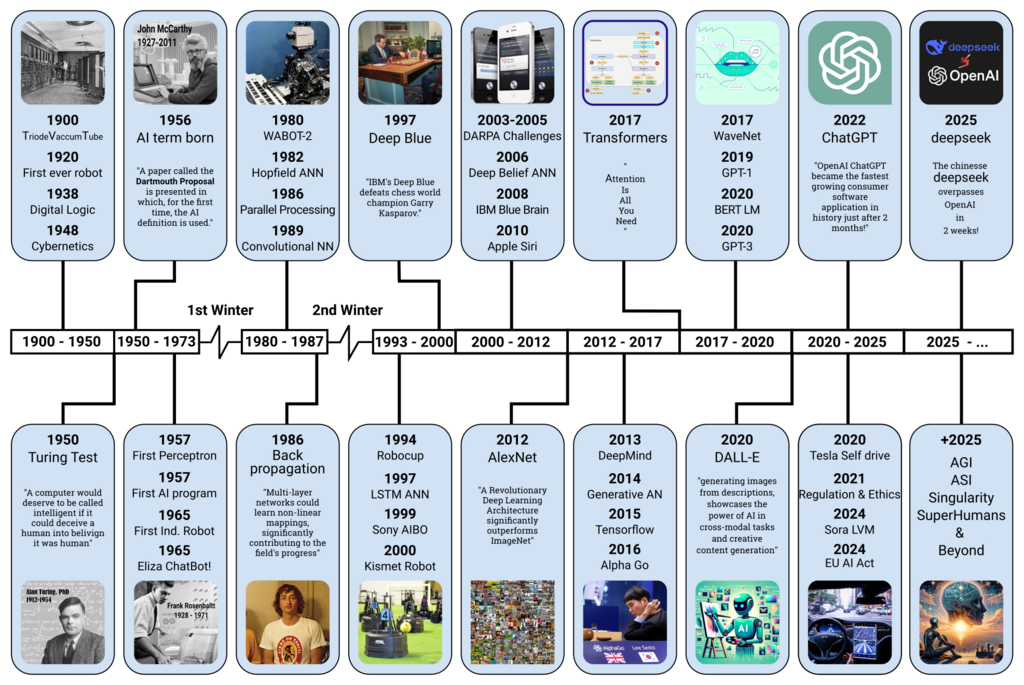
Progress wasn't a straight line. There were periods of great excitement and funding, followed by 'AI winters' when progress stalled and interest faded. But advances in computing power and the availability of massive amounts of data eventually fueled the breakthroughs we see today.
The AI Family
AI is a broad field with many different branches. Think of it as a big family tree. The most important branches to know are Machine Learning and Deep Learning. They are not different things from AI, but rather specific ways of achieving it.
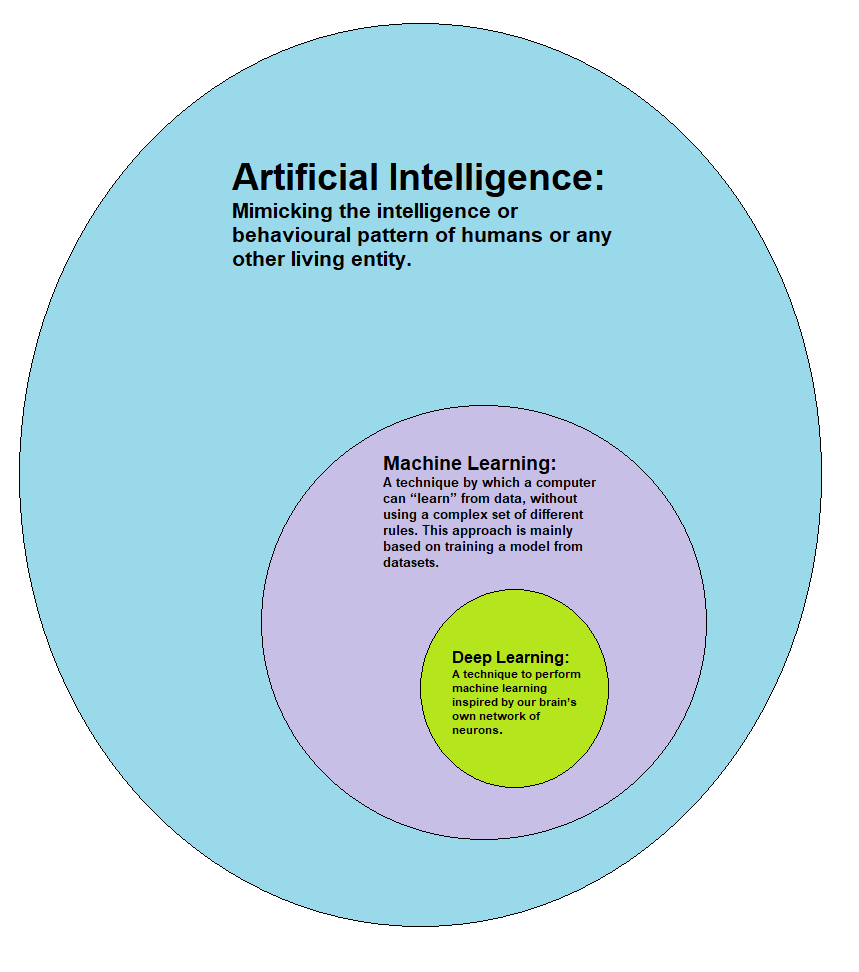
Machine Learning (ML) is a type of AI where systems learn directly from data. Instead of being programmed with explicit rules for every situation, an ML model is trained on a huge number of examples. It learns to recognize patterns and make predictions on its own. For instance, a spam filter learns to identify junk mail by analyzing thousands of emails you've marked as spam.
Deep Learning (DL) is a more advanced subset of machine learning. It uses structures inspired by the human brain called artificial neural networks. These networks have many layers of interconnected 'neurons' that process information, allowing them to learn much more complex patterns from data. This is the technology behind self-driving cars recognizing pedestrians and voice assistants understanding your commands.
In this simple network, information flows from the input layer, gets processed in the hidden layer, and results in a decision at the output layer. Deep learning networks can have dozens or even hundreds of hidden layers, allowing them to tackle incredibly sophisticated tasks.
Ethics and Society
As AI becomes more powerful and integrated into our lives, it raises important questions. The data used to train AI systems can contain biases present in our world. If an AI is trained on biased data, it will produce biased results. This can lead to unfair outcomes in areas like hiring, loan applications, and even criminal justice.
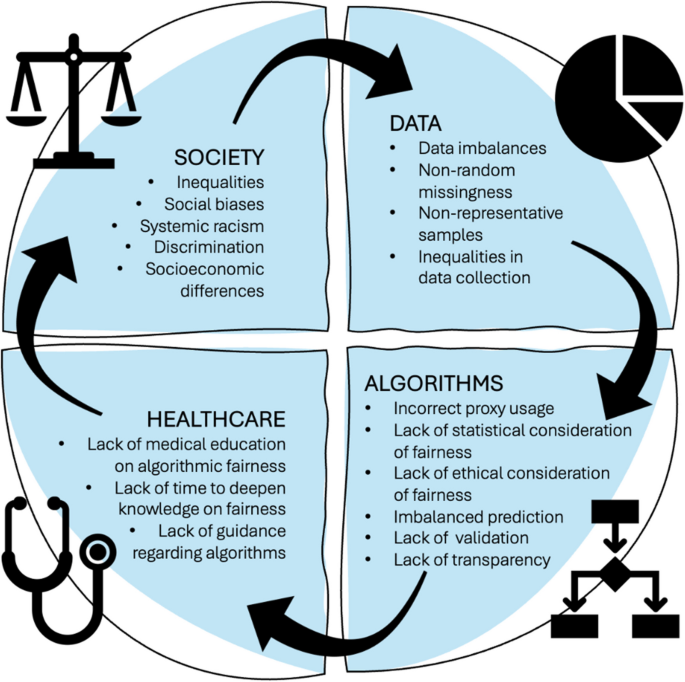
Another key issue is transparency. Many advanced AI systems are so complex that even their creators don't fully understand how they arrive at a particular decision. This is often called the 'black box' problem. If we don't know why an AI made a certain choice, how can we trust it or hold it accountable?
Ensuring fairness, accountability, and transparency in AI systems is one of the biggest challenges facing technologists and policymakers today.
The societal impact of AI is vast. It has the potential to automate many jobs, which could lead to economic disruption. At the same time, it can create new jobs and solve some of the world's most pressing problems, from discovering new medicines to combating climate change. Navigating this transition requires careful planning and public discussion about the kind of future we want to build with AI.
Let's check your understanding of these foundational ideas.
What is the primary goal of Artificial Intelligence (AI)?
Which statement best describes the relationship between Artificial Intelligence (AI), Machine Learning (ML), and Deep Learning (DL)?
By understanding these core concepts, you're ready to explore how AI is being applied in more specific fields.