Aircraft Turbine Engine Physics
Introduction to Gas Turbine Engines
How a Jet Engine Works
A gas turbine engine is what powers most modern aircraft. At its core, it's an air-breathing engine. It takes in air from the front, uses it to burn fuel, and then blasts hot gases out the back to push the aircraft forward. Think of it as a controlled, continuous explosion.
The entire process can be boiled down to four simple steps: suck, squeeze, bang, and blow. Air is sucked in, squeezed to a high pressure, mixed with fuel and ignited (bang), and then blown out the back.
The Four Key Parts
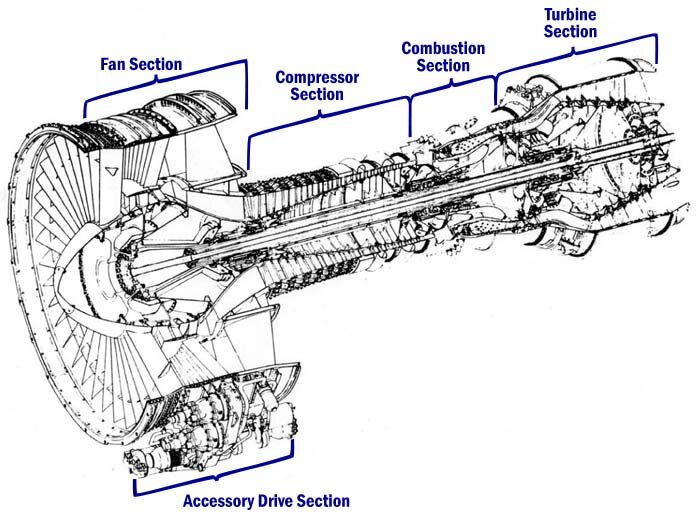
Every gas turbine engine has four main sections that work together to create thrust. Air flows through them in sequence.
- Compressor: A series of spinning blades, like a fan, that pulls air into the engine and compresses it, increasing its pressure and temperature.
- Combustor: The compressed air is mixed with a fine spray of fuel and ignited. This creates a high-temperature, high-pressure gas.
- Turbine: This hot gas expands rapidly and rushes past another set of blades. The turbine's job is to extract energy from the hot gas to spin the compressor and other engine accessories.
- Nozzle: The remaining hot gas blasts out of the back of the engine through the nozzle. This acceleration of gas out the back creates an equal and opposite reaction, pushing the engine—and the aircraft—forward.
The Brayton Cycle
The process happening inside a gas turbine is described by a thermodynamic cycle called the Brayton cycle. It's a model that helps engineers understand the changes in pressure, temperature, and volume of the air as it moves through the engine. The four steps of the Brayton cycle line up perfectly with the four parts of the engine.
| Brayton Cycle Step | Engine Component |
|---|---|
| 1. Isentropic Compression | Compressor |
| 2. Constant Pressure Heat Addition | Combustor |
| 3. Isentropic Expansion | Turbine |
| 4. Constant Pressure Heat Rejection | Exhaust (atmosphere) |
Don't worry too much about the technical terms. The key idea is that the cycle involves compressing a gas, adding heat (burning fuel), letting the hot gas expand to do work (spin the turbine), and then exhausting it. The continuous nature of this cycle is what allows a jet engine to produce constant thrust.
Turbojet vs. Turbofan
Not all jet engines are created equal. The two most common types are the turbojet and the turbofan. A turbojet is the simplest form. All the air that enters the engine goes through the compressor, combustor, and turbine. They are very powerful and work best at high speeds, which is why they were used in early jet fighters.
A turbofan engine is a more modern and efficient design. It has a large fan at the very front. This fan sends a portion of the incoming air around the engine's core, completely bypassing the combustor and turbine. This "bypass air" is still accelerated, creating thrust, but without burning any fuel. The rest of the air goes through the core, just like in a turbojet.
Most modern commercial airliners use turbofan engines. The bypass air makes them quieter and much more fuel-efficient at the speeds and altitudes where passenger planes fly.
The ratio of bypass air to the air that goes through the core is called the bypass ratio. High-bypass turbofans are the standard for commercial aviation, while low-bypass turbofans are often used in military fighter jets, which need to balance fuel efficiency with high-speed performance.
Now let's see how well you've grasped these core concepts.
What is the primary role of the compressor section in a gas turbine engine?
The thermodynamic cycle that describes the process inside a gas turbine engine is called the Brayton cycle.
Understanding these fundamentals—the main components, the Brayton cycle, and the key engine types—provides a solid foundation for exploring how we achieve flight.