Air Transport of Dangerous Goods
Introduction to Dangerous Goods
More Than Just Chemicals
When you think of “dangerous goods,” your mind might jump to barrels of toxic waste or sticks of dynamite. While those certainly count, the term covers a much wider range of items. Many common products, from the lithium batteries in your phone to a can of hairspray or a bottle of perfume, are considered dangerous goods when it comes to air travel.
Dangerous goods are articles or substances that can pose a risk to health, safety, property, or the environment when transported by air.
The key is that the conditions of flight can change how these items behave. The vibrations, temperature shifts, and pressure changes inside a cargo hold can cause seemingly harmless items to leak, ignite, or react in dangerous ways. That’s why there are strict international rules for shipping them.
The Nine Classes of Danger
To manage the risks, dangerous goods are sorted into nine distinct classes based on the type of hazard they present. This system helps everyone, from the shipper to the airline crew, understand exactly what they’re dealing with and how to handle it safely.
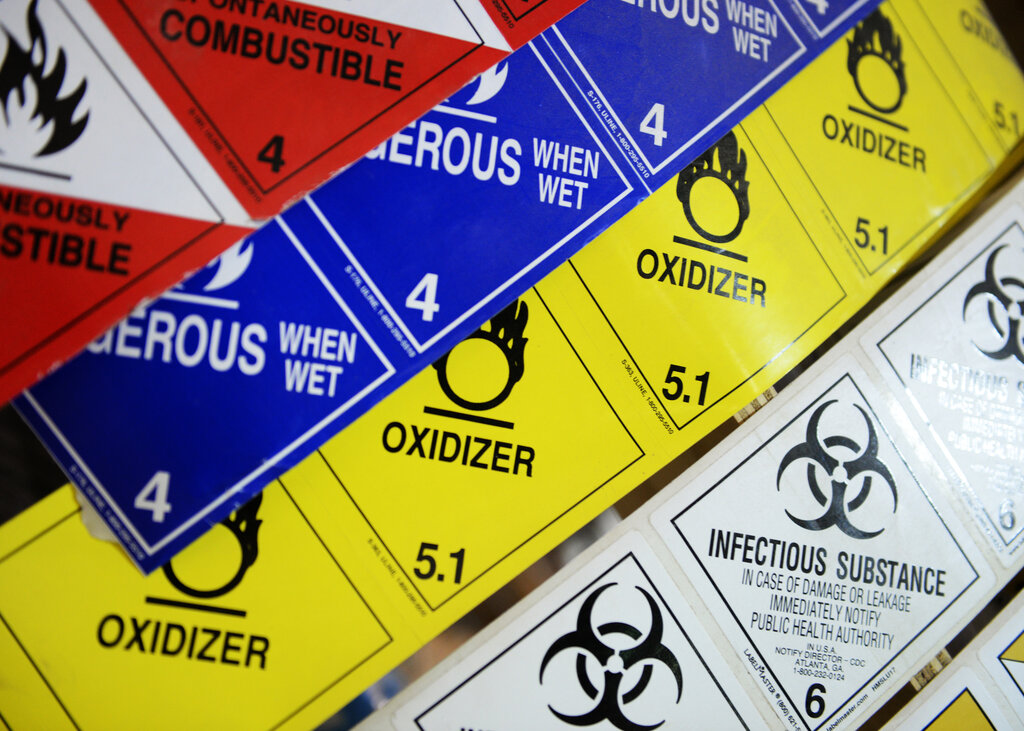
Here’s a quick look at the nine classes.
| Class | Type | Examples |
|---|---|---|
| 1 | Explosives | Fireworks, ammunition |
| 2 | Gases | Aerosol cans, fire extinguishers |
| 3 | Flammable Liquids | Perfume, gasoline, paint |
| 4 | Flammable Solids | Matches, sulfur |
| 5 | Oxidizers & Organic Peroxides | Chemical oxygen generators, fertilizers |
| 6 | Toxic & Infectious Substances | Pesticides, blood samples |
| 7 | Radioactive Materials | Medical isotopes |
| 8 | Corrosives | Bleach, car batteries |
| 9 | Miscellaneous | Lithium batteries, dry ice |
Risks at 30,000 Feet
Transporting goods by air is very different from moving them by road or sea. An airplane is a pressurized, sealed environment where even a small incident can quickly become a catastrophe. A fire or chemical leak on a truck is a serious problem; on a plane, it can be fatal for everyone on board.
The unique stresses of flight, like low pressure and constant vibration, can cause packaging to fail or materials to react unexpectedly.
Imagine a poorly packaged container of a flammable liquid. On the ground, it might be stable. But as the plane climbs, the air pressure in the cargo hold drops. The pressure difference between the inside and outside of the container could cause it to leak or even burst. The fumes could then be ignited by a spark, leading to a fire in a space where it's incredibly difficult to fight.
This is why understanding the definition and classification of dangerous goods is the first and most critical step. It’s not just about following rules; it’s about preventing disaster and ensuring the safety of the crew, passengers, and the aircraft itself.