Air Cargo Throughput Dynamics
Hub Sortation Mechanics
Inside the Sorting Machine
The journey of a package through a modern logistics hub is a masterclass in controlled chaos. When a plane or truck arrives at a facility like the FedEx Superhub in Memphis or UPS Worldport in Louisville, the clock is already ticking. The first step is the unload, where packages are moved from their containers onto a complex web of conveyor belts. In many advanced hubs, this isn't just a manual process. Automated systems use extendable belts that reach deep into trailers, helping workers move thousands of packages per hour onto the initial conveyor network.
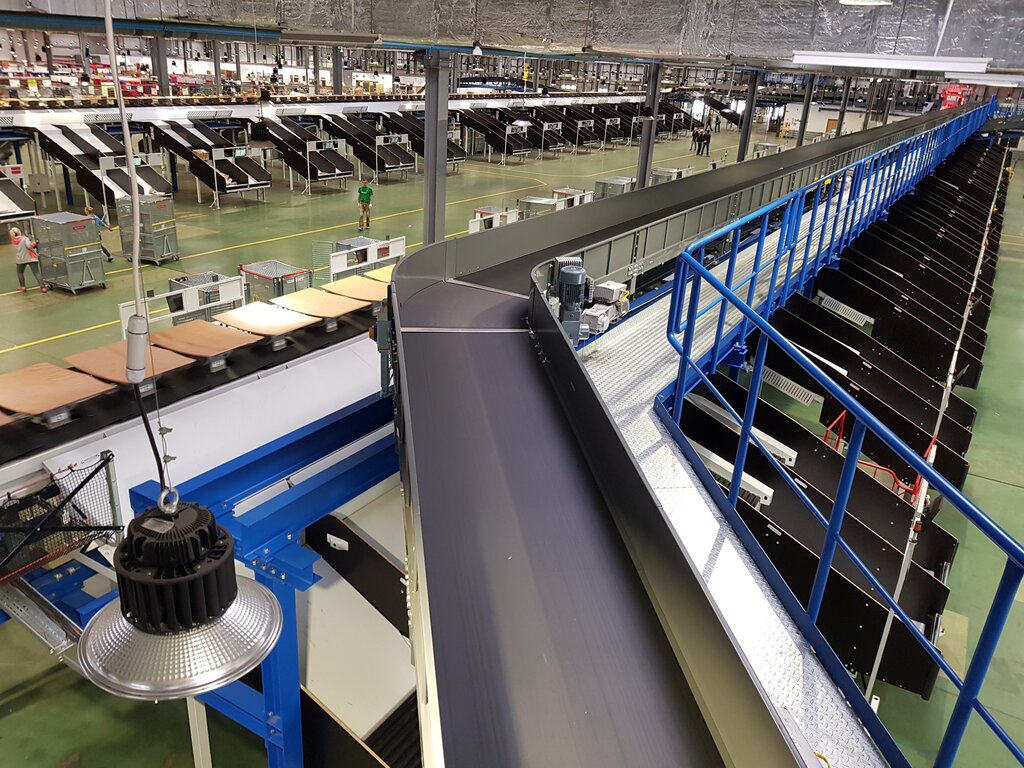
Once on the belts, each package begins its high-speed race. The goal is to get it scanned, sorted, and routed to the correct outbound location in an incredibly short window of time. To do this, hubs rely on sophisticated scanning technology. As packages snake through the system, they pass through scanning tunnels equipped with cameras and lasers on all sides. This six-sided scanning technology captures the barcode information no matter how the package is oriented on the belt, eliminating the need for manual repositioning. This single innovation is a massive contributor to the hub's overall speed.
This massive hub can process up to 484,000 packages every hour.
Primary and Secondary Sorts
The initial scan feeds the package's destination into the hub's control system, which triggers the first major step: the primary sort. Think of this as a rough, high-level sorting process. Giant conveyor belts divert packages into broad categories, such as geographic regions or even specific outbound flights. For example, all packages headed for the West Coast might be routed down one main artery of the conveyor system, while those headed for Europe go down another. It's a process of progressive differentiation, moving from one massive input stream to several large, semi-sorted output streams.
But the primary sort isn't granular enough. This is where secondary sortation layers come in. After being grouped by region, packages are funneled into smaller, more specialized sorting systems. Here, they are sorted by specific city, postal code, or individual delivery route. At FedEx, for instance, facilities known as Secondary 25 can handle over half of the primary volume, performing this finer sort during the busiest hours. This layered approach prevents bottlenecks and allows the hub to process an immense volume of items simultaneously.
Calculating Hub Throughput
The true measure of a hub's power is its throughput, typically measured in packages per hour (PPH). The headline number for UPS Worldport is a staggering 416,000 PPH. This figure is the result of a finely tuned equation involving every step of the process. The total unload-to-reload cycle time for any given package must be minimized.
Key to this is conveyor density and speed. Worldport contains over 155 miles of conveyor belts, moving at speeds that ensure packages flow continuously without piling up. The system is designed so that the time from a package entering the system to it arriving at its designated outbound chute is just over 10 minutes on average. This efficiency defines the hub's capacity. If packages slow down or stop, the entire system grinds to a halt.
Ultimately, the mechanics of hub sortation are a physical manifestation of data processing. Barcodes are the data inputs, scanners are the readers, and the sprawling network of conveyors and diverters acts as the physical routing algorithm. Every package's journey is a high-speed, automated decision-making process, repeated hundreds of thousands of times per hour.
Now let's test your understanding of how these massive logistics centers operate.
What is the primary purpose of "six-sided scanning" technology in a modern logistics hub?
Arrange the following steps in the typical order they occur for a package arriving at a major sorting hub.
The efficiency of these hubs is a critical, though often invisible, part of modern commerce.