AI Tools Demystified
Introduction to Artificial Intelligence
What Is Artificial Intelligence?
At its heart, artificial intelligence is the science of making machines smart. The goal is to build computer systems that can perform tasks that normally require human intelligence. This includes things like learning from experience, understanding language, recognizing objects, solving problems, and making decisions.
Think of it less as creating a conscious robot from a movie and more as teaching a computer a specific skill. Just as you might learn to ride a bike or speak a new language, AI involves training a machine to recognize patterns and make predictions based on data. It’s a broad field with many different approaches, but the core idea remains the same: creating technology that can perceive its environment and take actions to achieve a goal.
This introduction to this special issue discusses artificial intelligence (AI), commonly defined as “a system’s ability to interpret external data correctly, to learn from such data, and to use those learnings to achieve specific goals and tasks through flexible adaptation.”
A Quick Trip Through Time
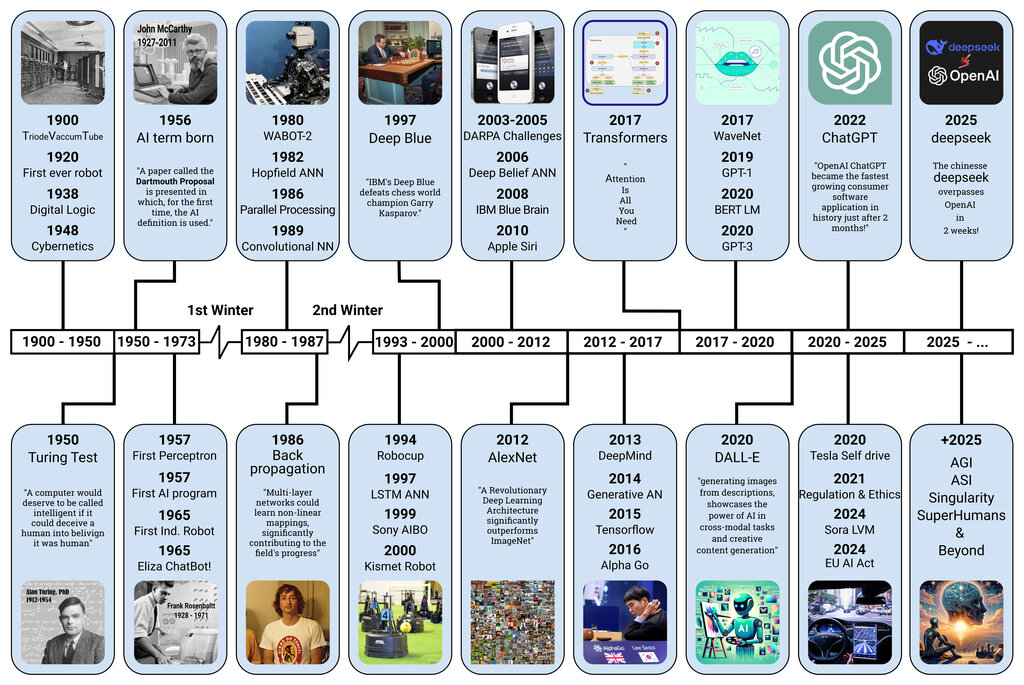
The dream of intelligent machines isn't new. Ancient myths are filled with stories of artificial beings. But the scientific journey of AI began in the mid-20th century. In 1956, a group of researchers gathered for a workshop at Dartmouth College and officially coined the term "artificial intelligence."
Early years were full of excitement. Scientists built programs that could solve algebra problems and prove logical theorems. But progress was slower than expected. The complexity of creating true intelligence led to a period in the 1970s and 80s known as the "AI winter," when funding and interest dried up.
The field was reborn in the 1990s and 2000s, thanks to more powerful computers and the availability of massive amounts of data. This led to the rise of machine learning, a subfield of AI. A major milestone came in 1997 when IBM's Deep Blue chess computer defeated world champion Garry Kasparov. More recently, the development of deep learning and large language models has triggered the explosion of AI tools we see today.
The Two Main Flavors of AI
When people talk about AI, they are usually referring to one of two very different concepts: Narrow AI or General AI.
Narrow AI
noun
Also known as Weak AI, this is intelligence that is focused on one specific task.
Virtually all the AI we interact with daily is Narrow AI. The recommendation engine that suggests what to watch next, the voice assistant on your phone, and the software that detects fraud on your credit card are all examples. They are incredibly powerful and efficient at their designated jobs, but they operate within a limited, pre-defined range. Your navigation app can find the fastest route, but it can't write a poem about the traffic.
The other type is still the stuff of science fiction.
General AI
noun
Also known as Strong AI or Artificial General Intelligence (AGI), this is a hypothetical type of AI that possesses the ability to understand, learn, and apply its intelligence to solve any problem, much like a human being.
An AGI would be able to switch between vastly different tasks—from doing your taxes to composing music to discovering a new scientific theory—without needing to be retrained. This level of flexible, adaptive intelligence does not yet exist.
Big Questions and Responsibilities
As AI becomes more powerful and integrated into our lives, it raises important ethical questions. Building AI responsibly is one of the most significant challenges of our time.
One major concern is bias. AI systems learn from data, and if that data reflects existing societal biases, the AI will learn and even amplify them. For example, if a hiring tool is trained on historical data where men were predominantly hired for a certain role, it might unfairly penalize female candidates.
Privacy is another issue. Many AI applications rely on collecting vast amounts of personal data, from our online habits to our location. Ensuring this data is used securely and ethically is critical.
Finally, there's the question of accountability. When a self-driving car has an accident, who is responsible? The owner, the manufacturer, or the programmer? Establishing clear lines of responsibility is essential as these systems become more autonomous.
Beyond these ethical dilemmas, AI is having a profound impact on society. It's transforming industries, creating new jobs while making others obsolete, and changing how we communicate and access information. Navigating this transition requires careful planning and public discussion to ensure the benefits of AI are shared broadly and its risks are managed effectively.
The goal isn't just to create intelligent machines, but to create machines that help humanity flourish.
Now, let's test what you've learned about the fundamentals of AI.
What is the primary goal of artificial intelligence?
The period in the 1970s and 80s when funding and interest in AI research declined is commonly known as the...
Understanding these core concepts is the first step in navigating the complex and fascinating world of artificial intelligence. It's a field that began as a bold idea and has grown into a technology that is reshaping our world.