AI Thinking and Reasoning Explained
Introduction to AI Reasoning
How AI Thinks
When we talk about artificial intelligence, the word "thinking" comes up a lot. But what does it actually mean for a machine to think? In AI, thinking is called reasoning. It's the process an AI uses to take in information, process it, and arrive at a conclusion or decision. It's not about consciousness or feelings; it's about structured, logical steps.
Effective AI systems merge robust knowledge bases (the what) with reasoning algorithms (the how).
At its core, AI reasoning mimics two fundamental types of human logic: working from the general to the specific, and from the specific to the general. These two methods, known as deductive and inductive reasoning, form the basis for how AI systems make sense of the world.
Two Paths to a Conclusion
Imagine you're solving a puzzle. You might start with the rules and figure out where a piece must go, or you might look at a few placed pieces and guess the overall pattern. AI uses digital versions of these same logical paths.
Deductive reasoning starts with a general rule and applies it to a specific case. If the rule is true, the conclusion is guaranteed to be true.
Think of it like a classic syllogism:
- All humans are mortal.
- Socrates is a human.
- Therefore, Socrates is mortal.
This is a top-down approach. You begin with a broad truth and narrow it down to a specific, certain conclusion.
Inductive reasoning does the opposite. It looks at specific examples and tries to form a general rule. The conclusion is probable, not guaranteed.
For instance:
- Every swan I have ever seen is white.
- Therefore, all swans are probably white.
This is a bottom-up approach. It builds a general theory from specific observations. Of course, this conclusion can be proven wrong if you eventually see a black swan. Inductive reasoning deals in likelihoods, not certainties.
| Feature | Deductive Reasoning | Inductive Reasoning |
|---|---|---|
| Direction | General to Specific | Specific to General |
| Approach | Top-down | Bottom-up |
| Conclusion | Certain | Probable |
| Example | Logic puzzles, math proofs | Scientific discovery, pattern recognition |
Building an AI Brain
These two styles of reasoning inspired the two main philosophies for building AI systems: the symbolic approach and the connectionist approach.
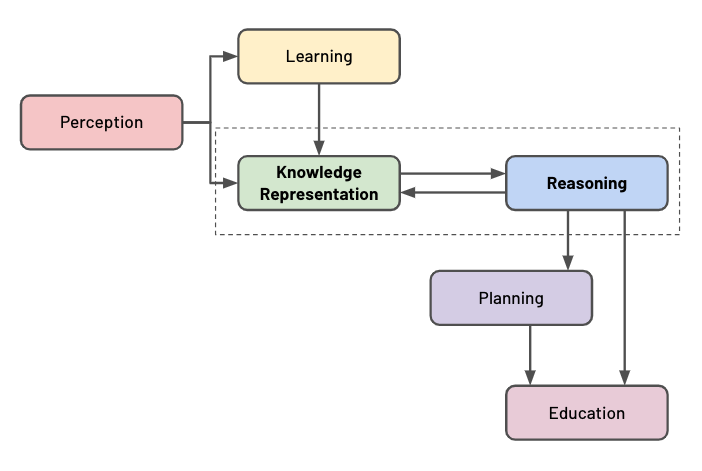
The Symbolic approach, also known as top-down AI, is based on deductive reasoning. In this method, humans give the AI a set of explicit rules and facts about the world, represented as symbols. The AI then uses these rules to make logical deductions.
Think of an early chess-playing computer. It was programmed with the rules of chess and strategies for evaluating moves. It didn't "learn" to play; it simply calculated the best move based on the rules it was given. This approach is very transparent—you can trace every step of its logic.
The Connectionist approach, or bottom-up AI, is inspired by inductive reasoning and the structure of the human brain. Instead of being fed rules, these systems are fed massive amounts of data. The AI analyzes this data for patterns and relationships, gradually "learning" the rules on its own.
This is the foundation of modern machine learning and neural networks. For example, to teach an AI to recognize cats, you don't give it a definition of a cat. You show it thousands of pictures of cats. It identifies common patterns—whiskers, pointy ears, tails—and builds its own internal model of what a cat is. This approach is powerful for complex problems where rules are hard to define, but its reasoning can be opaque, like a "black box."
Most advanced AI today uses a hybrid approach, combining the rule-based clarity of symbolic systems with the pattern-finding power of connectionist networks. This allows them to be both powerful and, ideally, more understandable.
Now, let's test your understanding of these core concepts.
An AI system is fed thousands of images of different dog breeds to learn how to identify them without being given explicit rules. This is an example of which approach?
Which form of reasoning starts with a general rule and applies it to a specific case to reach a certain conclusion?
Understanding these basic principles of reasoning is the first step to grasping how AI systems work, from simple calculators to the complex models shaping our world.