AI Surveillance and Defense Ethics
Automated Visual Surveillance
From Recording to Reacting
For decades, surveillance cameras were passive observers. They recorded countless hours of footage, which was then stored and often only reviewed after an incident occurred. This created a reactive security model, where operators had to manually sift through vast archives to find a specific event. The architectural shift in modern surveillance is a move from this record-and-review paradigm to real-time, automated analysis.
Instead of just storing pixels, today's systems interpret them on the fly. This transformation is powered by Computer Vision, a field of AI that trains computers to understand and process information from images and videos. The goal is no longer just to have a recording, but to turn a live video stream into a structured, searchable database of events, objects, and behaviours as they happen.
Computer Vision (CV) is a branch of AI that focuses on enabling computers to extract meaningful information from images and videos.
The Engine of Recognition
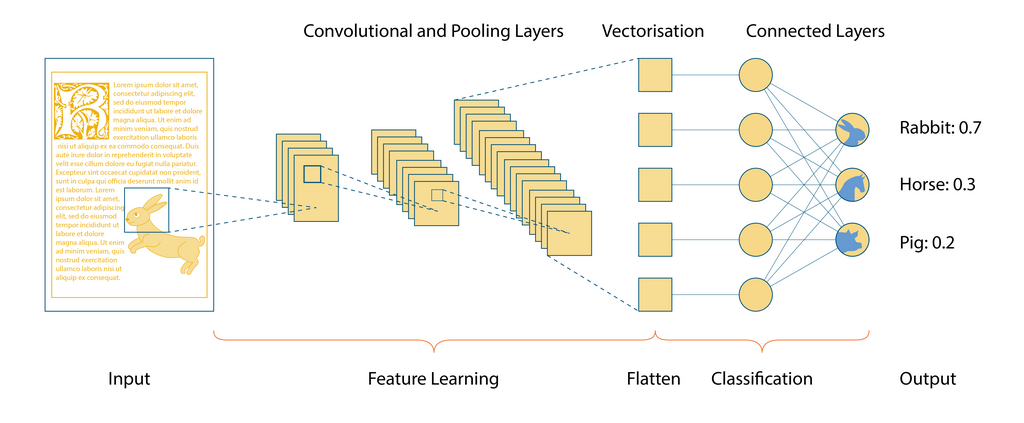
At the heart of modern visual surveillance are (CNNs), a class of deep learning models particularly adept at processing visual data. A CNN works by applying a series of filters to an image to identify features. Early layers in the network might detect simple edges and colours. Subsequent layers combine these to recognise more complex patterns like textures and shapes, until eventually, the network can identify whole objects like a person, a backpack, or a vehicle.
This process allows a system to perform several key tasks in real time:
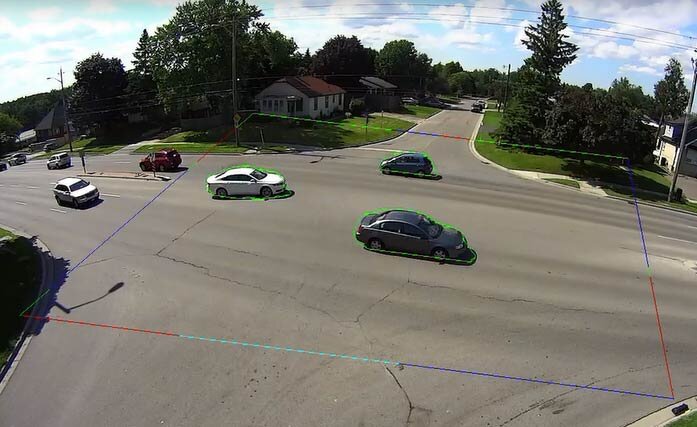
- Object Detection: Drawing a bounding box around a detected object.
- Image Segmentation: Outlining the precise pixel-by-pixel shape of an object.
- Classification: Assigning a label to the object (e.g., 'car', 'person').
This capability transforms a chaotic scene into organised data. A crowd is no longer an undifferentiated mass but a collection of individual, classifiable entities.
Searching Video with Words
While CNNs are excellent at identifying what is in a video, the next leap forward is to understand context and relationships. This is where (VLMs) come in. VLMs combine the visual understanding of CNNs with the language comprehension of Large Language Models (LLMs), allowing them to connect visual data with textual descriptions.
This enables a fundamentally new way of interacting with surveillance footage. Instead of scrubbing through timelines, an operator can simply type a natural language query like, "Show me all individuals wearing a blue jacket and carrying a backpack near the main entrance between 2 PM and 3 PM." The VLM parses the request, identifies the specified visual attributes, and retrieves only the relevant video segments. This capability drastically reduces the time needed to find specific events across a massive network of cameras.
The integration of these models into municipal and national security infrastructures is already underway. Vast networks of public and private cameras are being linked into unified platforms. Video data that was once siloed and difficult to access is now being aggregated into massive, searchable archives. This scalability is key; a system isn't just watching one street corner, but potentially an entire city grid.
Extracting Subtle Details
Modern surveillance goes beyond just identifying a person or a car. The systems are being trained to extract specific, subtle attributes from video data. This includes:
- Clothing: Colour, type (hat, coat, t-shirt), and even logos.
- Objects: Identifying items being carried, like a laptop bag, a mobile phone, or a package.
- Gait Analysis: Recognising individuals by their unique way of walking. This can be used to track a person even if their face is obscured.
- Group Associations: Determining which individuals are moving together or interacting, allowing the system to track groups, not just individuals.
This level of detail creates a rich digital fingerprint for every person captured on video. An AI can re-identify a person across different cameras, at different times, based on a collection of these attributes. For example, it can find a person first seen on a train platform and later spot them entering a building across town, all based on a consistent description.
This technical foundation—real-time analysis, natural language search, and detailed attribute extraction—is precisely what is being discussed in debates between AI safety labs and defence agencies. The tools are no longer science fiction; they are deployed components of modern security infrastructure, capable of turning raw video into actionable intelligence at an unprecedented scale.
What is the primary architectural shift in modern surveillance systems compared to older, traditional systems?
Which technology enables an operator to search surveillance footage using a query like, "Show me all people with a red hat near the park entrance"?