AI Strategy for Business
Introduction to AI in Business
What Is Artificial Intelligence?
Artificial Intelligence, or AI, is a broad field of computer science focused on creating systems that can perform tasks that typically require human intelligence. This includes things like learning, reasoning, problem-solving, perception, and understanding language.
Think of it less as creating a thinking robot and more as building specialized tools. A calculator is a tool that's better at arithmetic than any human. AI is a tool that can be better at spotting patterns in data, understanding spoken words, or identifying objects in an image.
Artificial Intelligence
noun
The theory and development of computer systems able to perform tasks that normally require human intelligence.
At its core, AI is about enabling machines to learn from experience and adapt to new inputs. This is achieved through various subfields. Two of the most important for business are Machine Learning and Natural Language Processing.
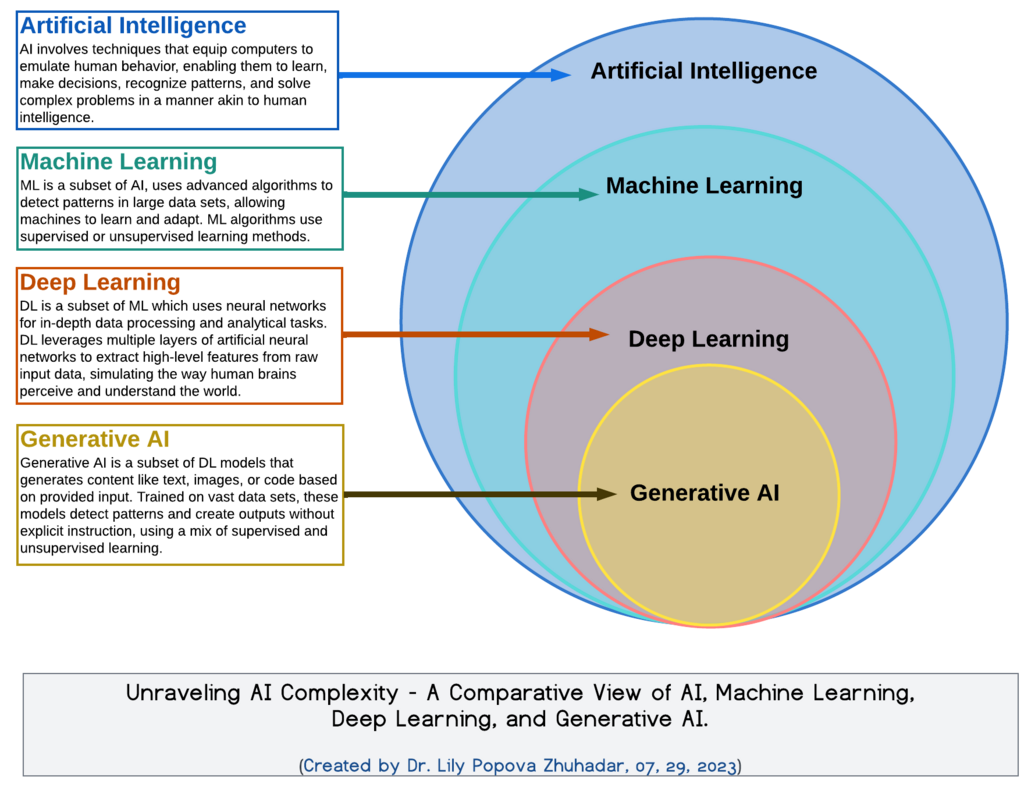
Machine Learning (ML) is a subset of AI where systems learn from data to identify patterns and make decisions without being explicitly programmed. Instead of writing code that says, "If you see A, do B," you feed the machine thousands of examples. It then learns the relationship between A and B on its own. This is the engine behind recommendation systems on streaming services and fraud detection at your bank.
Natural Language Processing (NLP) is another branch of AI that gives computers the ability to understand, interpret, and generate human language. If you've ever used a chatbot, a voice assistant like Siri or Alexa, or a translation app, you've interacted with NLP.
AI's Journey into Business
The concepts behind AI have been around since the 1950s, but for decades, they were mostly theoretical. The computers weren't powerful enough, and there wasn't enough digital data to make AI practical for most businesses.
That changed dramatically in the 21st century. The explosion of the internet, the rise of cloud computing, and the development of more powerful processors created the perfect environment. Suddenly, companies had access to vast amounts of data and the affordable computing power needed to analyze it.
Early business applications focused on specific, narrow tasks. Banks used machine learning to score credit applications. E-commerce sites used it to recommend products. These systems were effective because they solved a clear problem and delivered a measurable return on investment.
The key shift was moving from AI as a research project to AI as a business tool.
Now, AI is becoming more integrated into core business operations. It's not just a niche tool for data scientists; it's a technology that can enhance almost any part of an organization.
How AI Is Used Today
AI is no longer a futuristic concept. It's actively reshaping industries by automating processes, generating insights, and creating new customer experiences. Let's look at a few examples across different sectors.
Retail and E-commerce: AI powers personalized marketing, where ads and promotions are tailored to individual shoppers. It also optimizes supply chains by predicting demand for products, preventing stockouts, and reducing waste. Inventory management, once a manual chore, is now often handled by AI systems that can track items from the warehouse to the customer's door.
Finance: Banks use AI to detect fraudulent transactions in real-time, saving billions of dollars each year. Algorithmic trading systems can analyze market conditions and execute trades faster than any human. AI-powered chatbots handle customer service inquiries, freeing up human agents to deal with more complex issues.
Healthcare: In medicine, AI helps analyze medical images like X-rays and MRIs to spot signs of disease that a human radiologist might miss. It can also predict which patients are at high risk for certain conditions, allowing for preventative care. Pharmaceutical companies use AI to accelerate the long and expensive process of drug discovery.
Manufacturing: AI is at the heart of predictive maintenance. By analyzing data from sensors on factory equipment, AI can predict when a machine is likely to fail. This allows companies to perform repairs before a breakdown occurs, avoiding costly downtime.
AI is not just a technological advancement; it's a strategic tool for businesses seeking to thrive in today’s world.
These applications demonstrate how AI enhances efficiency and decision-making. By taking over repetitive, data-intensive tasks, AI allows people to focus on more strategic and creative work.
What is the fundamental principle that enables most modern AI systems to perform their tasks?
A manufacturing company uses sensors on its machinery to collect performance data. An AI system analyzes this data to predict when a part is likely to fail so it can be replaced beforehand. This application is best described as: