AI Strategy for Business Leaders
Understanding AI Fundamentals
What Is AI, Really?
Artificial intelligence is about making computers smart. Not just fast at calculating, but capable of tasks that usually require human intelligence. This includes things like learning from experience, understanding language, recognizing objects, and making decisions.
Think of it like this: a traditional computer program follows a strict set of instructions written by a human. If it sees condition X, it does action Y. An AI system, on the other hand, can be given a goal and a set of data, and it can figure out its own path to achieve that goal. It learns patterns and makes predictions, much like we do.
At its core, AI is the science of creating systems that can perceive their environment, think, learn, and take action to achieve goals.
A Quick Trip Through Time
The idea of intelligent machines isn't new. It has roots in mid-20th century science fiction and early computer science. The term "artificial intelligence" was first coined at a conference in 1956. Early AI research focused on creating systems that followed complex, hand-coded rules to solve problems, like playing chess.
For decades, progress was slow. The real breakthrough came with a shift in approach. Instead of trying to program intelligence rule by rule, researchers focused on creating systems that could learn from vast amounts of data. This approach, called machine learning, powers most of the AI we use today.
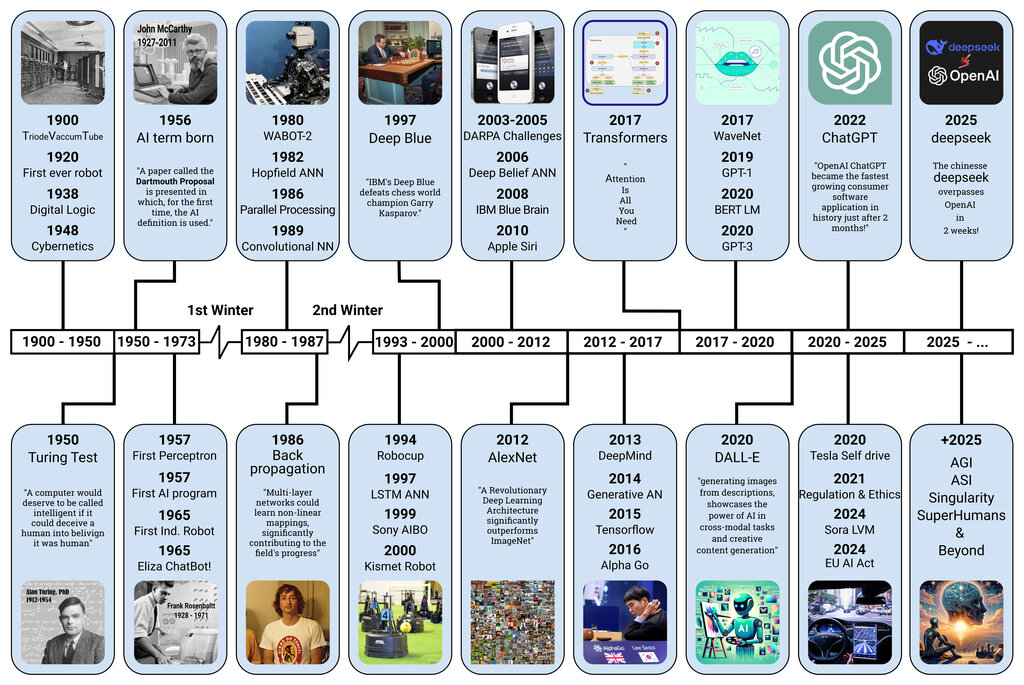
Recent advances in computing power and the availability of massive datasets have fueled the rise of even more sophisticated techniques, like deep learning and generative AI, bringing us the powerful tools we see today.
The AI Family Tree
AI isn't a single technology; it's a broad field with several key branches. Understanding how they relate to each other helps clarify what people mean when they talk about AI.
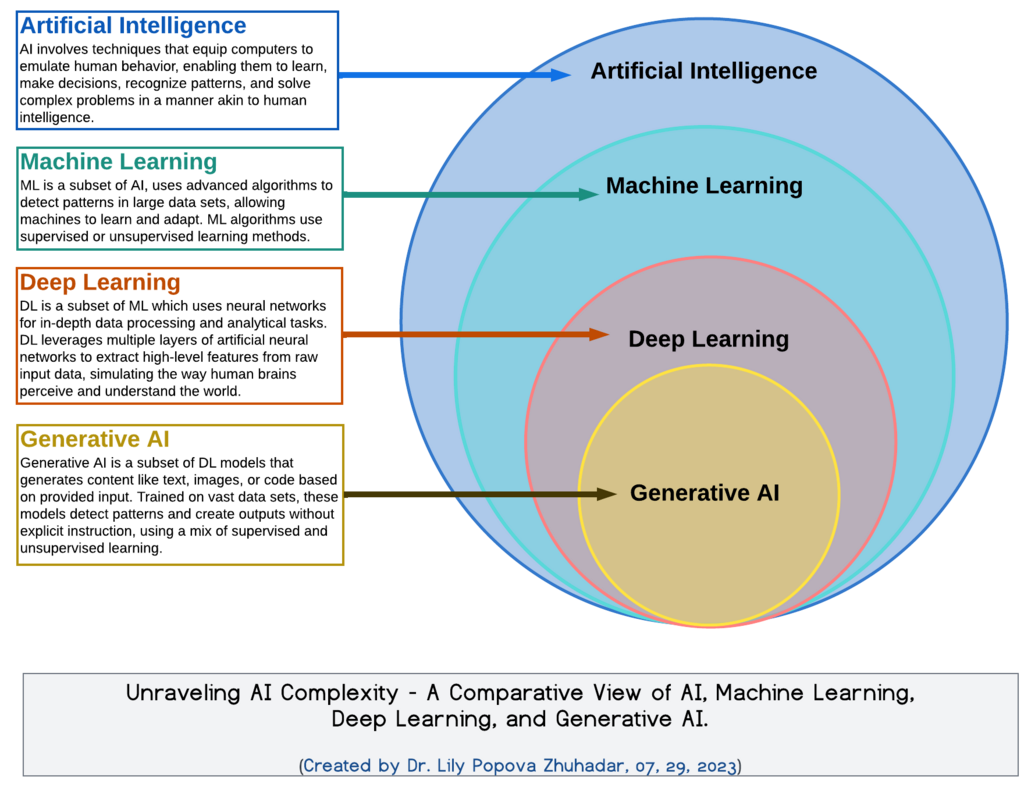
Here's a simple breakdown:
- Artificial Intelligence (AI): This is the parent category, the overall concept of intelligent machines.
- Machine Learning (ML): A subset of AI. Instead of being explicitly programmed, ML systems are trained on data to find patterns and make predictions. Your email's spam filter is a classic example. It learns what spam looks like based on thousands of examples.
- Deep Learning (DL): A subset of machine learning that uses complex, multi-layered structures called neural networks. Deep learning is especially powerful for tasks like recognizing images or understanding speech.
- Generative AI: A type of deep learning that can create new, original content. This includes generating text, images, music, or code that is similar to the data it was trained on.
Capabilities and Limitations
AI excels at specific tasks, particularly those involving pattern recognition in large datasets. It can analyze medical scans to spot anomalies, predict customer purchasing behavior, and optimize complex supply chains. It's incredibly fast, scalable, and can operate 24/7 without getting tired.
AI's strength lies in its ability to process information at a scale and speed that is impossible for humans.
However, AI has significant limitations. It lacks common sense and a true understanding of the world. An AI might identify a cat in a photo with 99% accuracy but won't know what a cat is—that it's a living animal that purrs and likes to nap. It relies entirely on the data it was trained on, which means it can inherit and even amplify biases present in that data.
AI is a tool, not a replacement for human judgment. It struggles with tasks requiring deep creativity, emotional intelligence, or complex ethical reasoning. The best results come when human expertise is combined with AI's analytical power.
AI as a Strategic Partner
For business leaders, the most powerful way to think about AI is as a strategic advisor. It's a partner that can sift through enormous amounts of information to uncover insights that would otherwise remain hidden.
By analyzing market trends, customer feedback, and internal operations, AI can help you make more informed decisions. It can identify new market opportunities, highlight operational inefficiencies, or forecast future demand with greater accuracy. This doesn't mean letting the AI make the final call. It means using its output to enhance your own strategic thinking.
For AI to become part of the strategic fabric, leaders across the organization (including the CEO) must understand its principles, limitations and ethical implications.
Integrating AI into your strategy isn't about replacing people; it's about augmenting their abilities. It frees up your team from repetitive data analysis to focus on what humans do best: creativity, collaboration, and making the final, nuanced decision.
Now, let's test your understanding of these core concepts.
What is the primary characteristic that distinguishes an AI system from a traditional computer program?
Which statement accurately describes the relationship between Artificial Intelligence (AI), Machine Learning (ML), and Deep Learning (DL)?
Having a solid grasp of these fundamentals is the first step toward effectively leveraging AI in any business context.