AI Retrieval-Augmented Generation Techniques
Introduction to RAG
Giving AI an Open Book
Large language models (LLMs) are powerful, but they have a fundamental limitation: they only know what they learned during their training. Their knowledge is frozen in time. If an LLM was trained on data from last year, it won't know about yesterday's news. It also doesn't have access to private, specialized information, like a company's internal product manuals.
This is where Retrieval-Augmented Generation, or RAG, comes in. RAG is a technique that connects an LLM to an external knowledge source, giving it on-demand access to timely and relevant information.
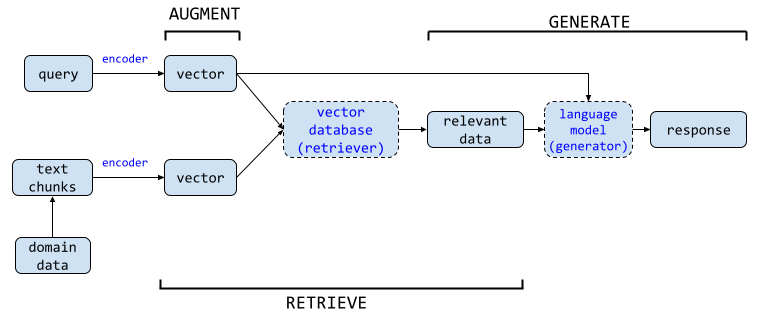
Retrieval-Augmented Generation (RAG) is an AI framework that connects a language model to an external knowledge repository, allowing the model to fetch and include relevant information when generating an answer.
Think of it like an open-book exam. Instead of trying to recall everything from memory, the LLM can first look up relevant facts from a trusted source—the “retrieval” step. Then, it uses that information to formulate a comprehensive, accurate answer—the “generation” step. This two-step process ensures the final response is grounded in facts, not just the model's memorized training data.
The Benefits of RAG
Integrating a retrieval step before generation provides several key advantages. The most significant is a major boost in accuracy. By grounding responses in external documents, RAG helps reduce the chances of an LLM “hallucinating”—making up plausible-sounding but incorrect information.
RAG also keeps the AI's knowledge current. An LLM connected to a live database or the internet can provide answers based on the very latest information, something a static model can't do. Finally, it allows for deep specialization. A company can connect an LLM to its own private knowledge base, creating a powerful internal tool that understands its specific products, policies, and data.
With RAG, an LLM's response is not just a guess based on old patterns; it's an informed answer built on specific, up-to-date facts.
RAG in the Real World
RAG is already transforming how we interact with AI. Here are a few common applications:
-
Advanced Q&A Systems: Customer support chatbots can use RAG to pull answers directly from product manuals or help articles, providing customers with precise, helpful instructions.
-
Research Assistants: A RAG system can scan thousands of recent academic papers or financial reports to synthesize the latest findings on a given topic, saving researchers hours of manual work.
-
Content Creation Tools: A marketing assistant powered by RAG can access real-time market data and competitor analysis to help draft relevant and timely blog posts or social media updates.
In each case, RAG makes the AI more reliable, relevant, and trustworthy by ensuring its generated text is based on a solid foundation of retrieved information.
Ready to test your knowledge?
What is the primary problem that Retrieval-Augmented Generation (RAG) is designed to solve for Large Language Models (LLMs)?
A customer support chatbot uses RAG to pull answers directly from the company's latest product manuals. What is the most significant advantage of this approach?
By connecting generative AI to external knowledge, RAG creates a smarter and more dependable tool for a wide range of tasks.