AI RAG Memory and Context Explained
Introduction to RAG
Giving AI a Library Card
Large language models (LLMs) are powerful. They can write essays, generate code, and answer complex questions. But they have a fundamental limitation: their knowledge is frozen in time, based only on the data they were trained on. They can't look things up on the internet or access private, up-to-date information. This can lead to them providing outdated or even incorrect answers, a problem often called "hallucination."
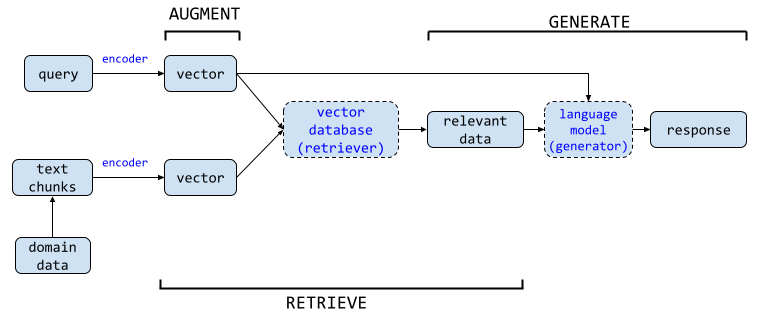
Retrieval-Augmented Generation, or RAG, is a technique designed to solve this problem. Think of a standard LLM as a brilliant scholar who has memorized an entire library but is now locked inside. They can't read any new books. RAG gives that scholar a library card and a super-fast librarian. When you ask a question, the librarian (the retriever) dashes into a current, external library of information, finds the most relevant passages, and hands them to the scholar (the generator). The scholar then uses this fresh information to craft a well-informed, accurate answer.
Retrieval-Augmented Generation (RAG) is an AI framework that connects a language model to an external knowledge repository, allowing the model to fetch and include relevant information when generating an answer.
This process happens in two main phases. First is retrieval, where the system searches an external knowledge base—like a company's internal documents, a collection of recent news articles, or a technical manual—for information relevant to the user's prompt. Second is generation, where the LLM takes the retrieved information and uses it as context to generate its response. This grounds the model's answer in specific, verifiable facts.
Why It's a Game-Changer
Integrating a retrieval step provides several key benefits that make LLMs dramatically more useful and reliable.
First, it improves accuracy and reduces hallucinations. By grounding the LLM's response in external data, RAG makes it much less likely to invent facts. The model is prompted to use the provided information, not just its own memorized training data.
Second, RAG gives LLMs access to current information. A model trained in 2022 has no knowledge of events from 2024. With RAG, it can retrieve up-to-the-minute information from a connected database and provide relevant answers about recent topics.
Finally, it allows for domain-specific expertise. An organization can connect an LLM to its own private knowledge base, like internal wikis, customer support logs, or technical documentation. This turns a general-purpose LLM into a specialized expert for that organization's needs, without the massive cost and complexity of retraining the entire model.
The Hurdles of RAG
While RAG is powerful, it isn't a magic bullet. Implementing a robust RAG system comes with its own set of challenges.
The most significant hurdle is the quality of the retrieval. The entire system hinges on the retriever's ability to find the correct and most relevant information. If it fetches irrelevant, outdated, or confusing documents, the LLM will likely produce a poor response. It’s a classic case of "garbage in, garbage out."
Integrating the two parts—the retriever and the generator—can also be complex. Deciding how much information to pass to the LLM and how to format it for the best results requires careful engineering and experimentation. Furthermore, running a retrieval system in addition to the LLM adds computational overhead, which can increase costs and slow down response times.
Implementing Retrieval-Augmented Generation (RAG) systems is inherently complex, requiring deep understanding of data, use cases, and intricate design decisions.
Despite these challenges, RAG represents a major step forward. It makes AI systems more trustworthy, knowledgeable, and adaptable by connecting them to the ever-changing world of information.
Let's test your understanding of Retrieval-Augmented Generation.
What is the primary problem with standard Large Language Models (LLMs) that Retrieval-Augmented Generation (RAG) is designed to solve?
In the analogy of an LLM as a brilliant scholar locked in a library, what role does the 'retriever' component of a RAG system play?