AI Protocols Explained
Introduction to AI Protocols
The Rules of the Road for AI
When you talk to a friend, you follow unwritten rules. You take turns speaking, use a shared language, and maybe nod to show you're listening. These social rules make conversation possible. Computers and AI systems need rules, too. They're just more formal. These rules are called protocols.
Protocol
noun
A set of rules and standards that govern how data is transmitted, received, and interpreted between different systems or components.
Think about browsing the internet. You type a website address, and the page appears. You don't need to know how your computer requested the page or how the server sent it back. Protocols handle all that complexity behind the scenes, ensuring every device speaks the same digital language. For AI, protocols do the same job. They are the essential instructions that allow different AI components, or even separate AI systems, to communicate and work together smoothly.
Protocols are sets of rules and standards that define how data is transmitted and received across the network.
Why Standardization Matters
Imagine trying to plug an American appliance into a European wall socket. It won't work. The plug and the outlet follow different standards. You need an adapter—a device that translates between the two—to make a connection. Without standard protocols, the world of AI would be like a world with a million different types of electrical outlets and no adapters. Each AI system would be an isolated island, unable to share information or collaborate with others.
Standardization creates a common ground. It ensures that an AI developed by one company can understand and interact with data or tools from another, just like how you can send an email from a Gmail account to a Yahoo account without a problem.
This ability for different systems to work together is called interoperability. When developers agree on a standard protocol, they can build specialized AI tools that plug into a larger ecosystem. A team in one country could create an AI that excels at analyzing medical images, while another team elsewhere builds an AI for diagnosing diseases. Thanks to a shared protocol, the image-analyzing AI can send its findings directly to the diagnostic AI, leading to faster and more accurate results.
Enabling Complex Systems
Modern AI applications are rarely built from a single, monolithic block of code. They are often complex systems made of many smaller, specialized parts that need to coordinate their actions. Think of a self-driving car. It has components for vision (seeing the road), decision-making (planning a route), and control (steering and braking). For the car to function, these components must communicate instantly and reliably. Protocols make this possible.
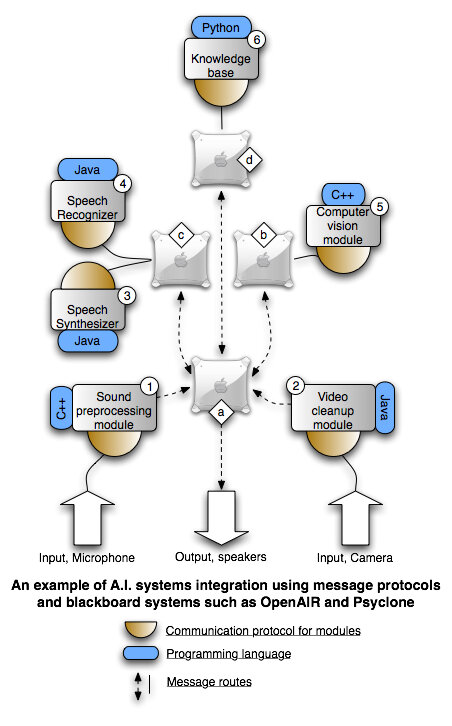
Protocols act as the nervous system of an AI application. They carry signals between different parts, ensuring that data from the 'eyes' of the car gets to the 'brain' in a format it can understand. This allows developers to build sophisticated, modular systems where each component can be improved or replaced without breaking the entire application.
What is the primary function of a protocol in AI systems?
The text uses the analogy of an American appliance and a European wall socket to explain why AI systems would be like 'isolated islands' without a key concept. What is this concept?
By establishing a common language, protocols remove barriers to collaboration and innovation, allowing for the creation of more powerful and integrated AI solutions.