AI Prompts and Agentic AI Explained
Introduction to Artificial Intelligence
What Is Artificial Intelligence?
Artificial Intelligence, or AI, is the science of making machines that can think like humans. It's about creating systems that can learn from experience, reason through problems, and correct their own mistakes. Think of it like teaching a child. At first, you show them examples. A cat is a small, furry animal with pointy ears and a tail. After seeing enough cats, the child starts to recognize them on their own. They've learned the pattern.
AI systems work in a similar way. They are trained on vast amounts of data—images, text, numbers—until they can identify patterns and make decisions. This process involves three key abilities:
- Learning: Acquiring information and rules for using it.
- Reasoning: Using those rules to reach approximate or definite conclusions.
- Self-correction: Continuously refining their processes to become more accurate over time.
AI isn't a single technology. It's a broad field of computer science that encompasses many different methods and applications, from a simple spam filter in your email to complex systems that can pilot a spacecraft.
A Brief History of AI
The dream of creating intelligent machines is ancient, but the scientific pursuit of AI began in the 1950s. A pivotal moment was the Dartmouth Workshop in 1956, where the term "artificial intelligence" was officially coined. Early researchers were optimistic, believing that a machine as intelligent as a human being was just a few decades away.
However, progress was slower than expected. The complexity of creating true intelligence led to periods known as "AI winters," when funding dried up and public interest waned. But breakthroughs continued quietly. In the last couple of decades, two key factors have reignited the field: the availability of massive amounts of data and the development of powerful computers that can process it all.
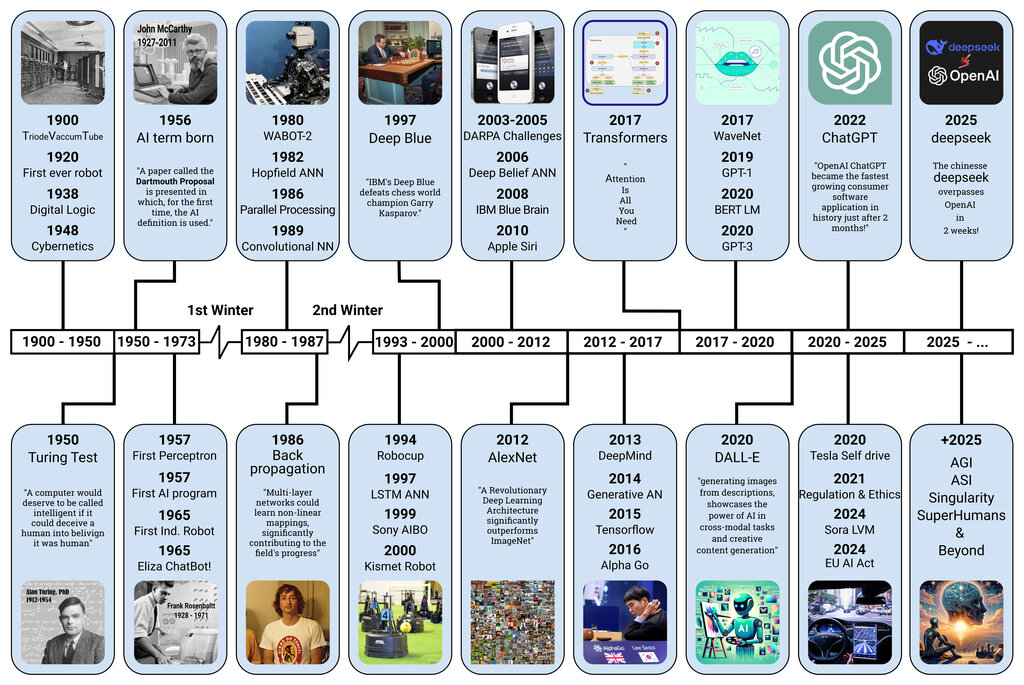
This combination of big data and powerful hardware has fueled the rapid advances we see today, from self-driving cars to generative models that can create art and text.
The Three Types of AI
AI is often discussed as a single entity, but it's more accurate to think of it in three distinct categories based on its capabilities.
Artificial Narrow Intelligence (ANI)
noun
This is AI that is specialized for one specific task. It's sometimes called "Weak AI."
All the AI we use today is ANI. Your smart assistant, the recommendation engine on a streaming service, and facial recognition software are all examples of narrow AI. They can perform their designated task incredibly well, often better than humans, but they can't operate outside of it. You can't ask your chess-playing AI to predict the weather.
Artificial General Intelligence (AGI)
noun
This is the type of AI that possesses the ability to understand, learn, and apply its intelligence to solve any problem, much like a human being. It's sometimes called "Strong AI."
AGI is still theoretical. It doesn't exist yet. Building an AI with the common sense, creativity, and adaptability of the human mind is a monumental challenge.
Artificial Superintelligence (ASI)
noun
An intellect that is much smarter than the best human brains in practically every field, including scientific creativity, general wisdom, and social skills.
This is the final, hypothetical stage of AI development. An ASI would surpass human intelligence in every way. The potential benefits and risks of such a creation are the subject of intense debate among scientists and ethicists.
Building Responsible AI
As AI becomes more integrated into our daily lives, its ethical and societal impacts become more important. Building AI responsibly means thinking carefully about the challenges it presents.
One of the biggest challenges is algorithmic bias. An AI system is only as good as the data it's trained on. If the data reflects existing societal biases, the AI will learn and even amplify them. For example, if a hiring AI is trained on historical data from a company that predominantly hired men, it might learn to favor male candidates, regardless of their qualifications.
Privacy is another major concern. Many AI systems require vast amounts of personal data to function, raising questions about how that data is collected, used, and protected. There's also the issue of accountability. When a self-driving car gets into an accident, who is responsible? The owner, the manufacturer, or the AI programmer?
These questions don't have easy answers. They are part of an ongoing conversation as we navigate the development of this powerful technology.
The societal impacts are equally profound. AI has the potential to automate many jobs, which could lead to significant economic shifts. At the same time, it can create new jobs and solve some of the world's most pressing problems in medicine, climate change, and education. The key is to manage this transition thoughtfully, ensuring that the benefits of AI are shared broadly and its risks are minimized.
To better understand these concepts, let's test your knowledge.
What are the three key abilities that an AI system uses to function, as described in the text?
The AI that powers your smart assistant and provides streaming service recommendations is an example of which category?
Understanding these core ideas is the first step in grasping the power and potential of Artificial Intelligence.