AI Program Management Essentials
AI Program Management Fundamentals
What is AI Program Management?
Managing a traditional software project is like following a recipe. You have a list of ingredients (features) and a set of instructions (a plan). If you follow them correctly, you end up with a predictable result. Managing an AI program, however, is more like embarking on a scientific experiment. You have a hypothesis, but the outcome is uncertain, and discovery is part of the process.
AI Program Management is the practice of guiding AI initiatives from an initial idea to a deployed product that provides real value, navigating the unique uncertainties and complexities of AI along the way.
This isn't just about overseeing a single project. A program manager might steer a portfolio of AI projects, ensuring they align with the company's broader goals. The scope can range from integrating a single AI-powered feature, like a recommendation engine, to leading a company-wide transformation that uses AI to reinvent core business processes.
How AI Projects Differ
The experimental nature of AI changes the rules of project management. Unlike building a bridge where the physics are known, building an AI model involves coaxing performance from data. Success isn't guaranteed, and the path is rarely linear.
| Aspect | Traditional Project Management | AI Program Management |
|---|---|---|
| Outcome | Defined and predictable | Probabilistic and uncertain |
| Data | Often a requirement or output | The core asset that defines the product |
| Process | Linear and sequential (e.g., Waterfall) | Highly iterative and experimental |
| Success | Measured by on-time, on-budget delivery | Measured by model performance and business impact |
In traditional projects, the requirements are fixed upfront. For AI projects, the performance of the model is a key variable. You might not know if your data is good enough or if an algorithm will work until you're deep into the development phase. This requires a flexible approach that embraces iteration and learning.
The AI Lifecycle
AI programs follow a distinct lifecycle that revolves around data and experimentation. While the stages might look familiar, the activities within them are unique to AI.
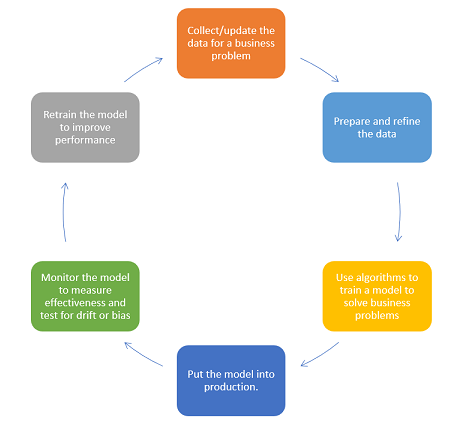
Here's a breakdown of the key phases:
-
Ideation & Data Collection: It starts with a business problem. Is AI the right solution? If so, what data do we need? This phase is about defining the goal and assessing the feasibility, with a heavy focus on data availability and quality.
-
Development & Training: This is the experimental core of the project. Data scientists and engineers clean the data, build models, and train them to perform a task. It's a cycle of building, testing, and refining until the model's performance is acceptable.
-
Deployment: Once a model performs well in the lab, it needs to be integrated into a real product or business process. This involves software engineering to make the AI accessible, reliable, and scalable.
-
Monitoring & Maintenance: An AI model isn't a one-and-done product. Its performance can degrade over time as real-world data changes. This final stage involves monitoring the model, collecting new data, and periodically retraining it to maintain its accuracy and relevance.
It Takes a Village
No AI project succeeds in a silo. The complexity and broad impact of AI demand deep collaboration across many different teams. A program manager's key role is to act as the conductor, ensuring all sections of the orchestra are playing in harmony.
Success in AI requires blending technical expertise with business acumen, ethical oversight, and a sharp focus on the user's needs.
Key collaborators typically include:
- Data Scientists: The experts who build and train the models.
- Engineers: The builders who deploy the model into a production environment.
- Product Managers: The strategists who define the user problem and the product vision.
- Business Stakeholders: The leaders who own the business goals and define success.
- Legal & Ethics Teams: The guardians who ensure the AI is used responsibly, fairly, and in compliance with regulations.
Each group brings a critical perspective. Business leaders provide context, data scientists provide the model, and engineers make it work. Without tight collaboration, a technically brilliant model might solve the wrong problem or never make it out of the lab.
Managing a traditional software project is like following a recipe, while managing an AI program is more like...
In which phase of the AI project lifecycle does the core experimentation of building, testing, and refining models occur?
Managing AI programs means guiding these diverse teams through an uncertain, iterative process. It's about framing the right questions, embracing experimentation, and connecting deep technical work to tangible business results.