AI Product Management Mastery
Introduction to AI Product Management
What is an AI Product Manager?
A product manager (PM) steers the development of a product, making sure it solves a real user problem and meets business goals. An AI product manager does the same, but for products powered by artificial intelligence. This adds new layers of complexity and opportunity.
Instead of just defining features, an AI PM works with vast amounts of data, navigates the uncertainties of machine learning models, and translates complex technical capabilities into real-world value. They are the crucial link between the data science team, engineers, and the overall business strategy.
An AI Product Manager bridges the gap between technical teams and business stakeholders, ensuring that AI products align with company goals.
Their scope goes beyond a typical feature roadmap. It involves identifying opportunities where AI can create a unique advantage, sourcing the right data to build models, and ensuring the final product is reliable, ethical, and understandable to its users.
Not Your Typical PM Job
While the core of product management remains the same—solving user problems—the 'how' changes significantly with AI. Traditional software is deterministic; you code specific rules, and the software follows them every time. AI is probabilistic. You train a model on data, and it learns to make predictions or decisions. This fundamental difference changes the job.
| Aspect | Traditional Product Management | AI Product Management |
|---|---|---|
| Core Logic | Deterministic (Rule-based) | Probabilistic (Data-driven) |
| Development | Build features based on specs | Experiment with models and data |
| Data Needs | Supports analytics and decisions | Is the core component of the product |
| Key Metric | Feature usage, conversion | Model accuracy, precision, recall |
| User Feedback | Informs the next set of features | Can be used to retrain and improve the model |
Because AI products are built on data, the discovery process is different. A traditional PM might start with a user problem. An AI PM often starts by looking at the available data to see what problems can be solved.
AI PMs need to approach AI initiatives differently by exploring data first to identify and vet business opportunities.
Connecting AI to Business Goals
Building an impressive AI model isn't the goal. The goal is to solve a business problem. A model that can predict customer churn with 99% accuracy is useless if the company has no strategy to act on those predictions. AI initiatives must be tied directly to clear business objectives.
This alignment starts with asking the right questions:
- What business outcome are we trying to achieve? (e.g., reduce costs, increase revenue, improve customer satisfaction)
- How can a prediction or automation help us reach that outcome? (e.g., by predicting which customers will leave, we can offer them an incentive to stay)
- Do we have the data needed to make that prediction? (e.g., do we have historical data on customers who have left and those who stayed?)
To effectively implement AI, organizations must develop a clear, strategic plan that aligns AI initiatives with broader business objectives.
An AI PM constantly translates between the technical capabilities of the model and the strategic needs of the business, ensuring that the team's effort is focused on what truly matters.
A Quick Look at the Technology
You don't need to be a data scientist to be an AI PM, but you do need to speak the language. Understanding the basic concepts helps you grasp the possibilities and limitations of what your team can build.
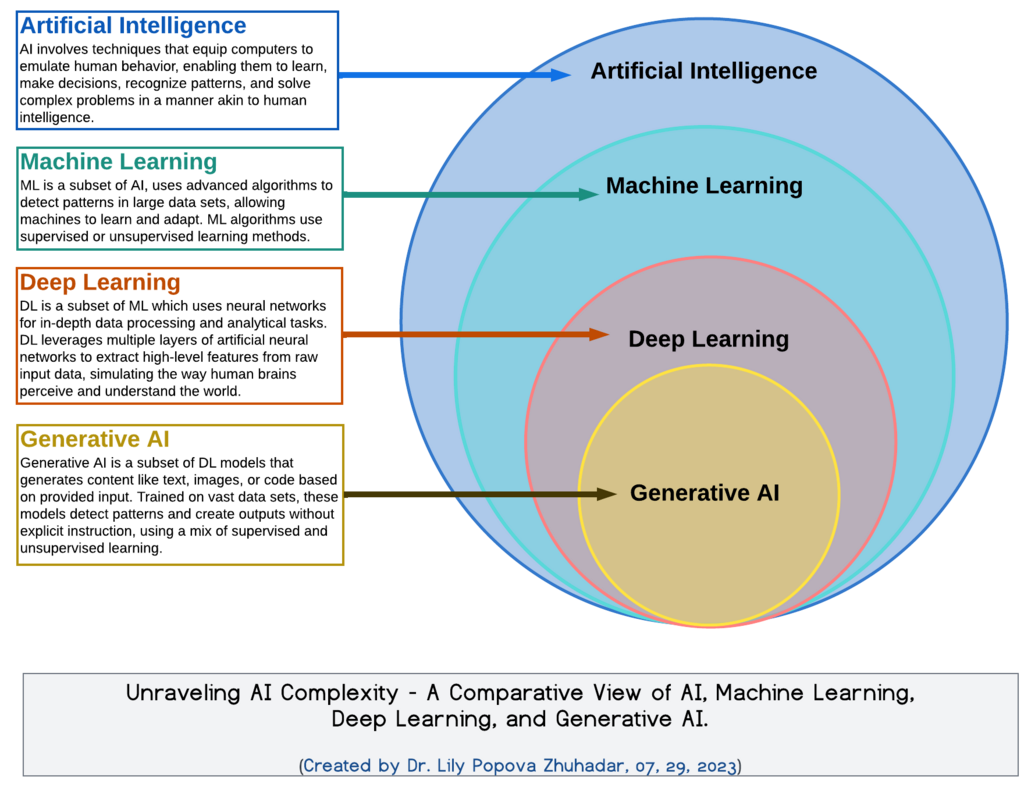
Here’s a simple breakdown of the key terms:
- Artificial Intelligence (AI): The broadest term, referring to any technique that enables computers to mimic human intelligence.
- Machine Learning (ML): A subset of AI. Instead of being explicitly programmed, ML systems use data to learn and improve from experience. This is the engine behind most modern AI products, from recommendation engines to spam filters.
- Deep Learning (DL): A specialized type of machine learning that uses complex, multi-layered neural networks (inspired by the human brain) to learn from vast amounts of data. It powers things like image recognition and natural language processing.
- Generative AI: A subset of deep learning. These models don't just classify or predict; they create new content, like text, images, or code. ChatGPT is a famous example.
An AI PM's job is to understand which of these tools is the right one for the problem at hand and to guide its development from an idea into a valuable product.