AI Product Management Masterclass
AI and ML Basics
AI and Machine Learning
Artificial Intelligence (AI) is a broad field of computer science focused on creating machines that can perform tasks that typically require human intelligence. This could be anything from understanding language to recognizing objects in a photo.
Machine Learning (ML) is a specific branch of AI. Instead of being explicitly programmed to perform a task, a machine learning system learns from data. It identifies patterns and makes decisions with minimal human intervention. Think of AI as the entire universe of intelligent machines, and ML as a star system within it.
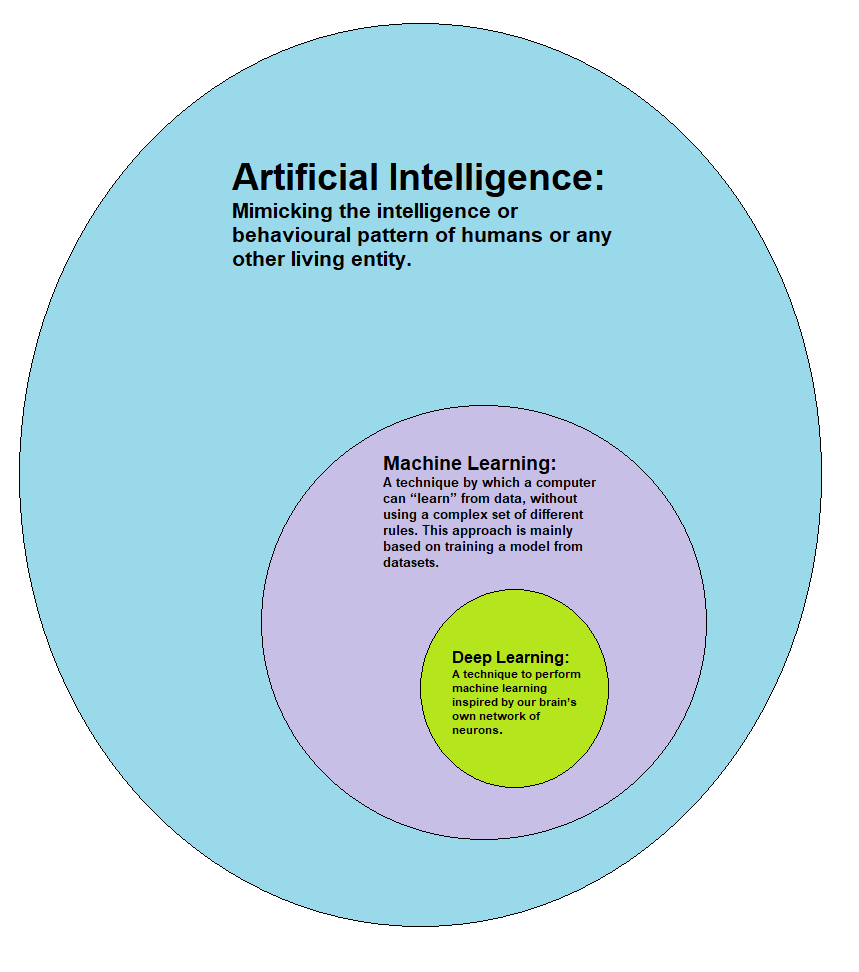
This relationship is key. All machine learning is AI, but not all AI is machine learning. Early AI systems, for instance, often relied on complex sets of hand-coded rules, not on learning from data.
AI is a broad field that encompasses machine learning, deep learning, natural language processing, computer vision, and more.
How Machines Learn
Machine learning models learn in different ways, depending on the data they're given and the problem they're trying to solve. The three main approaches are supervised, unsupervised, and reinforcement learning.
Supervised learning is like studying with an answer key. The machine learns from data that is already labeled with the correct outcomes.
Imagine you want to build a system that can tell you if a picture contains a cat or a dog. In supervised learning, you would feed the algorithm thousands of pictures, each one labeled 'cat' or 'dog.' The algorithm studies these examples to learn the features of each animal. After training, when you show it a new, unlabeled picture of a cat, it can correctly predict what it is.
Spam filters in your email work this way. They are trained on a massive dataset of emails that have already been marked as 'spam' or 'not spam' by people.
Unsupervised learning is about finding hidden patterns in data without any labels. It's like being asked to sort a box of mixed Lego bricks by shape and color without being told what the categories are.
The goal here is exploration. The algorithm sifts through the data and groups similar items together. For example, an online retailer might use unsupervised learning to group customers with similar buying habits. This creates customer segments for targeted marketing, without the need to define those segments in advance.
Reinforcement learning involves an 'agent' that learns by interacting with an environment. It's a process of trial and error, driven by rewards.
Think about teaching a dog a new trick. When the dog performs the correct action, you give it a treat (a reward). When it does the wrong thing, it gets nothing. Over time, the dog learns to perform the action that maximizes its treats.
Reinforcement learning algorithms work similarly. An algorithm, or 'agent', takes actions in an environment to maximize a cumulative reward. This is the technology behind AI that can play complex games like Go or Chess, and it's also used in robotics and optimizing traffic flow.
Neural Networks and Deep Learning
Some of the most powerful machine learning models are built using neural networks, which are computing systems inspired by the structure of the human brain.
Neural Network
noun
A computational model inspired by the brain, consisting of interconnected nodes, or 'neurons', that process and transmit information.
A simple neural network has an input layer, an output layer, and at least one 'hidden' layer in between. Each connection between neurons has a weight, which is adjusted during the training process. This allows the network to learn complex patterns.
Deep learning is simply machine learning that uses neural networks with many hidden layers—hence the term 'deep.' Traditional machine learning algorithms, like linear regression or decision trees, don't have this layered structure. They often work well with structured, tabular data but can struggle with complex data like images or audio.
| Feature | Traditional ML | Deep Learning |
|---|---|---|
| Structure | Simpler algorithms (e.g., decision trees) | Multi-layered neural networks |
| Data Needs | Works well with smaller datasets | Requires large amounts of data |
| Hardware | Can run on standard CPUs | Often requires powerful GPUs |
| Use Cases | Price prediction, fraud detection | Image recognition, natural language processing |
The depth of these networks allows them to learn hierarchical features. For example, in image recognition, the first layer might learn to detect simple edges, the next layer might combine those edges to detect shapes like eyes or noses, and a deeper layer might combine those shapes to recognize a face.
This ability to learn from massive, unstructured datasets is what has fueled many of the recent breakthroughs in AI, from self-driving cars to advanced language models.
Now, let's test your understanding of these core concepts.
All Artificial Intelligence systems use Machine Learning.
An email system is trained on a large dataset of messages pre-labeled as 'spam' or 'not spam' to learn how to filter new, incoming mail. What type of machine learning is this?
With these fundamentals in place, you have a solid foundation for understanding how AI products are built and managed.