AI Product Management Essentials
Introduction to AI Product Management
The AI Product Manager
Product management has always been about understanding customer needs and guiding a product from an idea to a successful launch. But what happens when that product is powered by artificial intelligence? The core mission stays the same, but the playbook changes.
AI Product Management is the practice of building, launching, and managing products that have AI at their core. These aren't just apps with a few clever features. They are systems that learn, adapt, and make decisions, often in ways that are not entirely predictable. An AI Product Manager, or AI PM, is the person who steers this complex process.
An AI Product Manager bridges the gap between technical teams and business stakeholders, ensuring that AI products align with company goals.
They must understand what AI can and can't do, without necessarily being a machine learning engineer. Their job is to identify real-world problems that AI can solve, articulate a vision for the product, and work with data scientists, engineers, and designers to bring it to life. Think of them as a translator between the world of algorithms and the world of human users.
What's Different About AI Products?
Managing a traditional software product is like building with LEGOs. You have defined bricks, you know how they fit together, and you can create a detailed blueprint. The outcome is predictable.
Managing an AI product is more like gardening. You choose the right seeds (data), plant them in the right soil (algorithms), and provide the right conditions (computing power). You can't predict the exact shape of each plant, but you guide its growth toward a desired outcome. This fundamental difference creates a unique set of challenges and opportunities.
| Feature | Traditional Product Management | AI Product Management |
|---|---|---|
| Core Component | Code and user interfaces | Data and models |
| Development | Deterministic and predictable | Probabilistic and experimental |
| Success Metrics | Feature usage, user retention | Model accuracy, prediction quality |
| User Experience | Static and rule-based | Adaptive and personalized |
Because AI products are built on data, an AI PM spends a lot of time thinking about it. Where will we get the data? Is it good quality? Is it biased? An AI model is only as good as the data it's trained on. A recommendation engine trained only on data from one demographic will not serve a diverse user base well.
AI PMs also deal with uncertainty. A traditional software feature either works or it doesn't. An AI model, however, works with probabilities. It might be 95% confident in a prediction, but there's always a chance it's wrong. Managing user expectations and designing fallback options for when the AI fails are key parts of the role.
Aligning with Business Goals
It's easy to get excited about the possibilities of AI. But a cool technology is not a product. For an AI initiative to be successful, it must be tied directly to a clear business objective.
The goal isn't just to build AI; it's to use AI to solve a customer problem and create business value.
An AI PM constantly asks questions like:
- Will this AI feature increase revenue or reduce costs?
- Does it solve a genuine pain point for our users?
- How will we measure the impact of this AI on our key business metrics?
For example, a company might want to use AI to create a personalized news feed for its users. The business objective isn't just to have a "personalized feed." It's to increase user engagement by 15% and reduce churn by 10%. The AI PM's job is to define that goal and then guide the team to build a model that can achieve it. This focus ensures that the company invests in AI projects that deliver a real return.
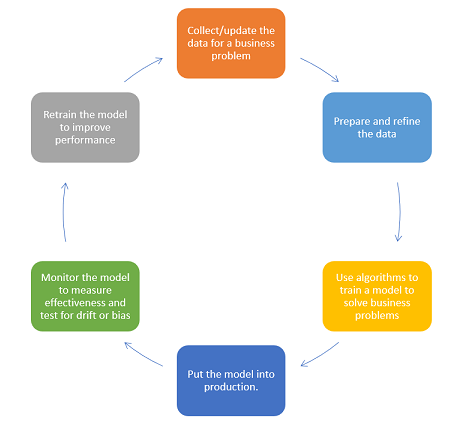
The Ethical Tightrope
With great power comes great responsibility. AI can have a profound impact on people's lives, from deciding who gets a loan to influencing what news we see. This puts ethical considerations at the very center of the AI PM's role.
Bias
noun
A systematic error in an AI system that results in unfair outcomes, such as privileging one arbitrary group of users over others.
AI PMs must be vigilant about potential harms. They need to ask tough questions about fairness, transparency, and accountability.
- Fairness: Could our model perpetuate or even amplify existing societal biases? For example, if a facial recognition system is trained primarily on images of one ethnicity, it will be less accurate for others.
- Transparency: Can we explain why our AI made a particular decision? For a user denied a credit card, simply saying "the algorithm said no" is not acceptable.
- Accountability: Who is responsible when the AI makes a mistake? The PM must establish clear processes for monitoring the system and correcting errors.
Navigating these ethical challenges isn't a one-time checklist. It's an ongoing process of discussion, testing, and thoughtful design that is woven into every stage of the product lifecycle.
Ready to check your understanding of the AI PM's role?
According to the text, what is the most significant shift in mindset for a product manager moving from traditional software to AI products?
An AI model designed to recommend candidates for a job is trained on historical data from a company where mostly men were hired for senior roles. What is the primary ethical risk an AI PM must address?
The role of an AI Product Manager combines classic product skills with a new understanding of data, probability, and ethics. It's a challenging but incredibly rewarding field, shaping the future of how we interact with technology.