AI Product Management Essentials
Introduction to AI Product Management
The AI-Powered Product
Product management has always been about solving user problems. Traditionally, that meant defining clear, step-by-step rules for how a product should behave. If a user clicks this button, that specific thing happens. It's a world of predictable inputs and outputs.
AI product management is different. It's about building products that can learn, adapt, and make decisions on their own. Instead of just following instructions, these products use artificial intelligence to analyze data, spot patterns, and deliver value in ways that weren't possible before. Think of a music app that doesn't just play songs you pick, but learns your taste and creates a perfect playlist for your morning run.
AI Product Management is the practice of managing the product lifecycle of AI-powered software, focusing on the integration of artificial intelligence to solve real-world problems and deliver value to users.
This isn't just a small change. It fundamentally shifts how products are built and managed. The focus moves from crafting static features to guiding intelligent systems.
From Rules to Learning
The biggest shift in AI product management is moving from a deterministic to a probabilistic mindset. A traditional feature is deterministic: the same input always produces the same output. An AI feature is probabilistic: it makes predictions and decisions based on what it has learned from data, so its output might have an element of uncertainty.
This is powered by a set of technologies that build on each other. At the broadest level is Artificial Intelligence (AI), the science of making machines smart. A key part of AI is Machine Learning (ML), which gives computers the ability to learn from data without being explicitly programmed. A specialized type of ML, Deep Learning, uses complex neural networks to solve even more intricate problems, like image recognition.
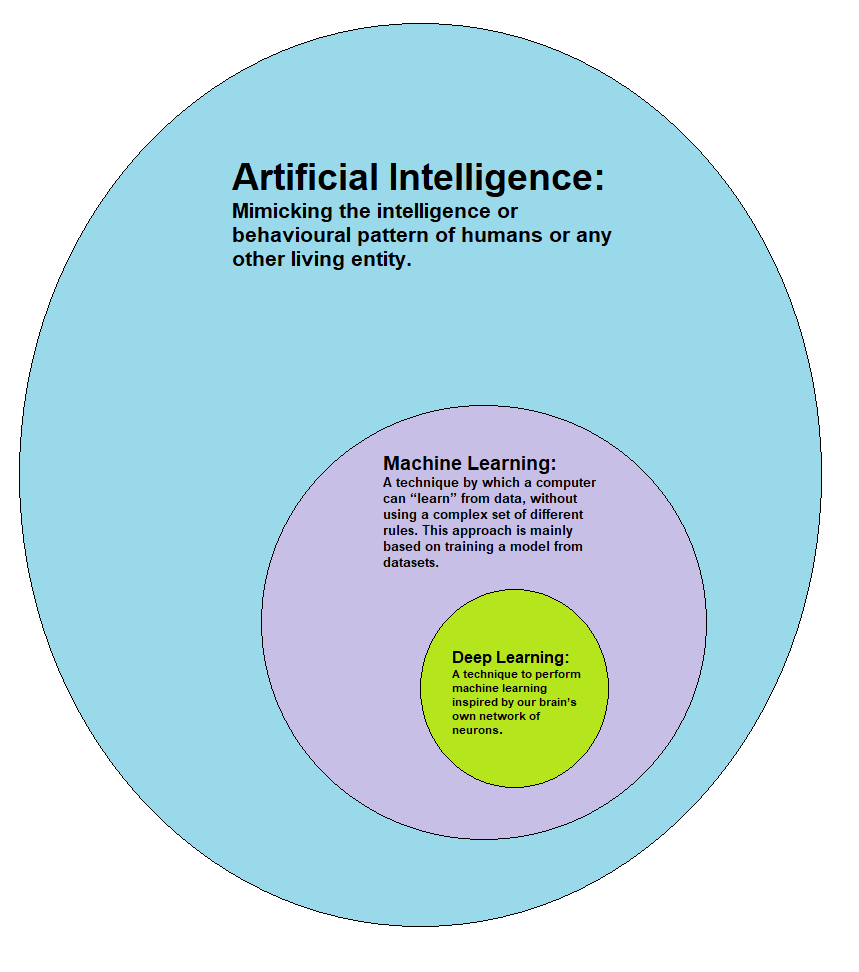
As an AI product manager, you don't need to be able to build these models yourself. But you do need to understand what they do. You'll work with technologies like:
- Machine Learning (ML): Used for tasks like recommendation engines (suggesting movies), fraud detection, and forecasting sales.
- Natural Language Processing (NLP): Allows products to understand and respond to human language, powering chatbots, translation apps, and sentiment analysis tools.
- Computer Vision: Enables products to "see" and interpret the visual world, used in everything from self-driving cars to photo tagging on social media.
Your job is to identify user problems that these technologies can solve better than a traditional, rules-based approach.
New Opportunities, New Challenges
Integrating AI opens up incredible opportunities. Products can become deeply personalized, predictive, and automated. They can anticipate a user's needs before the user is even aware of them. This allows for a new level of user experience that feels almost magical.
However, it also introduces unique challenges. Data is the lifeblood of AI, so product managers must think constantly about data acquisition, quality, and privacy. An AI model is only as good as the data it's trained on. Biased data leads to a biased product, creating ethical minefields that traditional product managers rarely faced.
Unlike a simple button, you can't always predict an AI's exact behavior. Managing an AI product means managing uncertainty and guiding a system that continuously evolves.
Furthermore, success isn't just about whether a feature works or not. It's about how well it works. Product managers need to define new metrics. Instead of just tracking clicks, you might track the accuracy of a prediction model or the user's trust in an AI-powered recommendation. This requires a deeper partnership with data scientists and engineers to define, measure, and improve the product's intelligence over time.
Welcome to the world of AI product management. It's more complex, but it's also where the most innovative products of the future are being built.