AI Product Development Mastery
AI Product Development Overview
The AI Product Journey
Building an AI product isn't like building a bridge. With a bridge, the plans are precise, the materials are known, and success means it stands firm. With AI, the process is more like gardening. You start with a seed of an idea, nurture it with data, and constantly tend to it as it grows and adapts. It's a living thing.
Because of this dynamic nature, a structured development process is essential. Without a clear lifecycle, an AI project can easily get lost in endless research, fail to solve a real user problem, or become impossible to maintain. A good process provides a map for this journey, guiding a team from a rough idea to a valuable, market-ready product.
Successful AI product management is about uncovering the right data and then figuring out how to use that data to design an innovative product.
From Idea to Iteration
The AI product development lifecycle guides a product from concept to launch and beyond. While specific methodologies vary, they generally follow a similar, cyclical path. Think of it less as a straight line and more as a loop of continuous improvement.
Ideation & Discovery: This is where it all begins. The goal is to identify a valuable problem that AI can solve. It’s not about finding a cool technology and searching for a problem. It’s about starting with a genuine user need or business challenge. A key question here is: Do we have or can we get the right data to solve this problem?
Design & Prototyping: Once a problem is defined, you design the solution. This involves more than just user interfaces. It includes defining the data strategy, outlining the desired behavior of the AI model, and deciding how users will interact with the system. Prototyping helps test assumptions early, before heavy engineering work begins.
Development & Training: This is the core technical phase where data scientists and engineers build, train, and validate the machine learning models. The team experiments with different algorithms and data to achieve the performance goals set during the design phase.
Deployment & Launch: A working model isn't the end goal. It needs to be integrated into a larger product and delivered to users. This stage involves setting up infrastructure, ensuring the system is scalable and reliable, and rolling it out to the market.
Monitoring & Iteration: AI products are never truly “finished.” After launch, it's crucial to monitor the model's performance in the real world. User behavior can change, and data patterns can shift, causing a model's accuracy to degrade. This monitoring provides feedback that fuels the next cycle of ideation and improvement.
A Framework for Building
To bring structure to this cycle, teams often adopt a formal methodology. One such framework is the Axiomatic Product Development Lifecycle (APDL).
It consists of three phases, Design, Develop and Deploy, and 17 constituent stages across the three phases from conception to production of any AI initiative.
APDL breaks down the complex process into more manageable, high-level phases. This approach helps align business goals with technical execution.
- Design: This phase is about understanding the context. It involves researching the problem, defining the value proposition, and planning the data and ethical requirements. It's the strategic foundation.
- Develop: Here, the plan becomes reality. Data is processed, algorithms are transformed into working models, and those models are tested and explained.
- Deploy: The final phase focuses on bringing the solution to users and ensuring it works reliably. This includes integration, scaling the system, and continuous monitoring.
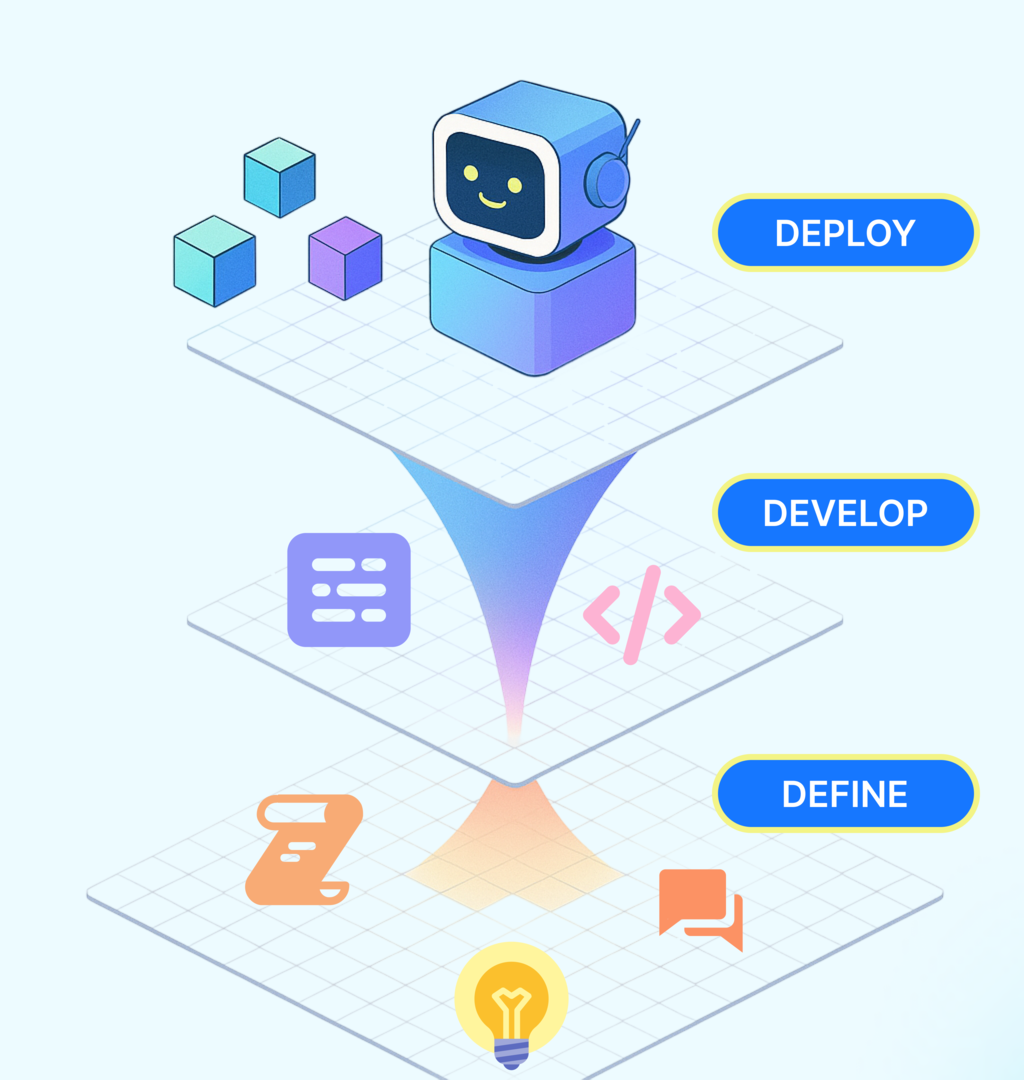
By using a structured process like APDL, teams can ensure that their AI initiatives are not just technical exercises, but well-designed products that deliver real value.
The text compares building an AI product to 'gardening' rather than 'bridge building'. What does this analogy primarily emphasize?
According to the described AI product development lifecycle, what is the most effective starting point for a new AI project?
This structured, iterative approach is key to navigating the complexities of AI development and turning promising ideas into successful products.