AI Powers Ocean Science
Introduction to AI in Oceanography
The Ocean's New Navigator
The ocean is vast, deep, and full of secrets. For centuries, scientists have tried to understand its currents, chemistry, and the life within it by collecting data point by point. This process has always been slow and challenging. Imagine trying to understand a whole city by only looking through one keyhole at a time. That's what oceanography has felt like.
But now, artificial intelligence (AI) is providing a panoramic window. AI isn't about sentient robots on a research vessel. It's about using smart computer systems to find patterns and make predictions from enormous amounts of information, far more than any human could process.
Artificial Intelligence
noun
A field of computer science focused on creating systems that can perform tasks that typically require human intelligence, such as learning, reasoning, and problem-solving.
At the heart of this revolution is a subset of AI called machine learning. Think of it like teaching a toddler to identify a fish. You don't write a long list of rules describing what a fish is. Instead, you show them lots of pictures: "this is a fish," "this is not a fish." Eventually, the toddler learns to recognize a fish on their own. Machine learning algorithms do the same thing, but with data. Scientists "feed" them vast datasets, and the algorithms learn to identify patterns, classify information, and make predictions without being explicitly programmed for each step.
A Flood of Information
Modern oceanography generates a staggering amount of data. Satellites scan the sea surface, autonomous underwater vehicles (AUVs) explore the depths, and networks of buoys constantly measure temperature, salinity, and currents. All this technology gives us a firehose of information that needs to be analyzed.
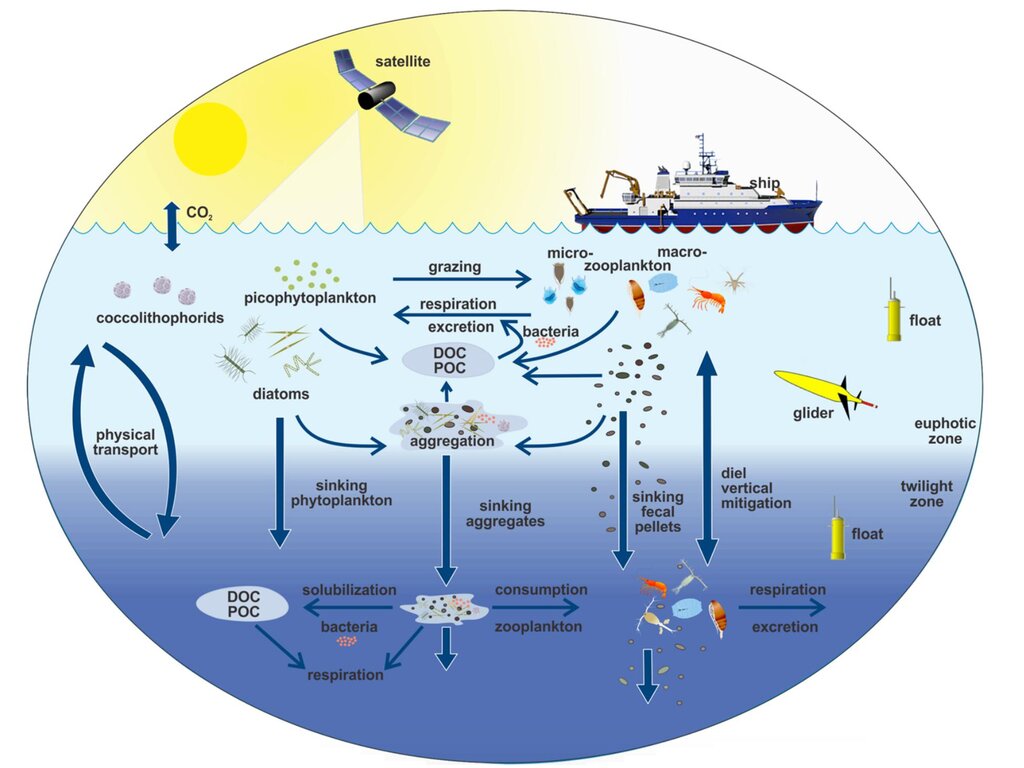
This is where AI becomes essential. It helps sift through this data flood to find the meaningful signals. For example, an AI model can analyze thousands of satellite images to detect the faint signatures of a developing harmful algal bloom, something that would be nearly impossible for a human team to do in real-time.
From Data to Discovery
AI isn't just about managing data; it's about accelerating discovery. Machine learning models can help scientists build more accurate simulations of ocean circulation, which are crucial for climate prediction. They can also analyze acoustic data from underwater microphones to identify and track whale populations, helping conservation efforts.
This changes how oceanographic operations work. Instead of spending months analyzing data from a single research cruise, scientists can use AI to get near-instant insights. This allows them to adapt their research strategies on the fly, making missions more efficient and effective. For instance, an AUV could use an onboard AI to decide where to sample next based on the data it has just collected, guiding itself toward scientifically interesting areas.
By automating data analysis and enabling real-time decision-making, AI helps oceanographers focus less on processing data and more on interpreting it and asking the next big questions.
This synergy between artificial intelligence and oceanography is just beginning. It’s transforming our ability to monitor, understand, and protect the world's oceans, opening up new frontiers in marine science.