AI-Powered Development for Enhanced Coding Flow
Introduction to AI Development Tools
A Smarter Way to Code
Imagine you're writing a novel, but you have an assistant who not only corrects your typos but also suggests the perfect word, finishes your sentences, and even drafts entire paragraphs based on your outline. That's what AI-powered development tools are for programmers. They are intelligent assistants built directly into a programmer's workspace, designed to make the process of writing software faster, more efficient, and less prone to error.
At their core, these tools analyze the code a developer is writing in real-time. They understand the context, the programming language's rules, and the developer's likely goals. Their purpose isn't to replace the developer, but to augment their skills, handling the tedious parts of coding so the human can focus on creative problem-solving and building great software.
AI currently helps developers by automating routine coding tasks, suggesting code improvements, and speeding up debugging through predictive analysis.
From Simple Helpers to Smart Partners
The idea of getting help while coding isn't new. For decades, developers have used tools that could autocomplete a word or highlight a syntax error, like a basic spell-checker. These early assistants were helpful but not very smart. They followed simple, pre-programmed rules and had no real understanding of the code's purpose.
The real shift came with the rise of modern artificial intelligence. Today’s tools are powered by complex machine learning models trained on billions of lines of code from open-source projects. This training allows them to learn patterns, structures, and best practices far beyond what any human could memorize.
Instead of just completing a single word, they can now generate entire functions, translate code from one language to another, and explain what a complex piece of code does in plain English. They've evolved from simple rule-based helpers into genuine collaborators in the development process.
Streamlining the Workflow
The main benefit of integrating AI into a developer's workflow is a massive boost in productivity. Developers spend less time on manual, repetitive tasks and more time on high-level design and logic. This can lead to a state of "flow," where a programmer is fully immersed and focused on solving a problem without being interrupted by minor frustrations.
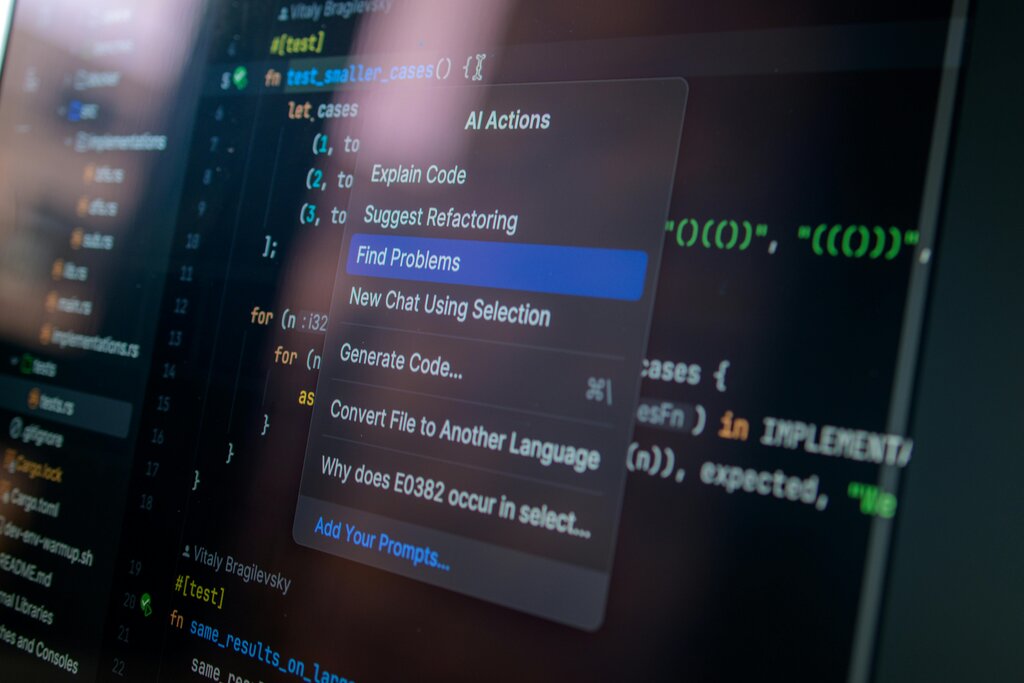
AI tools handle three key areas: automating the mundane, providing intelligent suggestions, and simplifying debugging.
First, they automate boilerplate code—the repetitive, structural code that's necessary for almost any application but isn't unique or creative. This could be setting up a new project file, writing a standard function, or creating tests.
Second, they offer intelligent code suggestions. As a developer types, the AI anticipates what they need and offers completions, from a single line to an entire block of code. This not only saves time but also helps developers discover new ways to write code and adhere to best practices.
Finally, AI tools are invaluable for debugging. They can spot potential errors before the code is even run, suggest fixes for bugs, and help refactor messy code to make it cleaner and more efficient. For a developer stuck on a tricky problem, having an AI explain a confusing section of code can be a game-changer.
What is the primary role of an AI-powered development tool, as described in the text?
How have coding assistance tools evolved with the rise of modern AI?
By handling the routine and providing intelligent assistance, these tools allow developers to work faster and focus on what truly matters: building innovative and effective software.