AI-Powered Computer Forensics
Introduction to AI
What Exactly Is AI?
At its core, Artificial Intelligence (AI) is the science of making computers smart. It’s a broad field focused on building systems that can perform tasks that typically require human intelligence, like learning, reasoning, and problem-solving. Think of it less as creating a conscious robot and more as teaching a machine to recognize patterns in complex information.
AI isn't a single technology. It's an umbrella term that covers many different methods and ideas. The most important of these for data analysis is Machine Learning.
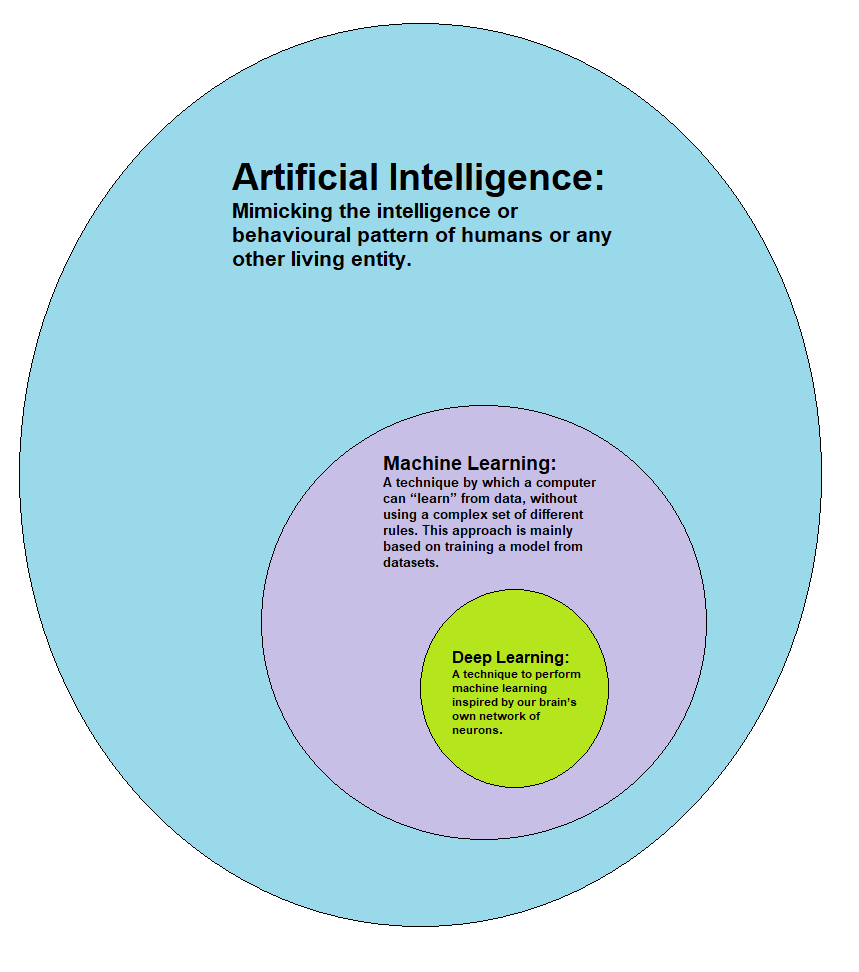
The idea of AI has been around since the 1950s, but for decades, it was mostly theoretical. The real breakthrough came with two key ingredients: massive amounts of data and powerful computers. With the ability to process huge datasets quickly, the ideas that were once just concepts on a whiteboard became practical tools that could learn and adapt.
Learning From Data
Machine Learning (ML) is the engine that powers most modern AI. Instead of writing explicit, step-by-step instructions for a computer, ML algorithms allow a computer to learn directly from data. It finds patterns and makes decisions on its own, improving with more experience.
This learning process generally falls into two main categories: supervised and unsupervised learning.
Supervised learning is like studying with flashcards. The AI is given a dataset where all the answers are already labeled. Its job is to learn the relationship between the questions and the answers.
For example, to train an AI to identify fraudulent transactions, you would feed it a huge dataset of past transactions. Each one would be labeled as either "fraudulent" or "legitimate." The model studies these examples and learns the characteristics associated with fraud. After training, it can look at a new, unlabeled transaction and predict whether it's fraudulent.
On the other hand, unsupervised learning is like being given a box of mixed Lego bricks and being told to sort them. No one tells you what the categories are; you have to figure them out yourself by grouping bricks of the same color, shape, or size.
An AI using unsupervised learning analyzes data to find hidden patterns or structures without any predefined labels. For instance, a company might use it to analyze customer data and discover natural groupings or segments of customers with similar purchasing habits. This can reveal market trends that weren't obvious before.
| Feature | Supervised Learning | Unsupervised Learning |
|---|---|---|
| Input Data | Labeled | Unlabeled |
| Goal | Predict outcomes | Discover hidden patterns |
| Example | Spam detection | Customer segmentation |
Brains of the Operation
So how does an AI actually learn these patterns? One of the most powerful approaches is through neural networks.
Inspired by the structure of the human brain, a neural network is a web of interconnected nodes, or "neurons," organized in layers. When data is fed into the first layer, each neuron processes it and passes its output to the next layer. Each connection has a weight, a value that determines the strength of the signal passing through it. During training, the network adjusts these weights over and over again until it gets better at producing the correct output.
Deep learning uses neural networks with many layers (hence, "deep"). These deep networks can learn incredibly complex patterns from vast amounts of data, which is why they are so effective for tasks like image recognition and understanding human language.
Speaking of language, Natural Language Processing (NLP) is a branch of AI that gives computers the ability to understand, interpret, and generate human text and speech. When you use a voice assistant, a translation app, or see an email automatically sorted into a folder, you're seeing NLP at work. It combines machine learning and neural networks to make sense of the complexity and nuance of human communication.
With these foundational techniques, AI provides a powerful toolkit for sifting through data to find signals in the noise. Whether it's predicting outcomes, clustering information, or understanding language, these concepts are the building blocks for applying AI to complex analytical challenges.
What is the core concept of Machine Learning (ML)?
A bank wants to build a system to identify fraudulent transactions. They have a large dataset of past transactions, each already labeled as 'fraudulent' or 'legitimate'. Which machine learning approach is most appropriate for this task?