AI-Powered Coding Agents and Token Optimization
Introduction to AI in Coding
Your New Coding Partner
For decades, writing code was a solitary, line-by-line craft. A programmer would sit down with a problem and, like a watchmaker, meticulously assemble a solution from tiny, logical pieces. Today, that process is changing. Artificial intelligence has stepped into the role of a hyper-competent assistant, capable of writing, debugging, and even designing software.
Think of it less as a tool and more as a collaborator. The programmer's job is shifting from writing every single command to guiding a powerful AI that can handle the routine work.
The Road to AI Assistance
The idea of computers helping us code isn't new. For years, developers have relied on tools that check for syntax errors or automatically complete a line of code they've started typing. These were helpful but limited. They could spot a typo or finish a familiar command, but they didn't understand the programmer's overall goal.
The big shift came with the rise of large language models (LLMs). These are the same kinds of AI that power chatbots. By training them on billions of lines of code from across the internet, they learned the patterns, structures, and logic of programming. Instead of just completing a word, they can now generate entire functions, suggest different ways to solve a problem, or translate code from one language to another.
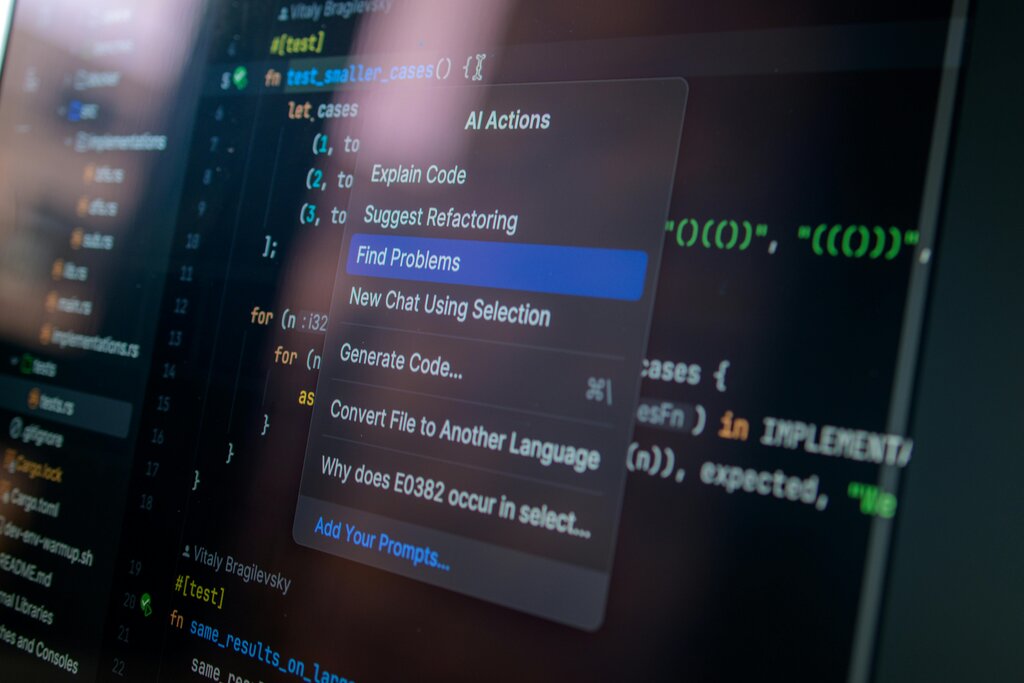
How AI Changes the Game
AI is weaving itself into every part of the software development lifecycle. It's not just about writing code faster. It's about building better, more reliable software in completely new ways.
One of the biggest trends is generative coding. A developer can describe what they want to achieve in plain English, and an AI tool will generate the necessary code. This dramatically speeds up prototyping and helps programmers tackle unfamiliar libraries or frameworks without spending hours on documentation.
AI also excels at debugging. Instead of a developer manually hunting for an error, an AI can analyze the code, identify the likely source of the problem, and suggest a fix. This turns a frustrating process into a quick correction. Similarly, AI can automatically generate test cases to ensure new code works as expected and doesn't break existing features.
Developers shift from manual coding to strategic guidance, focusing on problem-solving while AI handles execution.
This shift means developers can spend more time on the creative aspects of their work: designing elegant system architectures, understanding user needs, and solving complex business problems. The AI handles the repetitive, mechanical parts of coding, freeing up human minds for higher-level thinking.
Meet the Tools
A variety of AI-driven tools are now available to programmers. They integrate directly into the software developers use every day, offering assistance without interrupting their workflow. While they share the common goal of making coding more efficient, each has its own strengths.
| Tool | Primary Function |
|---|---|
| GitHub Copilot | Autocompletes lines and entire functions of code. |
| Amazon CodeWhisperer | Generates code suggestions and scans for security vulnerabilities. |
| Tabnine | Provides code completions tailored to your team's specific codebase. |
| Replit AI | A full coding environment with AI assistance for creating and deploying apps. |
As these tools become more sophisticated, the line between writing code and simply describing it will continue to blur. Now, let's test your understanding of how AI is changing the world of coding.
According to the text, what is the most significant shift in modern software development?
What enabled AI to move beyond simple code completion to generating entire functions and suggesting complex solutions?