AI ML Engineering Mastery
AI/ML Engineering Foundations
The AI/ML Engineering Lifecycle
Building an AI or machine learning system isn't a linear process. It's a cycle. You define a problem, gather data, build a model, and deploy it. But then you watch it, learn from its performance, and start the cycle all over again. This iterative approach, borrowed from modern software development, is what allows AI/ML systems to improve and adapt over time.
Let's break down each stage of this cycle.
Problem Definition and Data
Everything starts with a clear problem. A good AI/ML engineer doesn't just build models; they solve problems. This first step involves translating a business goal into a specific, measurable machine learning task. For example, a goal to "improve customer retention" becomes a task to "predict which customers are likely to churn in the next 30 days."
Defining the problem also means defining success. What does a good outcome look like? How will the model's output be used? Answering these questions upfront prevents building a technically impressive model that doesn't actually help anyone.
Once the problem is framed, the focus shifts to data. This is often the most time-consuming part of the entire lifecycle. Data must be collected, cleaned, and transformed into a usable format. This process, known as data preparation and feature engineering, involves handling missing values, normalizing data, and creating new features that might help the model find patterns. A crucial step here is splitting the data into separate sets for training, validation, and testing to ensure the model's performance can be honestly evaluated.
A brilliant model trained on messy, irrelevant data is still a useless model. The quality of your data sets the ceiling for your model's performance.
Building and Evaluating Models
With a well-defined problem and clean data, it's time to build a model. This is an experimental phase. You might try several different algorithms, from simple linear regression to complex neural networks, to see which performs best on your data.
The core of this stage is training—the process where the model learns patterns from the training data. But how do we know if it's actually learning anything useful? That's where evaluation comes in. We use the validation data set, which the model hasn't seen during training, to tune the model's parameters and choose the best one. Finally, we use the test set for a final, unbiased assessment of its performance.
Choosing the right evaluation metric is critical and depends entirely on the problem you're solving.
| Metric | Use Case | What It Measures |
|---|---|---|
| Accuracy | Classification | The proportion of total predictions that were correct. Can be misleading with imbalanced data. |
| Precision | Classification | Of all the positive predictions made, how many were actually positive? Measures relevance. |
| Recall | Classification | Of all the actual positives, how many did the model correctly identify? Measures completeness. |
| Mean Absolute Error (MAE) | Regression | The average absolute difference between the predicted values and the actual values. |
| R-squared | Regression | The proportion of the variance in the dependent variable that is predictable from the independent variable(s). |
No single metric tells the whole story. A skilled engineer analyzes multiple metrics to get a complete picture of a model's strengths and weaknesses.
From Model to Product
A trained model is just a file. It doesn't create value until it's deployed into a production environment where it can make predictions on new, live data. This is where software engineering best practices become absolutely essential. The goal is to build a robust, scalable, and maintainable system around the model.
Deployment isn't a one-time event. It's the start of the model's life in the real world.
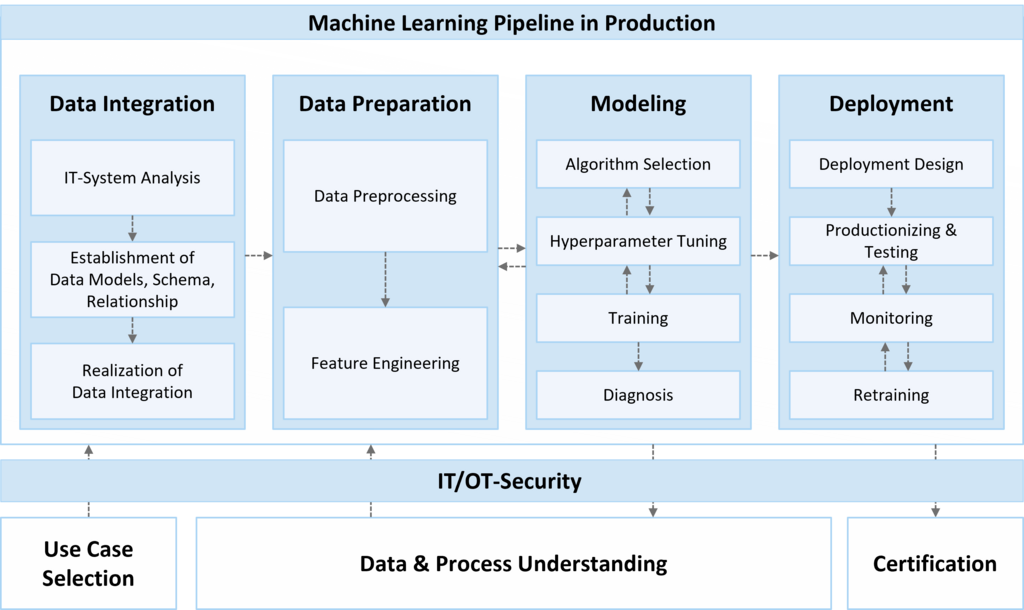
There are several common deployment strategies:
- Batch Prediction: The model runs periodically (e.g., once a day) on a large batch of data. This is useful for tasks like generating daily reports or updating customer segments.
- Real-time Inference via API: The model is wrapped in an API. An application can send a request with a single data point (or a small batch) and get a prediction back almost instantly. This is common for fraud detection or recommendation engines.
- Edge Deployment: The model runs directly on a user's device, like a smartphone or an IoT sensor. This is great for applications requiring low latency and offline capabilities, such as real-time language translation on a mobile app.
After deployment, the work continues with monitoring. We need to track the model's performance over time to detect issues like data drift, where the live data starts to look different from the training data, causing performance to degrade. When this happens, it's time to start the cycle again by collecting new data and retraining the model.
Which statement best describes the overall process of building and maintaining an AI/ML system?
A food delivery app wants to run a marketing campaign to keep its users. Which of the following is the best example of translating this business goal into a specific machine learning problem?
This lifecycle provides a structured framework for building AI systems that are not just clever, but also reliable and valuable in the real world.