AI Math Foundations
Linear Algebra
The Language of Data
Artificial intelligence often works with vast amounts of information. To make sense of it all, AI needs a structured language. That language is linear algebra. It provides the tools to organize, manipulate, and analyze data efficiently.
Linear algebra deals with vectors, matrices, and linear transformations - all essential tools for expressing and manipulating data, solving equations, and calculating geometric transformations.
Think of it as the grammar for data. Instead of nouns and verbs, we use vectors and matrices. These concepts might sound intimidating, but they are just ways of packaging numbers so a computer can work with them. We'll start with the most basic building block: the vector.
Vectors and Matrices
A vector is simply a list of numbers. It can represent anything from the coordinates of a point in space to the features of a user profile, like age, height, and hours spent online. In AI, a vector could represent all the pixel values in an image or the importance of different words in a sentence.
Vectors have two key properties: magnitude (how long it is) and direction. We typically write a vector as a column of numbers.
This vector points 3 units along the x-axis and 4 units along the y-axis.
We can perform operations on vectors. The two most common are addition and scalar multiplication.
Vector Addition: To add two vectors, you just add their corresponding components. This is like walking in one direction, then another.
Scalar Multiplication: A scalar is just a single number. Multiplying a vector by a scalar scales its magnitude. If the scalar is negative, it also flips the vector's direction.
Now, what if you have a collection of vectors? You can stack them together to form a matrix. A matrix is a rectangular grid of numbers, arranged in rows and columns. Matrices are workhorses in AI. They can represent a dataset (where each row is a data point and each column is a feature), a transformation of space, or the weights in a neural network.
This is a 2x3 matrix because it has 2 rows and 3 columns. Like vectors, matrices have their own operations, such as addition and multiplication. Matrix multiplication is particularly important. It's how transformations are applied and how signals are passed through neural networks. The rule is that the number of columns in the first matrix must match the number of rows in the second matrix.
Multiplying a matrix by a vector transforms the vector. This is a key idea. Think of the matrix as a machine and the vector as an input. The output is a new, transformed vector.
Transformations and Eigen-things
A linear transformation is a function that takes a vector as input and produces a new vector as output, but it follows special rules. It won't bend or curve space. Straight lines remain straight, and the origin stays put. Rotations, scaling, and shears are all examples of linear transformations. Every linear transformation can be represented by a matrix.
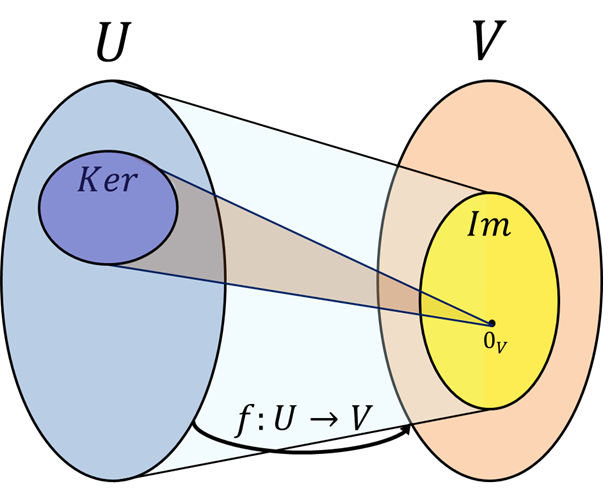
When a matrix acts on a vector, it usually changes the vector's direction. But for any given transformation, there are special vectors that don't change their direction at all. They only get stretched or shrunk.
These special vectors are called eigenvectors. The factor by which they are stretched or shrunk is called their eigenvalue.
Eigenvector
noun
A vector that, when a linear transformation is applied to it, changes only in magnitude, not in direction.
Mathematically, if is a matrix representing a transformation, is an eigenvector, and (lambda) is its corresponding eigenvalue, the relationship is:
This equation says that applying the transformation to the eigenvector has the same effect as just multiplying by the scalar eigenvalue .
Why does this matter for AI? Eigenvectors and eigenvalues reveal the fundamental properties of a transformation. They point to the directions where the transformation has its simplest effect. In data analysis, a technique called Principal Component Analysis (PCA) uses eigenvectors to find the most important patterns in a dataset, helping to reduce its complexity without losing crucial information.
Time to test your knowledge of these foundational concepts.
In the context of AI, what is a vector most fundamentally?
Given vector $$ \vec{v} = \begin{bmatrix} 3 \ -2 \end{bmatrix}
Linear algebra is the bedrock for many advanced AI topics. Understanding how vectors and matrices represent and manipulate data is the first step toward understanding how machine learning models learn.