AI Integration in Modern UX Design
AI in Design Workflows
Your New Co-Pilot
For decades, digital design was a hands-on, meticulous craft. Designers acted as builders, manually placing every element, adjusting every pixel, and defining every interaction. The process was direct and transparent, but also labor-intensive. Now, artificial intelligence is fundamentally changing that dynamic. Instead of being the sole builder, the designer is becoming an orchestrator, a creative director with a powerful new partner.
Think of AI as a co-pilot. It doesn't steer the plane, but it handles countless routine tasks, runs calculations at lightning speed, and presents options you might not have considered. This frees you, the pilot, to focus on the most critical parts of the journey: setting the destination (strategy), navigating turbulence (user problems), and ensuring a smooth landing (a great user experience). Your value shifts from manual execution to strategic direction and critical judgment.
Designers now find themselves focusing on things like: orchestrating AI-powered tools, curating AI-generated solutions, and maintaining the balance between automation and human creativity.
Commanding Intent
This new partnership is built on a paradigm shift from imperative to declarative design. Traditionally, design has been imperative. You give the software explicit, step-by-step commands: "draw a rectangle here," "make this text blue," "set the corner radius to 8 pixels." You are responsible for the 'how'.
Declarative design, powered by generative AI, flips the script. You simply state your intent—the 'what'. You might prompt an AI with, "Create a user onboarding screen for a mobile banking app with a clean, trustworthy feel." The AI interprets your intent and generates a complete design, or multiple variations, for you to evaluate and refine. It's the difference between giving a taxi driver turn-by-turn directions versus simply telling them your destination address.
| Imperative Design | Declarative Design | |
|---|---|---|
| Input | Direct manipulation, specific commands | Natural language, abstract intent |
| Process | Manual creation of each element | AI generation of multiple options |
| Focus | How to build the interface | What the interface should achieve |
| Designer's Role | Maker, pixel-pusher | Director, curator, strategist |
This isn't science fiction; it's happening now. Design platforms like Figma are integrating AI plugins that can generate UI elements from text descriptions. Tools like can create entire visual styles and assets based on a simple prompt. This allows designers to explore a much wider range of creative possibilities in a fraction of the time, moving from a blank page to a set of viable concepts almost instantly.
Supercharging the Double Diamond
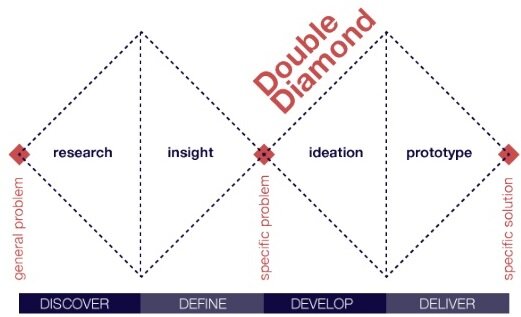
Established UX frameworks like the aren't being replaced by AI; they're being accelerated. Each phase of this classic model, which moves from discovering a problem to delivering a solution, can be augmented.
- Discover: AI can analyze vast amounts of user feedback, interview transcripts, and market data to rapidly synthesize key insights and identify user pain points.
- Define: After discovery, AI helps clarify the problem. It can cluster research findings into affinity diagrams and even draft initial problem statements and user personas based on the data.
- Develop: This is where generative AI shines. Instead of a designer painstakingly creating a few wireframes, AI can generate dozens of distinct layout options, color palettes, and component variations based on a single prompt. This massively expands the solution space.
- Deliver: In the final phase, AI assists in creating high-fidelity prototypes, generating design system documentation, and even writing production-ready code snippets from a finished design, bridging the gap between design and engineering.
This acceleration doesn't remove the need for human oversight. If anything, it makes it more critical. With so many options generated so quickly, the designer's ability to curate, critique, and select the best path forward becomes their most valuable skill.
The goal isn't to automate the designer, but to augment their creativity and decision-making.
By handling the repetitive and time-consuming aspects of design, AI frees up cognitive resources. Designers can spend less time 'making' and more time thinking, strategizing, and validating ideas with users. The focus shifts from the craft of production to the art of direction, ensuring that what gets built is not just well-made, but is the right thing to build in the first place.
How has the role of a digital designer evolved with the integration of artificial intelligence?
Which statement best describes the concept of declarative design, as powered by AI?