AI Integration in Enterprise Software Development
Understanding AI Fundamentals
What is AI?
Artificial intelligence is the science of making machines that can think or act intelligently. The core idea is to build systems that can perform tasks that normally require human intelligence, like learning, reasoning, problem-solving, and understanding language.
Artificial Intelligence
noun
A field of computer science dedicated to creating systems capable of performing tasks that typically require human intelligence.
The dream of intelligent machines is ancient, but the modern field of AI began to take shape in the mid-20th century. Pioneers like Alan Turing proposed tests for machine intelligence, and in 1956, a group of researchers at the Dartmouth Workshop officially coined the term "artificial intelligence."
From those early days of rule-based systems, AI has gone through periods of rapid progress and frustrating setbacks. Today, thanks to massive amounts of data and powerful computers, AI is more capable than ever.
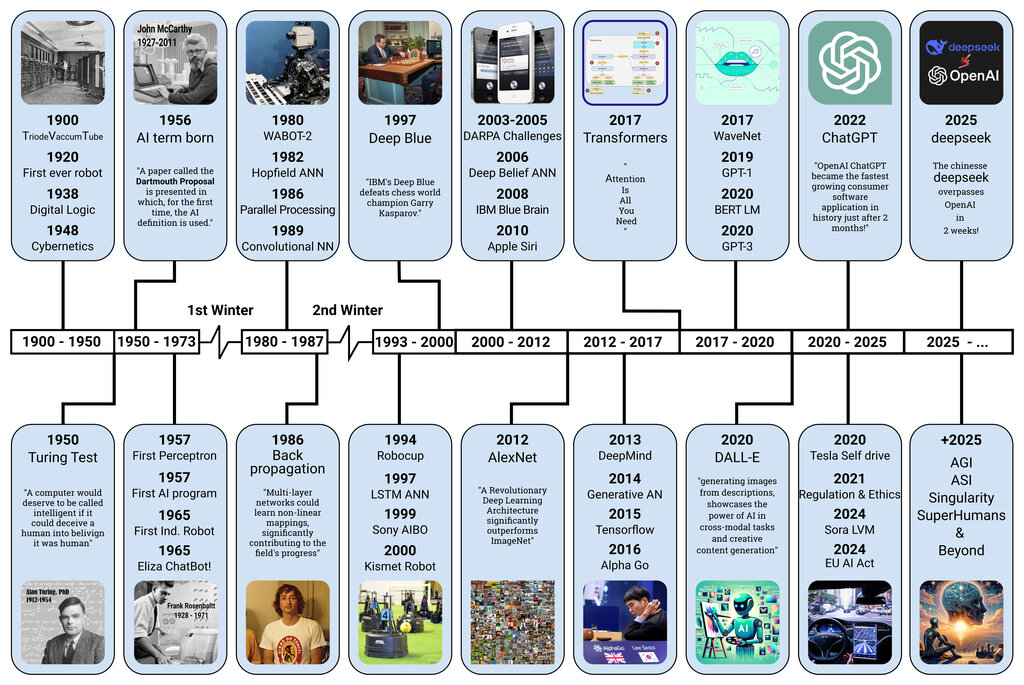
The AI Family Tree
AI isn't just one thing. It’s a broad field with many specialized branches. The most important relationship to understand is between AI, Machine Learning, and Deep Learning. Think of them as nested dolls, each one a more specific version of the one before it.
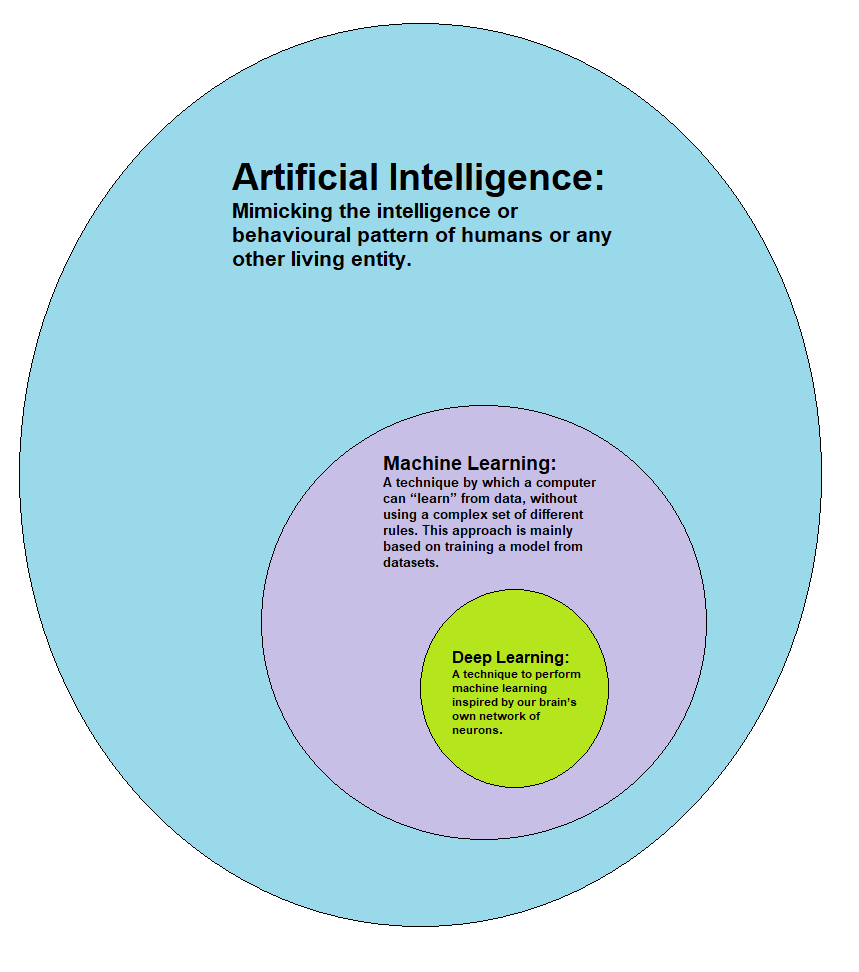
The largest doll is Artificial Intelligence itself, the overall concept of intelligent machines. The next doll inside is Machine Learning (ML).
Machine learning gives computers the ability to learn without being explicitly programmed. Instead of writing step-by-step instructions, developers feed the machine data, and it learns to recognize patterns on its own.
Your email's spam filter is a classic example. It wasn't programmed with a list of every possible spam email. Instead, it was trained on millions of examples of spam and legitimate emails. It learned the tell-tale signs of spam and now applies that knowledge to your inbox.
The smallest doll, nestled deep inside the others, is Deep Learning (DL). It's a powerful type of machine learning that uses structures called neural networks, which are loosely inspired by the human brain. These networks have many layers that process information, allowing them to learn incredibly complex patterns from vast amounts of data.
Deep learning powers many of the most advanced AI applications, such as facial recognition on your phone or the systems that allow self-driving cars to identify pedestrians and traffic lights.
Another major branch of AI is Natural Language Processing (NLP). This field focuses on giving computers the ability to understand, interpret, and generate human language. Every time you talk to a smart assistant like Alexa, use a translation app, or see a chatbot pop up on a website, you're interacting with NLP.
AI's Ethical Tightrope
As AI becomes more powerful and widespread, its ethical implications become more urgent. The same systems that can help doctors diagnose diseases can also be used in ways that are unfair or harmful. A key challenge is bias.
AI systems learn from the data they are given. If that data reflects existing biases in society, the AI will learn and often amplify those biases.
For example, if a hiring AI is trained on historical data from a company that predominantly hired men for engineering roles, it might learn to favor male candidates, even if gender isn't explicitly listed as a factor. It might pick up on proxies for gender in the data, like certain universities or hobbies mentioned on resumes.
This creates a serious risk of perpetuating discrimination in areas like hiring, loan applications, and even criminal justice. Addressing this requires careful data collection, rigorous testing for fairness, and transparency in how AI models make their decisions.
We recommend that introductory AI courses should (1) highlight ethical challenges of AI to present a more balanced perspective, (2) raise ethical issues explicitly relevant to the technical concepts discussed and (3) nurture a sense of accountability in future AI developers.
Beyond bias, questions of privacy, accountability, and the impact of AI on jobs are all critical conversations. Building responsible AI isn't just a technical challenge; it's a social one that requires input from everyone, not just programmers.
Let's review these core concepts.
Now, check your understanding of these foundational ideas.
What is the core idea behind artificial intelligence?
Which statement best describes the relationship between Artificial Intelligence (AI), Machine Learning (ML), and Deep Learning (DL)?
Grasping these fundamentals—what AI is, its key subfields, and the ethical issues it raises—is the first step to understanding its role in the world.