AI Infrastructure Layers Deep Dive
AI Infrastructure Overview
The Engine Room of AI
Artificial intelligence feels like magic, but it runs on a very real, physical foundation. This foundation is its infrastructure, a complex ecosystem of hardware and software designed to handle the immense demands of AI workloads.
AI infrastructure represents the complete hardware and software ecosystem specifically designed to support artificial intelligence and machine learning workloads.
Think of it as the engine room of a massive ship. It’s not just one big engine; it's a network of powerful processors, vast storage systems, and lightning-fast connections, all working together. Without this specialized infrastructure, training and running sophisticated AI models would be impossible.
From Basements to Global Networks
AI's journey from academic curiosity to a global force is mirrored in the evolution of its data centers. In the early days, AI research was confined to universities and corporate labs, running on single computers or small clusters. As models and datasets grew, these humble beginnings gave way to the need for dedicated, powerful computing facilities.
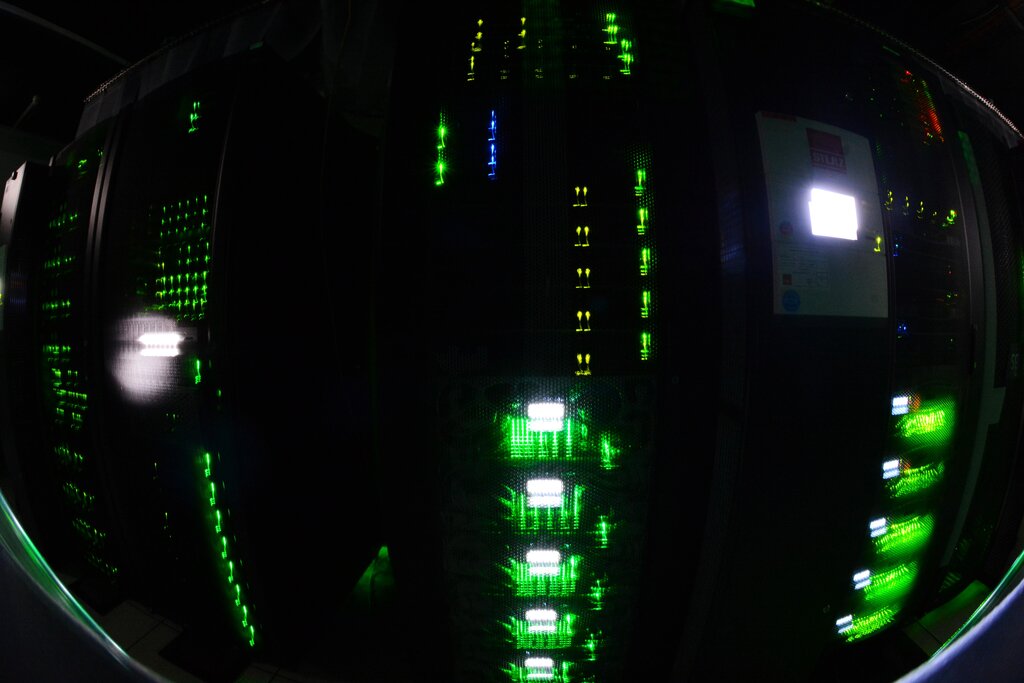
Today, the most advanced AI models are trained in hyperscale data centers. These are enormous, purpose-built facilities, often spanning the size of several football fields, packed with specialized hardware and cooled by complex systems. They represent the massive scale required to push the boundaries of AI.
The Powerhouses
At the heart of these data centers are processors that go far beyond the standard CPUs found in most computers. While CPUs are great for handling a wide variety of tasks one after another, they struggle with the unique demands of AI.
AI training involves performing millions or even billions of simple calculations at the same time. This is where specialized hardware shines.
Graphics Processing Units (GPUs) were originally designed to render graphics for video games, a task that requires handling many parallel operations to create complex images. Researchers discovered this parallel architecture was perfect for training neural networks. Instead of processing data sequentially, GPUs can tackle huge chunks of it all at once.
Tensor Processing Units (TPUs) are the next step in specialization. Developed by Google, TPUs are Application-Specific Integrated Circuits (ASICs) built for one purpose: to run AI models as quickly and efficiently as possible. They are tailored specifically for the mathematical operations common in machine learning.
Think of it this way: a CPU is a master chef who can meticulously prepare any complex dish. A GPU is an army of line cooks all chopping vegetables simultaneously. A TPU is a custom-built, ultra-fast vegetable chopping machine.
Connecting the Dots
Having thousands of powerful processors is only half the battle. If they can't communicate with each other and access data quickly, they become a bottleneck. This is why high-speed networking is a critical pillar of AI infrastructure.
Training a single large AI model can involve distributing the workload across hundreds or thousands of GPUs. These GPUs need to constantly exchange information and synchronize their calculations. Standard networking is too slow for this, leading to processors sitting idle while they wait for data. High-speed, low-latency interconnects like InfiniBand or specialized Ethernet ensure that data flows seamlessly between all the components, keeping the entire system running at peak efficiency.
Flexibility in the Cloud
Building and maintaining a cutting-edge AI data center is incredibly expensive and complex. For this reason, many organizations rely on cloud providers for their AI infrastructure. But they aren't limited to just one provider.
Hybrid cloud strategies involve using a mix of private infrastructure (an organization's own data centers) and public cloud services. This allows a company to keep sensitive data on-premises while using the massive, scalable power of the public cloud for intensive AI training.
Multi-cloud strategies take this a step further, using services from multiple different cloud providers (like AWS, Google Cloud, and Azure). This approach helps organizations avoid being locked into a single vendor. It also provides resiliency; if one provider has an outage, workloads can be shifted to another. This flexibility is crucial for building robust and scalable AI applications.
What is the primary reason specialized hardware like GPUs are preferred over traditional CPUs for training large AI models?
A Tensor Processing Unit (TPU) is a type of Application-Specific Integrated Circuit (ASIC). What does this mean?