AI Infrastructure Explained
Introduction to AI Infrastructure
The Foundation of AI
Artificial intelligence isn't magic. It's built on a physical and digital foundation known as AI infrastructure. Think of it like the kitchen for a master chef. The chef can have amazing recipes (the AI models), but without ovens, mixers, fresh ingredients, and a well-organized space, they can't cook anything. AI infrastructure is that kitchen.
AI infrastructure is the combination of hardware and software that supports the extensive data processing demands of AI and machine learning models.
This foundation is crucial because AI systems, especially machine learning models, are incredibly demanding. They need to process massive amounts of data, run complex calculations, and deliver results quickly. A solid infrastructure ensures that AI applications are powerful, scalable, and reliable. Without it, even the most brilliant AI algorithm is just an idea on a whiteboard.
The Core Components
AI infrastructure is made up of four key pillars that work together. Each one plays a distinct and vital role.
1. Hardware This is the raw muscle. AI requires immense computational power, which standard computer processors (CPUs) often can't provide efficiently. Graphics Processing Units (GPUs) are the workhorses of AI because they can perform many calculations simultaneously, a process called parallel processing. This hardware can be located on-site in a company's own data center or accessed through cloud providers.
2. Software This is the toolkit. It includes everything from the operating systems to the specialized frameworks and libraries (like TensorFlow and PyTorch) that data scientists use to build, train, and test AI models. It also covers MLOps (Machine Learning Operations) platforms, which help manage the entire lifecycle of an AI model, from experiment to production.
3. Data Management Data is the lifeblood of AI. The infrastructure must be able to handle vast datasets efficiently. This involves systems for storing data (like data lakes and warehouses), processing it to make it clean and usable, and governing it to ensure security and compliance.
4. Networking This is the circulatory system. All the components need to communicate with each other. A high-speed, low-latency network is essential to move enormous datasets from storage to the processing hardware and to deliver the AI model's results to users without delay.
Powering the AI Lifecycle
The purpose of this infrastructure is to support the end-to-end process of creating and running an AI system. This process is often called the AI lifecycle, which generally moves from development to deployment.
Development Phase: A data scientist uses software tools on powerful hardware to train a machine learning model with massive datasets. The network shuttles data back and forth between storage and the hardware. This is where the AI learns.
Deployment Phase: Once the model is trained, it's integrated into a real-world application. The infrastructure is responsible for running the model, providing it with new data, and serving its predictions or outputs to users. It also includes tools for monitoring the model's performance to ensure it remains accurate over time.
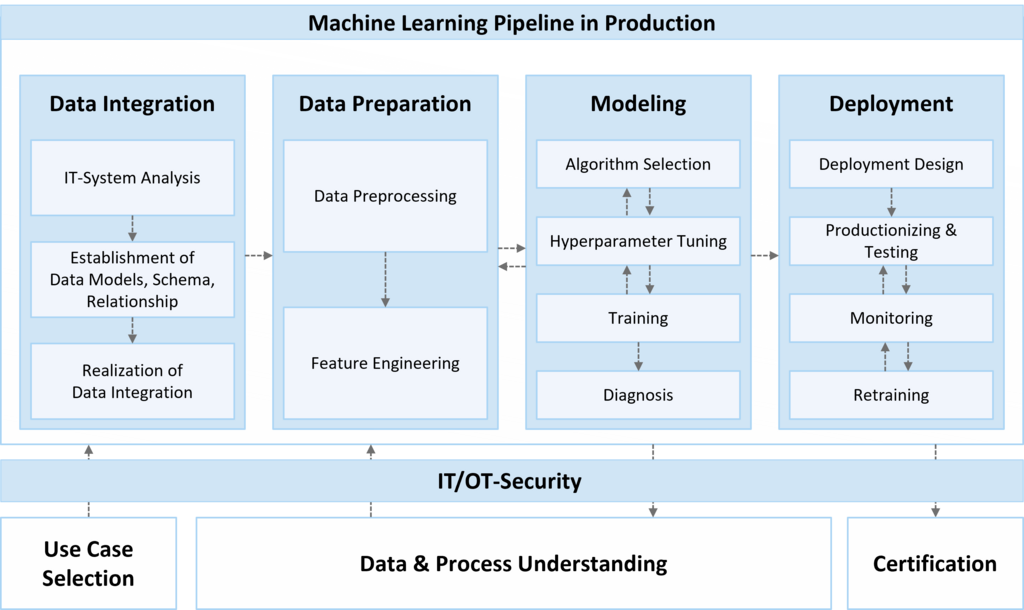
Each stage of this cycle relies heavily on the underlying infrastructure. A bottleneck in any of the four components—hardware, software, data, or networking—can slow down development and cripple the performance of a deployed AI application. Getting the infrastructure right is the first step to building successful AI.
Using the analogy of a kitchen, what does AI infrastructure represent?
Which component is considered the 'workhorse' of AI hardware due to its ability to perform many calculations simultaneously?