AI in User Research
Introduction to AI
What Is AI?
Artificial intelligence is about making computers that can think or act like humans. The goal is to create systems that can perform tasks that normally require human intelligence, such as learning, reasoning, problem-solving, and understanding language.
The idea isn't new. Philosophers have dreamed of artificial beings for centuries. But the modern field of AI truly began in the 1950s. A key moment was the Dartmouth Workshop in 1956, where the term "artificial intelligence" was officially coined. Early researchers were optimistic, believing they could create human-level intelligence within a few decades.
Progress wasn't a straight line. There were periods of excitement followed by "AI winters," when funding dried up and progress stalled. But recent advances in computing power and the availability of massive amounts of data have led to the AI boom we see today.
AI is a system’s ability to correctly interpret data, learn from that data, and use those learnings to achieve specific goals through flexible adaptation.
The Two Main Types
When people talk about AI, they're usually referring to one of two broad categories. Understanding the difference is key.
First, there's Artificial Narrow Intelligence (ANI), sometimes called Weak AI. This is the only type of AI we have successfully created so far. ANI is designed and trained for one specific task. It's incredibly good at what it does, but it can't operate outside its defined parameters.
Think about the AI in your life: the recommendation engine that suggests what to watch next, the voice assistant on your phone, or the software that filters spam from your email. These are all examples of ANI. They are powerful tools for specific jobs, but they don't possess general awareness or consciousness.
The other category is Artificial General Intelligence (AGI), or Strong AI. This is the AI you see in movies—a machine with the ability to understand, learn, and apply its intelligence to solve any problem, just like a human being. AGI would have consciousness, self-awareness, and the ability to think abstractly and creatively.
Creating AGI is the ultimate goal for many AI researchers, but it remains a monumental challenge. We are not yet close to achieving it. Beyond AGI is the concept of Artificial Superintelligence (ASI), an intellect that would be much smarter than the best human brains in practically every field.
Core Concepts
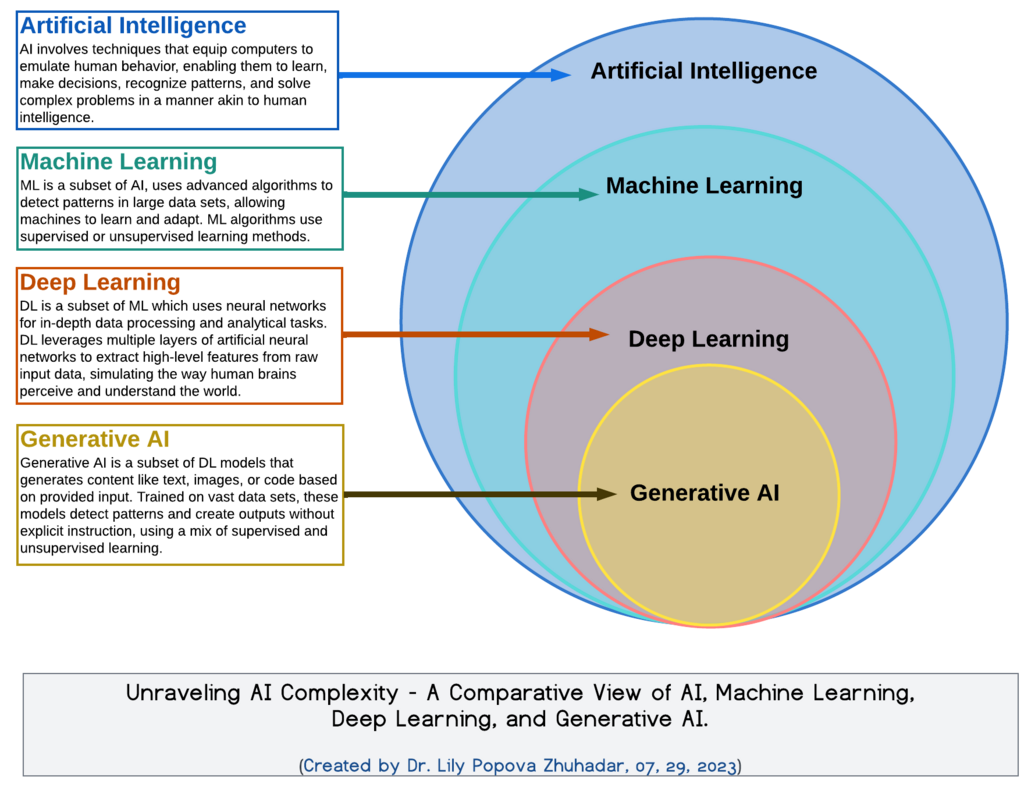
AI is a broad field, with several important subfields. Let's look at the key concepts that power most modern AI systems.
Machine Learning
noun
A subset of AI where systems learn and improve from experience without being explicitly programmed. Instead of writing rules, developers feed the system large amounts of data and let it learn patterns on its own.
Imagine trying to teach a computer to recognize a cat. The old way was to program a set of rules: "if it has pointy ears, whiskers, and a tail, it's a cat." But this is brittle; what about a cat with folded ears? Machine Learning takes a different approach. You show the system thousands of labeled pictures of cats, and it learns the defining features by itself.
Deep Learning
noun
A subfield of machine learning based on artificial neural networks with many layers (hence "deep"). These networks are inspired by the structure of the human brain and are particularly effective at finding complex patterns in large datasets.
Deep learning has been the driving force behind many recent AI breakthroughs, especially in areas like image recognition and natural language processing. It's what allows a service to instantly identify your friends in a photo or translate a conversation in real time.
Natural Language Processing
noun
A branch of AI that helps computers understand, interpret, and generate human language. NLP is the bridge between human communication and computer understanding.
Ethical Considerations
As AI becomes more powerful and integrated into our lives, it's crucial to consider the ethical implications. AI is not neutral; it reflects the data it's trained on and the values of the people who create it.
Key ethical challenges include:
- Bias: If an AI system is trained on biased data, its decisions will also be biased. For example, a hiring tool trained on historical data from a male-dominated industry might unfairly favor male candidates.
- Privacy: AI systems often require vast amounts of personal data to function, raising significant concerns about how that data is collected, stored, and used.
- Accountability: When an AI system makes a mistake, who is responsible? The programmer, the user, or the company that deployed it? Establishing clear lines of accountability is a complex but necessary task.
- Impact on Jobs: AI is automating many tasks, which will inevitably lead to shifts in the job market. Society must grapple with how to manage this transition and support affected workers.
These are not easy questions, and they require ongoing discussion among technologists, policymakers, and the public.
Time to review what we've covered.
Now, let's test your understanding of these core concepts.
What is the primary goal of Artificial Intelligence?
The term "artificial intelligence" was officially coined at which key event in 1956?
This foundation gives you the essential vocabulary and context to understand how AI is changing the world, from how we work to how we conduct research.