AI in Protein Design
Protein Structure Basics
The Building Blocks of Life
Proteins are the workhorses of the cell, carrying out a vast array of tasks. To understand how they do what they do, we first need to look at what they're made of. The fundamental building blocks of every protein are molecules called amino acids.
Every amino acid has the same basic skeleton: a central carbon atom connected to an amino group (), a carboxyl group (), and a hydrogen atom. What makes each amino acid unique is its side chain, also known as the R-group. This is the part that varies, giving each of the 20 common amino acids its distinct properties, like being acidic, basic, or hydrophobic (water-repelling).
Think of these 20 amino acids as a set of LEGO bricks. They can be connected in countless sequences to build a vast range of structures.
From Chains to Shapes
Amino acids link together to form a chain called a polypeptide. This happens through a chemical reaction where the carboxyl group of one amino acid joins with the amino group of another. The bond they form is called a peptide bond, and a molecule of water is released in the process.
Amino Acid + Amino Acid → Peptide Bond + Water
A protein isn't just a long, floppy chain of amino acids, though. It's a precisely folded, three-dimensional object. The function of a protein is completely dependent on its final 3D shape. This intricate structure is described at four different levels.
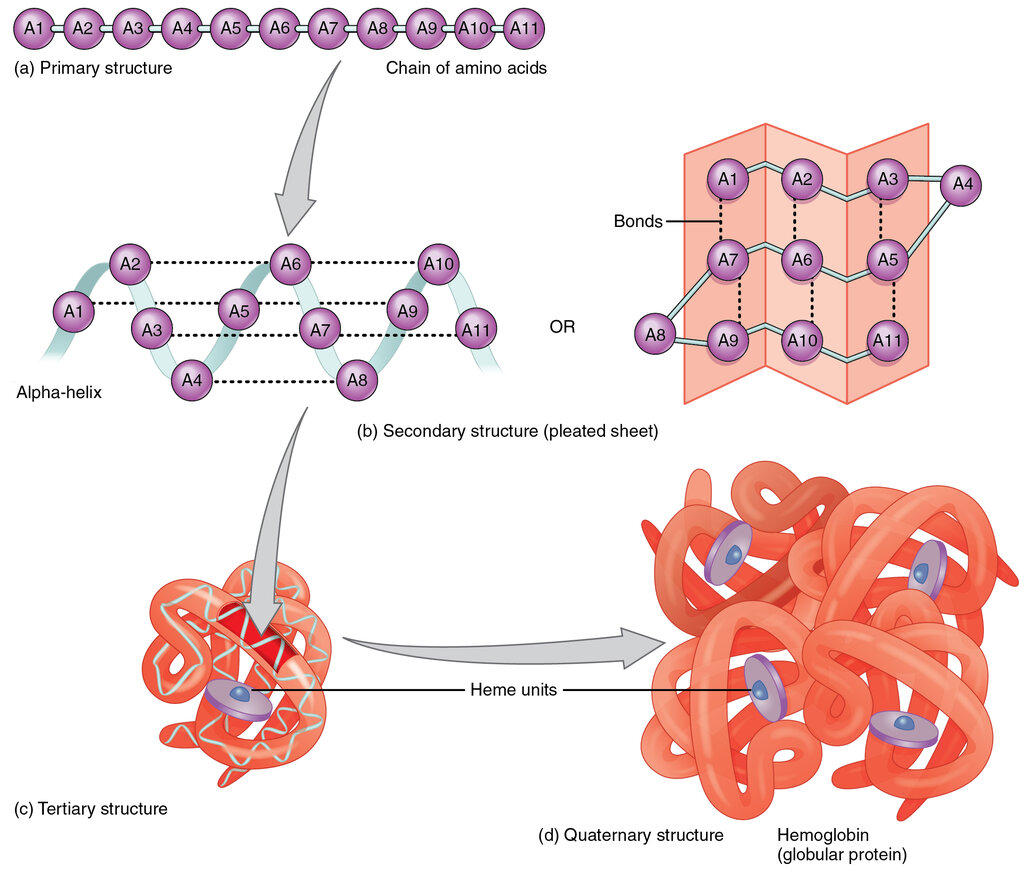
Primary Structure is the simplest level. It's just the linear sequence of amino acids in the polypeptide chain. If you think of amino acids as letters, the primary structure is the specific way those letters are spelled out to form a word. This sequence is determined by the genetic code in our DNA.
The primary structure is critical because it dictates all the subsequent levels of folding. A single change in the sequence can sometimes alter the protein's final shape and function dramatically.
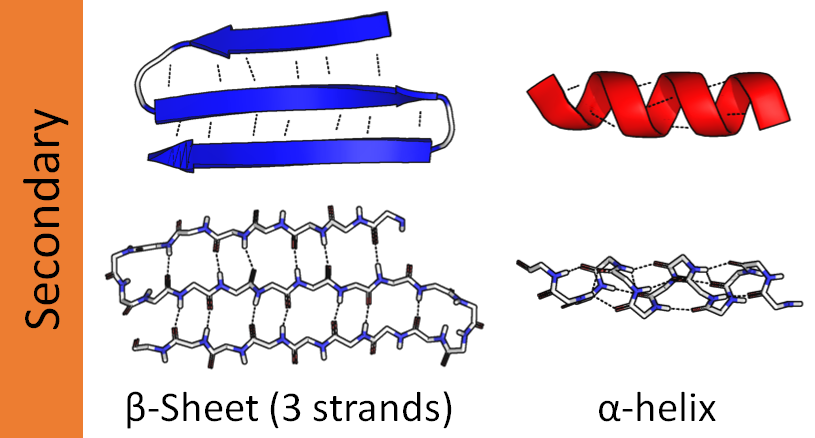
Secondary Structure refers to the regular, repeating shapes that form in local segments of the polypeptide chain. These structures aren't random; they're stabilized by hydrogen bonds that form between atoms of the polypeptide backbone (not the side chains). The two most common types of secondary structure are the alpha-helix (a delicate coil) and the beta-sheet (a pleated, folded structure).
Tertiary Structure is the overall 3D shape of a single polypeptide chain. This is where the protein really starts to look like a complex, globular object. This shape is determined by a variety of interactions between the R-groups (the side chains) of the amino acids. These interactions can include hydrogen bonds, ionic bonds between charged groups, disulfide bridges (strong covalent bonds between sulfur-containing amino acids), and hydrophobic interactions, which cause nonpolar side chains to tuck away from water on the protein's interior.
Quaternary Structure exists only in proteins that are made of more than one polypeptide chain (also called subunits). This level describes how these multiple subunits fit together to form a larger, functional protein complex. A famous example is hemoglobin, the protein in our blood that carries oxygen, which is made of four separate polypeptide chains.
The Process of Folding
The process by which a polypeptide chain contorts itself into its functional 3D shape is called protein folding. It's not a random process. It's a highly complex and rapid dance, guided largely by hydrophobic interactions. The water-repelling side chains try to escape the surrounding water inside the cell by burying themselves in the core of the protein, which helps drive the overall folding process.
Imagine a string with oily and non-oily beads. When you drop it in water, the oily beads will clump together in the middle to avoid the water, forcing the string into a specific shape. Protein folding works in a similar way.
This process is remarkable because for a given amino acid sequence, a protein will almost always fold into the same, unique 3D structure, known as its native state. This precise shape is what allows the protein to perform its specific job, whether that's catalyzing a reaction, transporting a molecule, or forming a structural support.
Now that you understand these fundamental structures, you have the groundwork for exploring the incredible world of proteins and how they work.