AI in English Lesson Planning
Understanding AI Basics
What Is AI, Really?
Artificial Intelligence is about making computers smart. It's the science of creating machines that can think, learn, and solve problems in ways that usually require human intelligence. This includes abilities like recognizing a friend's face in a photo, understanding a spoken command, or even driving a car.
Artificial Intelligence
noun
The theory and development of computer systems able to perform tasks that normally require human intelligence, such as visual perception, speech recognition, decision-making, and translation between languages.
Think of it this way: when you write a traditional computer program, you give it a strict set of rules to follow. If X happens, do Y. With AI, the goal is different. Instead of giving it rules, you often give it data and let it figure out the rules for itself.
The Building Blocks of AI
AI isn't a single technology. It's a broad field with many different branches and techniques. To understand how AI works, it helps to know about its core components. The most important ones you'll hear about are Machine Learning, Neural Networks, and Natural Language Processing.
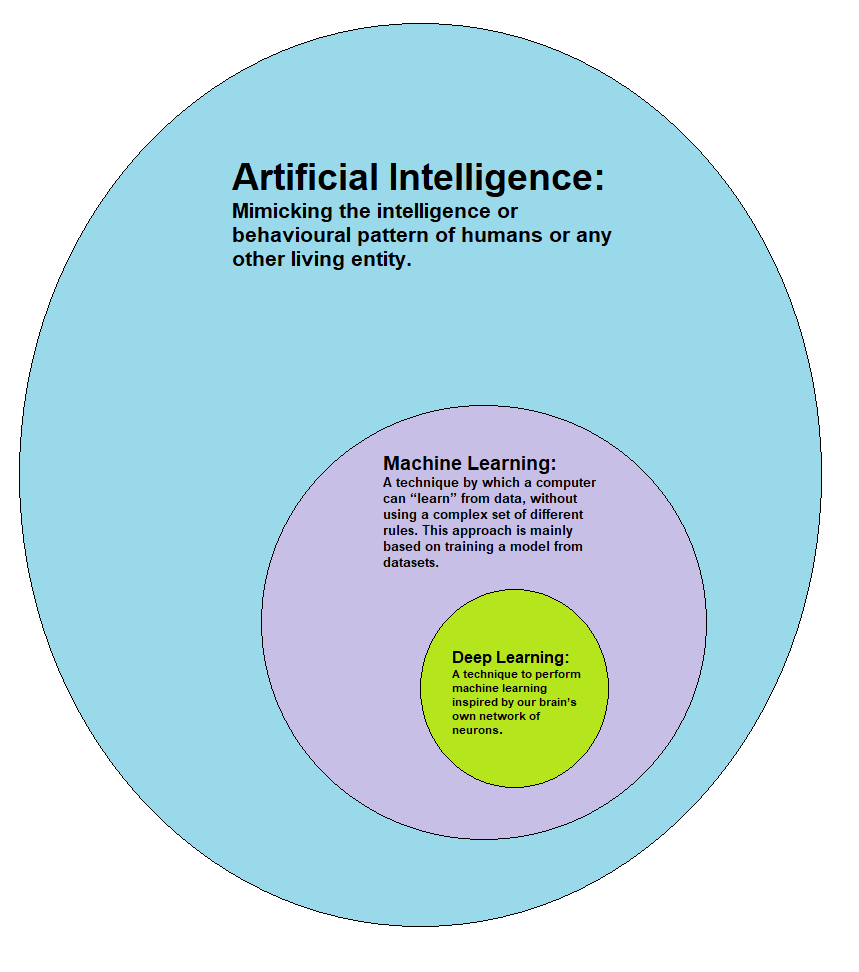
Let's start with Machine Learning (ML). This is the most common type of AI today. It’s the process of teaching a computer to make predictions or decisions without being explicitly programmed for that specific task. You don't write code that says, "If an email contains the word 'free', it's spam." Instead, you show the machine thousands of emails you've already marked as spam and thousands you haven't. The machine then learns the patterns and figures out its own rules for identifying spam.
Then there are Neural Networks. Inspired by the human brain, these are systems of interconnected nodes, or 'neurons,' that process information. Neural networks are a powerful tool within machine learning, especially for a technique called Deep Learning. They are excellent at finding very complex, subtle patterns in massive amounts of data. This is how AI can recognize images, understand speech, and even generate realistic art.
Finally, we have Natural Language Processing (NLP). This is the part of AI that deals with language. NLP gives computers the ability to read, understand, and generate human language. Every time you use a voice assistant like Siri or Alexa, talk to a chatbot, or see a language translation app work its magic, you're seeing NLP in action. It combines machine learning and other techniques to bridge the gap between human communication and computer understanding.
AI in the Wild
AI is no longer just a concept from science fiction; it's a part of our daily lives and a tool that's transforming entire industries. In healthcare, AI helps doctors diagnose diseases earlier and more accurately by analyzing medical images like X-rays and MRIs. In finance, it's used to detect fraudulent transactions in real-time and to make smarter investment decisions.
Automakers use AI for self-driving cars, which need to perceive the world around them and make split-second decisions. Retail companies use it to recommend products you might like, manage their inventory, and personalize your shopping experience. Even in entertainment, AI helps streaming services suggest movies and creates special effects in films.
From agriculture to education, there are few fields left untouched by AI's influence.
Ready to check your understanding?
What is the fundamental goal of Artificial Intelligence?
In contrast to traditional programming where developers provide explicit rules, Machine Learning models primarily learn from ________.
Understanding these fundamental concepts is the first step. They provide the foundation for exploring how these powerful tools can be used in more specific applications.