AI in Digital Marketing
Introduction to AI
What Is Artificial Intelligence?
Artificial intelligence is the field of computer science dedicated to creating systems that can perform tasks that normally require human intelligence. This includes things like learning from experience, solving problems, understanding language, and recognizing patterns.
At its core, AI isn't about creating a machine that thinks like a human. Instead, it’s about making a machine that can act intelligently to achieve a specific goal. Whether it's recommending your next favorite movie or navigating a car through city streets, AI systems are designed to process information and make decisions.
Think of it this way: AI gives a computer the ability to learn and reason, turning it from a simple calculator into a problem-solving partner.
A Quick History
The idea of intelligent machines has been around for centuries, but the actual science of AI began in the 1950s. Early researchers were incredibly optimistic, believing that human-level intelligence was just a few decades away.
Progress wasn't a straight line. The field went through periods of excitement followed by "AI winters," when funding dried up and progress stalled. But in recent decades, two key ingredients have changed everything: massive amounts of data and powerful computers. This combination has fueled a surge in AI development, leading to the powerful tools we see today.

Narrow vs. General AI
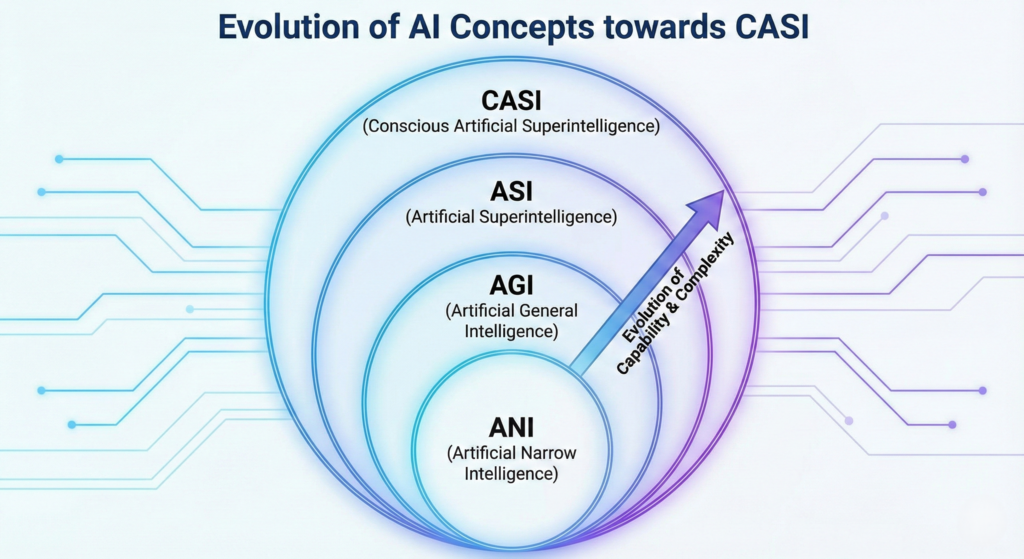
It's important to distinguish between the AI that exists today and the AI you see in movies. All the AI we currently use is considered Artificial Narrow Intelligence (ANI), or "Weak AI."
ANI is designed to perform a single, specific task exceptionally well. A chess program can beat a grandmaster but can't tell you a joke. A spam filter is great at catching junk mail but can't write an email for you. These systems are highly specialized and operate within a limited, pre-defined range.
Every AI application you interact with, from voice assistants to recommendation engines, is a form of Narrow AI.
The other type is Artificial General Intelligence (AGI), or "Strong AI." This is the hypothetical AI with the ability to understand, learn, and apply its intelligence to solve any problem, much like a human being. AGI could write a novel, compose a symphony, and conduct scientific research all with the same underlying intelligence.
Right now, AGI is purely theoretical. We haven't created it, and we are still a long way from achieving it.
The Core Components
So how does an AI system actually work? It boils down to three main components working together.
Data
noun
The raw information fed into an AI system. This can be text, images, numbers, or any other form of digital information. Data is the fuel that AI learns from.
An AI is only as good as the data it's trained on. Without high-quality, relevant data, even the most sophisticated system will fail.
Algorithm
noun
A set of rules or instructions that the AI system follows to process data, learn from it, and make decisions or predictions. It's the 'brain' of the operation.
Different tasks require different algorithms. An algorithm for recognizing faces is structured very differently from one that translates languages.
Finally, you need a way to run the algorithm on the data. That requires computing power. Training modern AI models involves performing billions of calculations, which demands specialized hardware, like Graphics Processing Units (GPUs), that can handle these intensive tasks efficiently.
These three pillars—data, algorithms, and computing power—form the foundation of every AI system.