AI in Construction
Introduction to AI in Construction
What Is AI Anyway?
Artificial intelligence is about making machines that can think, learn, and solve problems like humans. It's not one single thing, but a broad field of computer science. Think of it less like a sci-fi robot and more like a very powerful tool for analyzing information and making predictions.
Artificial Intelligence
noun
A field of computer science dedicated to creating systems capable of performing tasks that normally require human intelligence, such as visual perception, speech recognition, decision-making, and problem-solving.
When we talk about AI today, we're almost always talking about Artificial Narrow Intelligence (ANI). This is AI that's really good at one specific task, like recognizing objects in a photo or forecasting project timelines. This is different from Artificial General Intelligence (AGI), the movie-style AI that can understand and perform any intellectual task a human can. We aren't there yet.
The goal in construction isn't to replace people with thinking robots. It's to use ANI to handle complex calculations, spot patterns in huge amounts of data, and automate repetitive tasks, freeing up human experts to focus on critical thinking and hands-on work.
The Brains of the Operation
AI isn't magic. It's powered by specific technologies that allow it to learn. The most important ones to know are Machine Learning, Neural Networks, and Deep Learning. They fit together like nesting dolls, with each concept being a subset of the one before it.
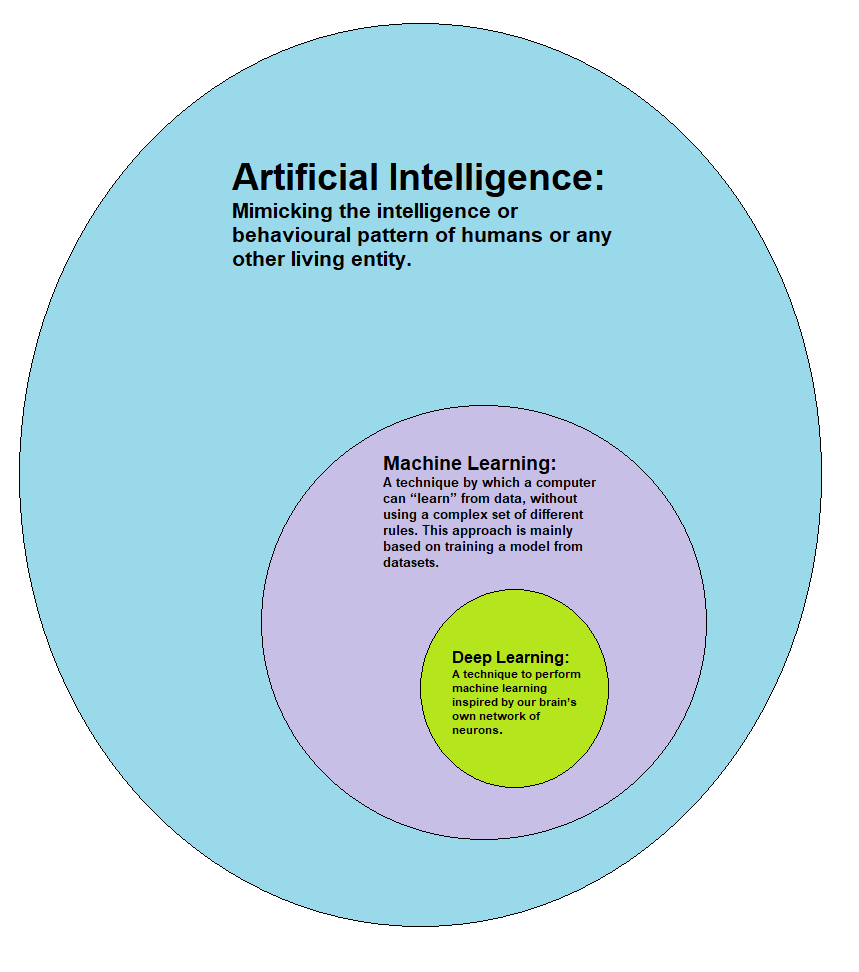
Machine Learning (ML) is the core idea. Instead of being programmed with explicit rules for every situation, an ML model is trained on a huge amount of data. It learns to recognize patterns on its own. For example, you could feed a model thousands of past project schedules and their outcomes. It would then learn to predict potential delays in a new project based on its initial plans.
Neural Networks are a type of machine learning model inspired by the structure of the human brain. They're made of interconnected 'neurons' that process information in layers. A simple neural network might take in data like project size, budget, and season, and output a prediction for completion time.
Deep Learning just means using a neural network with many, many layers—a 'deep' stack of them. This complexity allows them to find incredibly subtle patterns in vast datasets. This is the technology that powers image recognition, which can scan drone photos of a site to count materials or identify safety hazards.
Think of it this way: AI is the whole car. Machine learning is the engine. A neural network is a specific type of engine, and deep learning is a high-performance, multi-cylinder version of that engine.
From Theory to the Job Site
The idea of AI in construction isn't new, but for decades it was mostly theoretical. The industry lacked two key ingredients: massive amounts of usable data and the computing power to process it. Early systems were limited and couldn't handle the complexities of a real-world construction site.
That has changed dramatically. Today, job sites are flooded with data from sources like Building Information Modeling (BIM), drones, laser scanners, and IoT sensors on equipment. This data is the fuel for modern AI. Combined with powerful cloud computing, AI can now analyze this information to provide insights that were impossible just a decade ago.
This article explores how AI is already shaping the way architects work, improving everything from early design to construction.
Despite this potential, the construction industry has historically been slow to adopt new digital technologies. Adoption is growing fast, but it's not without its challenges. Implementing AI requires significant upfront investment, specialized skills, and a willingness to change long-standing workflows.
The main benefits and hurdles can be broken down like this:
| Benefits | Challenges |
|---|---|
| Increased efficiency & productivity | High initial cost of software and hardware |
| Improved safety through hazard detection | Lack of standardized, high-quality data |
| Better cost and schedule prediction | Shortage of skilled data scientists in construction |
| Reduced waste and optimized material use | Resistance to change from traditional workflows |
| Enhanced decision-making with data insights | Concerns about data security and privacy |
Understanding these core concepts is the first step. By grasping what AI is and how its underlying technologies work, we can better see how it's being applied to solve real-world problems on the construction site.
What is the primary goal of implementing Artificial Intelligence (AI) in the construction industry today?
The type of AI currently used in construction, which excels at specific tasks like analyzing drone photos or forecasting schedules, is known as...