AI Image Embedding Models Explained
Introduction to Image Embeddings
What Are Image Embeddings?
Computers don't "see" images the way we do. They see a grid of pixels, each with a color value. To make sense of this raw data, we need to translate it into a language a machine can understand and compare. This is where image embeddings come in.
An image embedding is a list of numbers—a vector—that represents the important features of an image. Think of it like giving an image a specific set of coordinates in a massive, multi-dimensional library. Instead of organizing books by author or title, this library organizes images by their meaning.
Images with similar content, like two different photos of a golden retriever, will have very similar coordinates, placing them close together in this conceptual space.
This numerical representation captures the essence of the image. The vector for a picture of a cat will be mathematically similar to the vector for another cat, but very different from the vector for a picture of a car. This allows us to perform powerful operations, like searching for conceptually similar images without relying on file names or tags.
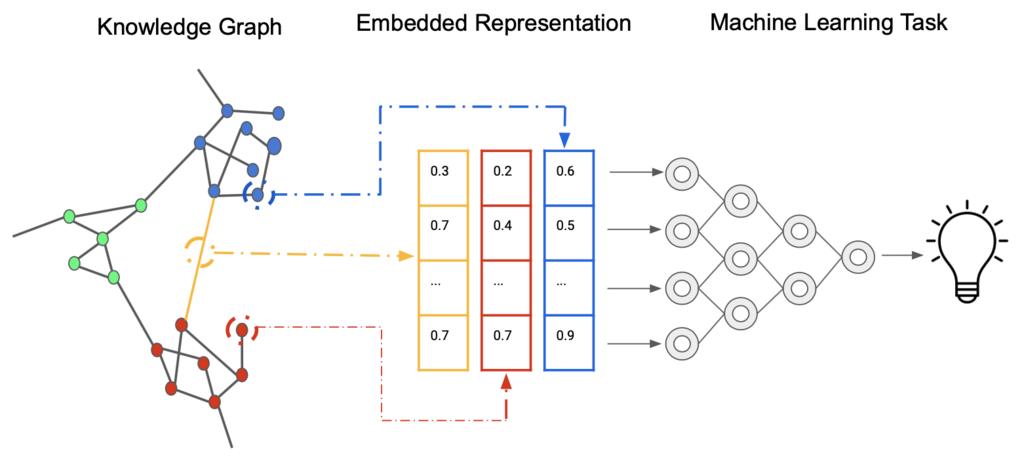
Why Bother With Numbers?
Turning images into vectors is crucial for machine learning. Once images are represented as numbers, we can use math to compare them. We can calculate the distance between two vectors to see how similar their corresponding images are. A small distance means high similarity; a large distance means they are very different.
This simple idea unlocks many possibilities:
- Image Search: You can provide an image of a red sneaker and find all other red sneakers in a database, just by finding the vectors closest to your query vector.
- Classification: A machine learning model can learn to recognize patterns in the vectors. For example, it might learn that vectors in a certain region of the "meaning space" all correspond to images of dogs.
- Recommendations: If you like an image, a system can recommend others by finding those with similar embeddings.
Embedding-based retrieval avoids training massive classifiers by embedding product images into a vector space and matching detections by similarity.
How Are Embeddings Made?
Image embeddings are typically created using a deep neural network, specifically a model that has already been trained to recognize a vast number of objects in images. The process is surprisingly straightforward.
First, an image is fed into the network. As the image data passes through the network's layers, the model extracts increasingly complex features—from simple edges and colors in the early layers to shapes, textures, and eventually whole objects in the later layers.
Instead of using the network's final output (like the label "cat"), we intercept the data at one of the last internal layers. At this stage, the image is represented as a dense vector of numbers. This vector is the image embedding, a rich, numerical summary of the image's content.
Now that you understand the basics of what image embeddings are and why they are useful, let's test your knowledge.
What is an image embedding?
If two images are conceptually very similar (e.g., two different photos of a golden retriever), the mathematical distance between their embedding vectors will be small.
By converting images into meaningful numerical vectors, embeddings provide the foundation for many of the powerful image-based AI tools we use today.