AI Idea Validation Through Simple Signals
Understanding Behavioral Economics
Why We Aren't Rational
Traditional economics often starts with a big assumption: that people are rational. It pictures us as calculating machines, always making choices that give us the most value. If you've ever bought a lottery ticket or splurged on something you didn't need, you know that's not the full story.
Behavioral economics bridges this gap. It blends psychology and economics to explore why we make the choices we do, especially when they seem illogical. It accepts that our decisions are often influenced by emotions, social pressures, and mental shortcuts, not just cold, hard facts.
Instead of assuming we're perfectly rational, behavioral economics studies how we actually behave.
By understanding these patterns, we can get a much clearer picture of why people buy, sell, save, or spend the way they do. This is incredibly useful, whether you're building a new product or just trying to understand your own habits.
The Brain's Shortcuts
Our brains process a massive amount of information every day. To cope, they create mental shortcuts to make decisions faster. These shortcuts are called heuristics.
Heuristic
noun
A mental shortcut that allows people to quickly make judgments and solve problems.
Think about choosing a restaurant in a new city. Instead of researching every single option, you might just pick one with a lot of customers, assuming it must be good. That's a heuristic at work. It saves you time and energy, and it often leads to a good outcome.
But sometimes, these shortcuts lead us down the wrong path. The systematic errors that result from heuristics are known as cognitive biases.
Common Mental Glitches
Cognitive biases are predictable patterns in how we misjudge things. They're not signs of weakness; they're just part of how our brains are wired. Let's look at two of the most common ones.
Confirmation Bias: We tend to search for, interpret, and remember information that confirms what we already believe. We like to be right, so our brains filter reality to support our existing views.
Imagine you're convinced a certain brand of smartphone is the best. When you research it, you'll likely click on positive reviews and quickly dismiss the negative ones. You aren't trying to be biased, but your brain is helping you confirm the decision you've already made.
Loss Aversion: The pain of losing something is psychologically about twice as powerful as the pleasure of gaining the same thing.
This is why losing a $20 bill feels so much worse than the joy of finding one. Loss aversion explains a lot of strange financial behavior, like why someone might refuse to sell a stock that has lost value. They're waiting for it to go back up to avoid "locking in" the loss, even if selling and reinvesting elsewhere would be the smarter move.
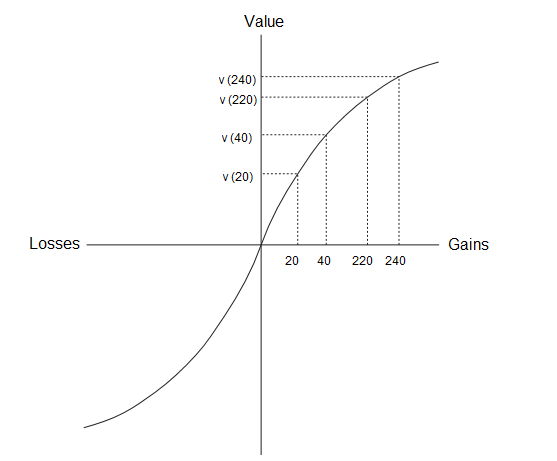
This graph illustrates loss aversion perfectly. Notice how the curve is much steeper on the left (losses) than it is on the right (gains). This simple psychological quirk has a huge impact on how we evaluate risk and make decisions every single day.
Understanding these biases is the first step toward recognizing them in ourselves and others. When you're trying to figure out if an idea has legs, you need to see how people actually behave, not just how they say they'll behave.
Now, let's test your understanding of these core ideas.
What core assumption of traditional economics does behavioral economics primarily challenge?
Mental shortcuts used to make decisions more quickly and efficiently are called:
Recognizing these patterns in human behavior is a powerful tool for making better decisions.