AI Fundamentals
Introduction to Artificial Intelligence
What Is AI?
Artificial intelligence, or AI, is the science of making machines that can think and learn like humans. The main goal is to create systems that can perform tasks that normally require human intelligence. This includes things like understanding language, recognizing images, making decisions, and solving problems.
At its core, AI tries to replicate three key human cognitive functions:
Learning: Acquiring information and rules for using it. Reasoning: Using those rules to reach approximate or definite conclusions. Perception: Understanding the world through sensory input, like sight and sound.
An AI system doesn't just follow pre-programmed instructions. It uses these functions to adapt to new situations and improve its performance over time. Think of a spam filter in your email. It doesn't just have a list of bad words; it learns from the emails you mark as spam to get better at catching unwanted messages.
AI, Machine Learning, and Deep Learning
The terms AI, machine learning, and deep learning are often used interchangeably, but they represent different layers of the same idea. Artificial Intelligence is the broad, overarching concept of intelligent machines.
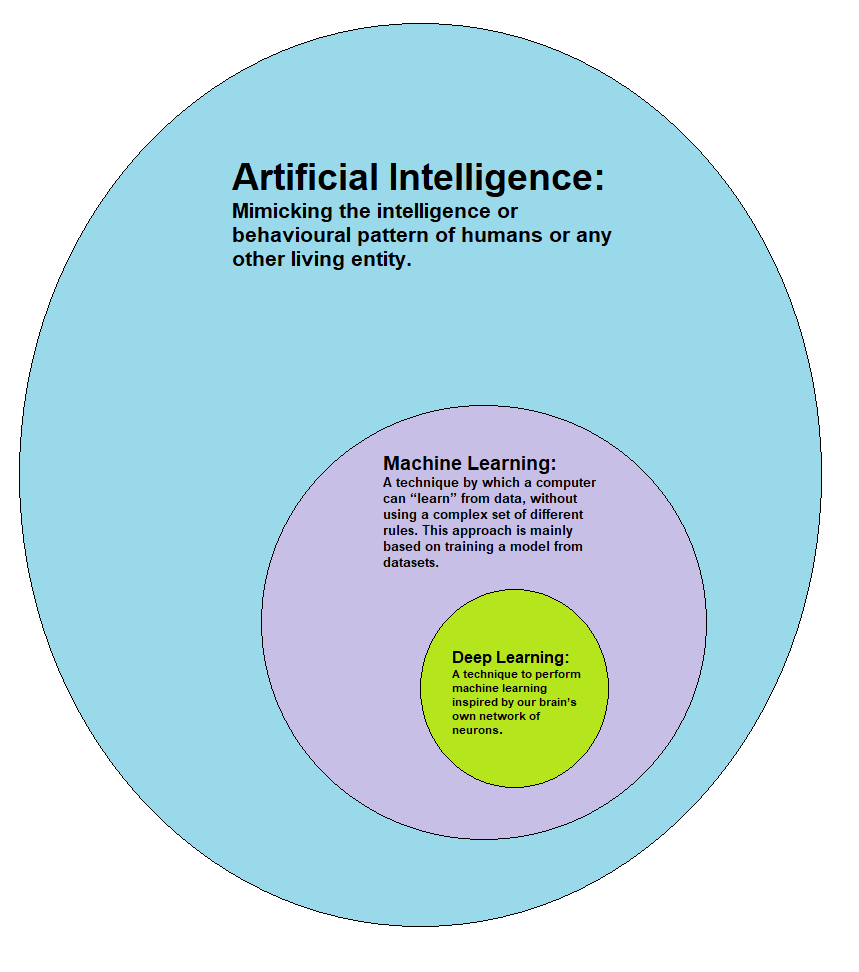
Machine Learning (ML) is a subset of AI. It's an approach where we give a system a large amount of data and let it learn for itself. Instead of writing code for every possible decision, developers create algorithms that allow the machine to identify patterns and make predictions from the data it's given.
Deep Learning (DL) is a further subset of machine learning. It uses complex, multi-layered structures called neural networks, which are loosely inspired by the human brain. Deep learning is particularly good at handling vast amounts of unstructured data, like images and text, and is the technology behind many recent AI breakthroughs, such as advanced image recognition and natural language processing.
Think of it this way: AI is the overall vision. Machine learning is a method to achieve that vision. Deep learning is a powerful technique within machine learning.
Thinking About AI's Impact
As AI becomes more integrated into our lives, it's crucial to consider its effects. The development of AI isn't just a technical challenge; it's a social and ethical one, too. We have to think carefully about how these powerful tools are built and used.
Bias
noun
A prejudice in favor of or against one thing, person, or group compared with another, usually in a way considered to be unfair.
One of the biggest ethical concerns is bias. AI systems learn from data, and if that data reflects existing societal biases, the AI will learn and even amplify them. For example, if an AI is trained on historical hiring data that favored men for a certain job, it might learn to unfairly penalize female applicants. This can create a harmful cycle where biased data leads to biased algorithms, which in turn lead to unfair outcomes that reinforce the original bias.
Beyond bias, other considerations include privacy (how our data is used), accountability (who is responsible when an AI makes a mistake?), and the overall societal impact. AI is already transforming industries from healthcare to finance, creating new jobs while making others obsolete. Navigating these changes requires thoughtful planning and a commitment to responsible innovation.
Use of artificial intelligence (AI) in human contexts calls for ethical considerations for the design and development of AI-based systems.
Let's review the main concepts we've covered with some flashcards.
Ready to check your understanding? Take this short quiz to see what you've learned.
What is the primary goal of artificial intelligence?
Which statement accurately describes the relationship between Artificial Intelligence (AI), Machine Learning (ML), and Deep Learning (DL)?
Understanding these foundational ideas is the first step in navigating the complex and fascinating world of artificial intelligence.