AI Fundamentals That Matter
Introduction to Artificial Intelligence
What Is Artificial Intelligence?
Artificial Intelligence, or AI, is about creating machines that can think, learn, and solve problems like humans do. It's a broad field in computer science that aims to simulate human intelligence. Think of it like teaching a computer to see patterns, understand language, or make a decision, tasks that normally require a human brain.
Artificial Intelligence
noun
The theory and development of computer systems able to perform tasks that normally require human intelligence, such as visual perception, speech recognition, decision-making, and translation between languages.
At its core, AI is not one single technology but a collection of different methods and tools. Some AI is designed for a very specific task, like playing chess or identifying faces in photos. Other, more advanced forms are built to be more flexible, but the fundamental goal is the same: to create systems that can operate intelligently and autonomously.
A Brief History of AI
The idea of intelligent machines has been around for centuries, but the formal field of AI research began in the mid-20th century. Early pioneers believed that a machine as intelligent as a human being could be built in a matter of decades.
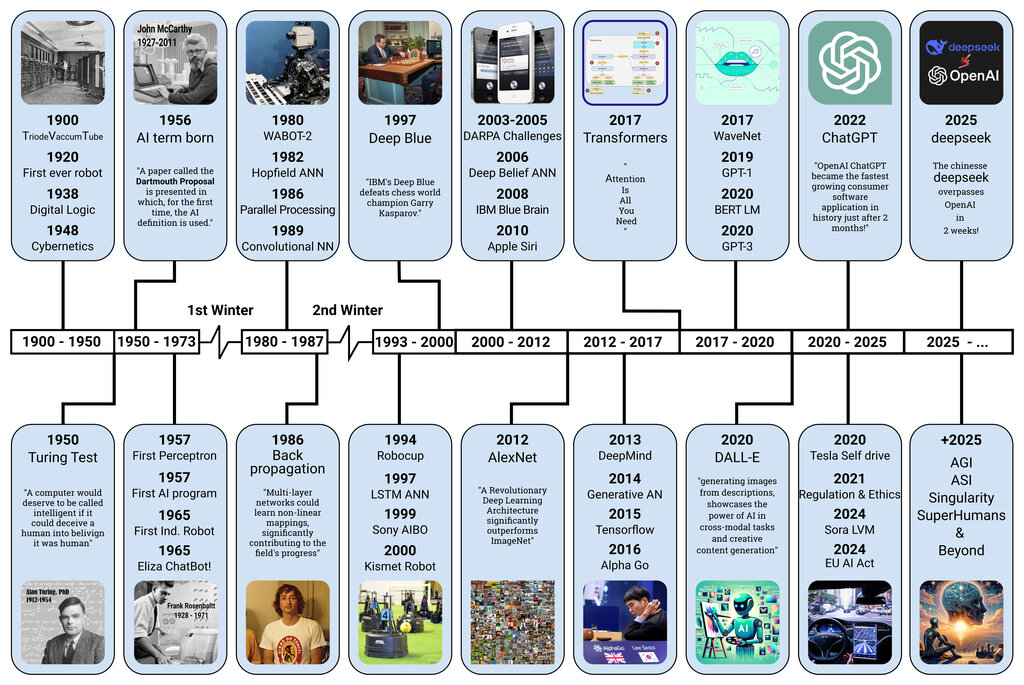
Progress came in waves. There were periods of great excitement and funding, known as "AI summers," followed by times when progress stalled and funding dried up, called "AI winters."
Early AI focused on rule-based systems. Programmers would write explicit rules for the computer to follow, like the rules of a game. This worked for well-defined problems, but it struggled with the messiness of the real world. A major shift came with the rise of new approaches that allowed machines to learn from data instead of being programmed with rules for every possible situation.
Core Concepts
To understand modern AI, you need to know about a few key concepts. These are the building blocks that enable many of the AI applications we see today.
Machine Learning (ML) is a subset of AI that gives computers the ability to learn without being explicitly programmed. Instead of writing rules, developers feed the computer large amounts of data, and the machine learning algorithm uses that data to learn how to perform a task.
For example, to build an ML model that identifies cats in photos, you would show it thousands of pictures labeled "cat" and thousands labeled "not a cat." The model learns the patterns that define a cat on its own.
A specific type of machine learning uses something called a neural network.
Neural Network
noun
A computer system modeled on the human brain and nervous system, composed of layers of interconnected nodes or 'neurons'.
Neural networks are inspired by the structure of the human brain. They consist of layers of interconnected nodes that process information. When a neural network has many layers, it's often called "deep learning." This structure is particularly good at finding complex patterns in large datasets, making it powerful for tasks like image recognition and speech.
Another crucial area of AI is getting computers to understand our language.
Natural Language Processing (NLP) is the branch of AI focused on enabling computers to understand, interpret, and generate human language. This is what powers chatbots, translation services, and voice assistants.
These three concepts—Machine Learning, Neural Networks, and Natural Language Processing—are closely related. Machine learning is the overall technique of learning from data. Neural networks are a powerful model for doing that learning. And NLP is a specific application area where these techniques are used to tackle the challenge of human language.
Now, let's review these core ideas.
Time to test your knowledge.
What is the fundamental goal of Artificial Intelligence (AI)?
In the history of AI, what does the term "AI winter" refer to?
These foundational concepts are the starting point for exploring the vast and rapidly evolving world of artificial intelligence.