AI Fundamentals
Introduction to Artificial Intelligence
What Is AI Anyway?
Artificial intelligence, or AI, is about creating machines that can think, learn, and solve problems. The goal is to build systems that can perform tasks that usually require human intelligence, like recognizing a face, understanding speech, or making a strategic decision.
Artificial intelligence (AI) is a broad field of computer science and engineering that focuses on developing computers capable of performing activities that normally require human intelligence, such as learning, problem-solving, decision-making, and natural language processing.
Think of it as teaching a computer not just to follow instructions, but to reason and adapt. This ability has a huge impact, allowing us to tackle complex challenges in new ways and automate tasks that were once thought to be exclusively human.
More Than Just Robots
The term "AI" might bring to mind images of science fiction robots, but it's actually a vast field with many different specializations. It's not one single technology, but a collection of related disciplines, each focused on a specific aspect of intelligence.
Each of these subfields tackles a different challenge:
- Machine Learning (ML): This is about creating algorithms that allow computers to learn from data without being explicitly programmed for every task. It's the engine behind many AI advancements.
- Natural Language Processing (NLP): This area focuses on the interaction between computers and human language. It enables machines to read, understand, and generate text and speech.
- Computer Vision: Just as humans use their eyes to see and interpret the world, computer vision gives machines this ability. It involves processing and analyzing images and videos to identify objects and scenes.
- Robotics: This field combines AI with engineering to create physical machines (robots) that can move around and perform actions in the real world.
- Expert Systems: These are early forms of AI designed to mimic the decision-making ability of a human expert in a specific domain, like diagnosing a medical condition.
Two Flavors of AI
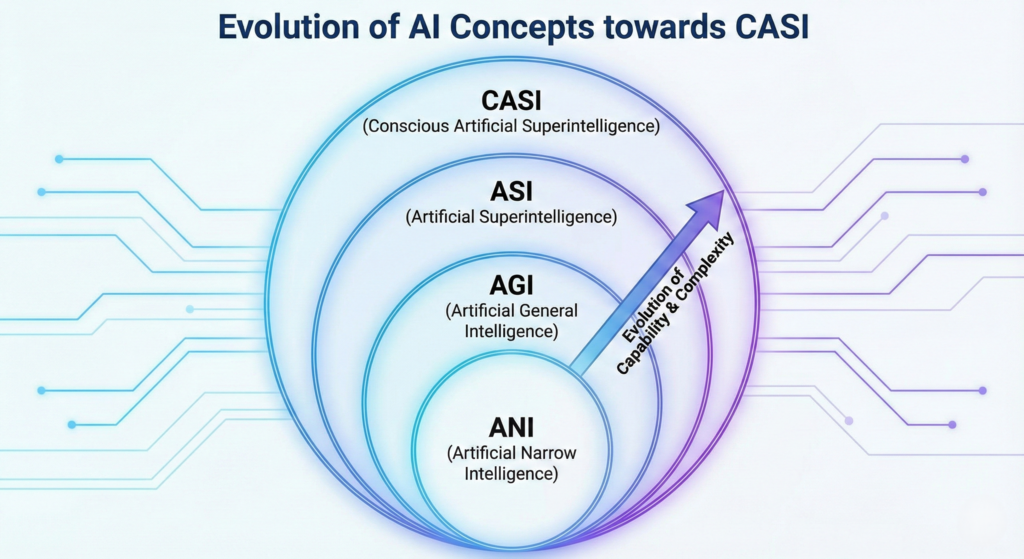
Not all AI is created equal. The field is broadly divided into two categories based on capability: Narrow AI and General AI.
Artificial Narrow Intelligence (ANI), sometimes called Weak AI, is designed to perform a single, specific task. All the AI we interact with today falls into this category.
A chess-playing AI can beat a grandmaster, but it can't tell you the weather, write a poem, or drive a car. Its intelligence is deep but extremely narrow. It excels at its one job and nothing else.
Artificial General Intelligence (AGI), or Strong AI, is the kind of AI you see in movies. It refers to a machine with the ability to understand, learn, and apply its intelligence to solve any problem, much like a human being.
An AGI could switch from translating languages to composing music to developing scientific theories. This type of AI is still purely theoretical and does not yet exist.
A Team Effort
Creating artificial intelligence isn't just a job for computer scientists. It's an interdisciplinary effort that pulls from many different fields of study. To build machines that can think, we first need to understand how thinking works.
Cognitive psychologists provide insights into human reasoning and memory. Neuroscientists help us understand the physical structure of the brain, which inspires the design of AI systems like neural networks. Linguists contribute to our understanding of language structure, which is vital for NLP. Philosophers even play a role, asking critical questions about the nature of consciousness and the ethics of creating intelligent machines.
This collaboration is what makes AI such a rich and rapidly evolving field. It’s the intersection of technology, biology, and philosophy, all working toward the common goal of understanding and creating intelligence.